

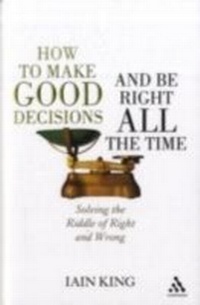
How to Make Good Decisions and Be Right All the Time
Solving the Riddle of Right and Wrong
1st Edition
Published on 16. October 2008
256 pages
978-1-4411-4986-2 (ISBN)
Description

A compelling guide to ethical thinking for everyday life
In How to Make Good Decisions and Be Right All the Time Iain King presents an introduction to moral philosophy from the ancient Greeks to the Enlightenment and beyond. He argues that right and wrong need a Newtonian revolution so that they are no longer a matter of judgment or guesswork and presents a system of simple formulas for solving difficult moral quandaries. Clearly argued, the book combines new ideas with old and rips apart traditional tenets of morality, dismantling even the golden rule that you should "do unto others as you would have done unto you." In their place, the author constructs a new, comprehensive system of ethics, identifying the basic DNA of right and wrong and offering clear advice on how to be good in today's complicated and challenging world.
Sometimes controversial and thoroughly engaging throughout, How to Make Good Decisions and Be Right All the Time is required reading for anyone with a difficult decision to make.
In How to Make Good Decisions and Be Right All the Time Iain King presents an introduction to moral philosophy from the ancient Greeks to the Enlightenment and beyond. He argues that right and wrong need a Newtonian revolution so that they are no longer a matter of judgment or guesswork and presents a system of simple formulas for solving difficult moral quandaries. Clearly argued, the book combines new ideas with old and rips apart traditional tenets of morality, dismantling even the golden rule that you should "do unto others as you would have done unto you." In their place, the author constructs a new, comprehensive system of ethics, identifying the basic DNA of right and wrong and offering clear advice on how to be good in today's complicated and challenging world.
Sometimes controversial and thoroughly engaging throughout, How to Make Good Decisions and Be Right All the Time is required reading for anyone with a difficult decision to make.
Reviews / Votes
'Iain King's ambitious book is an honest attempt to think through and answer questions at the heart of morality. Anyone with an interest in practical answers to moral questions will find this book of interest too.' - James Garvey, The Royal Institute of Philosophy, UK "...If your focus leaflets are starting to get soggy and you're frustrated with BBC political reporting, this book could be the perfect antidote for you - a reminder that there probably are deep moral truths out there and there is a reason to try to do what's right...This may well become a classic; it's certainly a good read, and definitely makes you think." - Liberal Democrat NewsMore details
Edition
1. Auflage
Language
English
Place of publication
New York
United States
Target group
Professional and scholarly
ISBN-13
978-1-4411-4986-2 (9781441149862)
Copyright in bibliographic data and cover images is held by Nielsen Book Services Limited or by the publishers or by their respective licensors: all rights reserved.
Schweitzer Classification
Other editions
Additional editions
Book
10/2008
Continuum International Publishing Group Ltd.
€44.76
Article exhausted; check different version
Person
Iain King, a former fellow of the University of Cambridge, UK, and author of the acclaimed Peace at Any Price (Cornell University Press, 2006), has faced many testing decisions working in Kosovo, Afghanistan and Africa.
Content
Part I. The Problem: We Need to Make Decisions, But We Don't Know How
1. Five challenges to the formula of right and wrong
2. Desperately seeking a system
3. Unreliable advice from religion and dice
4. The Enlightenment decision-making machine: do whatever is best...
5. ... does not seem best
6. Can we fix it: the pieces of the puzzle
Part II. The Proof: Finding the Basics of Right and Wrong
7. The meaning of life
8. A plan for Robinson Crusoe
9. Answering an eight-year old who incessantly asks 'why?'
10. I say this, you say that - can we ever know who's right?
11. Applying the Sherlock Holmes method
12. How to become a better person (and answer Aristotle)
13. The Help Principle
14. The DNA of right and wrong
Part III. The Principle: Refining the Help Principle
15. Putting the DNA of 'right' and 'wrong' in a Petri dish
16. Using your watch to tell right from wrong
17. Letting people choose for themselves
18. Torturers and charitable show-offs
19. Revenge, reciprocity and received wisdom
20. What if you didn't mean to do it?
21. The new ladder to humility
22. The first seven Principles of right and wrong
Part IV. The Programme: Extending the Principles to Other Problems
23. The myth of blame
24. Punishment, mercy and remorse
25. Something funny about promises
26. A credible rule on lying and the Richard Nixon problem
27. Rules for romance and sex
28. How to choose in small groups
29. How to choose in large groups
30. The system for making decisions
31. The riddle answered?
Part V. Practical Advice: For Real People in the Modern World
32. So why aren't people good then?
33. Why people hate lawyers
34. When it's best to be bad
35. The Live Aid problem: does charity begin at home?
36. The Mother Teresa quandary: can you be good without giving everything away?
37. The man on the morning train
38. How to lead a good life in a rough world
Part VI. The Prognosis: How to Make Good Decisions and Be Right All the Time
39. Newton's limits
40. What to do and why
1. Five challenges to the formula of right and wrong
2. Desperately seeking a system
3. Unreliable advice from religion and dice
4. The Enlightenment decision-making machine: do whatever is best...
5. ... does not seem best
6. Can we fix it: the pieces of the puzzle
Part II. The Proof: Finding the Basics of Right and Wrong
7. The meaning of life
8. A plan for Robinson Crusoe
9. Answering an eight-year old who incessantly asks 'why?'
10. I say this, you say that - can we ever know who's right?
11. Applying the Sherlock Holmes method
12. How to become a better person (and answer Aristotle)
13. The Help Principle
14. The DNA of right and wrong
Part III. The Principle: Refining the Help Principle
15. Putting the DNA of 'right' and 'wrong' in a Petri dish
16. Using your watch to tell right from wrong
17. Letting people choose for themselves
18. Torturers and charitable show-offs
19. Revenge, reciprocity and received wisdom
20. What if you didn't mean to do it?
21. The new ladder to humility
22. The first seven Principles of right and wrong
Part IV. The Programme: Extending the Principles to Other Problems
23. The myth of blame
24. Punishment, mercy and remorse
25. Something funny about promises
26. A credible rule on lying and the Richard Nixon problem
27. Rules for romance and sex
28. How to choose in small groups
29. How to choose in large groups
30. The system for making decisions
31. The riddle answered?
Part V. Practical Advice: For Real People in the Modern World
32. So why aren't people good then?
33. Why people hate lawyers
34. When it's best to be bad
35. The Live Aid problem: does charity begin at home?
36. The Mother Teresa quandary: can you be good without giving everything away?
37. The man on the morning train
38. How to lead a good life in a rough world
Part VI. The Prognosis: How to Make Good Decisions and Be Right All the Time
39. Newton's limits
40. What to do and why
