

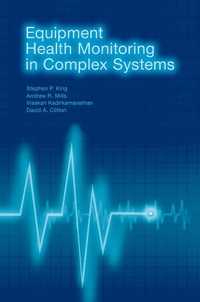
Equipment Health Monitoring in Complex Systems
Published on 1. January 2017
250 pages
978-1-63081-497-7 (ISBN)
Description

This timely resource provides a practical introduction to equipment health monitoring (EHM) to ensure the cost effective operation and control of critical systems in defense, industrial, and healthcare applications. This book highlights how to frame health monitoring design applications within a system engineering process, to ensure an optimized EHM functional architecture and practical algorithm design. This book clarifies the need for intelligent diagnostics and proposed health monitoring framework. Machine learning for health monitoring, including feature extraction, data visualization, model boundaries and performance is presented. Details about monitoring aircraft engines and model based monitoring systems are described in detail. Packed with two full chapters of case studies within industrial and healthcare settings, this book identifies key problems and provides insightful techniques for solving them. This resource provides a look into the future direction in health monitoring and emerging developments within sensing technology, big data analytics, and advanced computing capabilities.
More details
Other editions
Additional editions
Visakan Kadirkamanathan | Stephen P. King | David A. Clifton
Equipment Health Monitoring in Complex Systems
Book
10/2017
Artech House Publishers
€164.90
Shipment within 10-20 days
Content
- Equipment Health Monitoring in Complex Systems
- Contents
- Acknowledgments
- 1 Introduction
- 1.1 Maintenance Strategies
- 1.2 Overview of Health Monitoring
- 1.3 Organization of Book Contents
- References
- 2 Systems Engineering for EHM
- 2.1 Introduction
- 2.2 Introduction to Systems Engineering
- 2.2.1 Systems Engineering Processes
- 2.2.2 Overview of Systems Engineering for EHM Design
- 2.2.3 Summary
- 2.3 EHM Design Intent
- 2.3.1 State the Problem: Failure Analysis and Management
- 2.3.2 Model the System: Approaches for Failure Modeling
- 2.3.3 Investigate Alternatives: Failure Models
- 2.3.4 Assess Performance: Case Study
- 2.4 EHM Functional Architecture Design
- 2.4.1 State the Problem: EHM Functional Architecture Design
- 2.4.2 Model the system: Function Modeling and Assessment
- 2.4.3 Investigate Alternatives: Tools for Functional Architecture Design
- 2.4.4 Assess Performance: Gas Turbine EHM Architecture Optimization
- 2.5 EHM Algorithm Design
- 2.5.1 State the Problem: Monitoring Algorithm Design Process
- 2.5.2 Model the System: Detailed Fault Mode Modeling
- 2.5.3 Investigate Alternatives: Development Approaches
- 2.5.4 Assess Performance: Algorithm Design Case Study
- 2.6 Conclusion
- References
- 3 The Need for Intelligent Diagnostics
- 3.1 Introduction
- 3.2 The Need for Intelligent Diagnostics
- 3.3 Overview of Machine Learning Capability
- 3.4 Proposed Health Monitoring Framework
- 3.4.1 Feature Extraction
- 3.4.2 Data Visualization
- 3.4.3 Model Construction
- 3.4.4 Definition of Model Boundaries
- 3.4.5 Verification of Model Performance
- References
- 4 Machine Learning For Health Monitoring
- 4.1 Introduction
- 4.2 Feature Extraction
- 4.3 Data Visualization
- 4.3.1 Principal Component Analysis
- 4.3.2 Kohonen Network
- 4.3.3 Sammon's Mapping
- 4.3.4 NeuroScale
- 4.4 Model Construction
- 4.5 Definition of Model Boundaries
- 4.6 Verification of Model Performance
- 4.6.1 Verification of Regression Models
- 4.6.2 Verification of Classification Models
- References
- 5 Case Studies of Medical Monitoring Systems
- 5.1 Introduction
- 5.2 Kernel Density Estimates
- 5.3 Extreme Value Statistics
- 5.3.1 Type-I EVT
- 5.3.2 Type-II EVT
- 5.3.3 Gaussian Processes
- 5.4 Advanced Methods
- References
- 6 Monitoring Aircraft Engines
- 6.1 Introduction
- 6.1.1 Aircraft Engines
- 6.1.2 Model-Based Monitoring Systems
- 6.2 Case Study
- 6.2.1 Aircraft Engine Air System Event Detection
- 6.2.2 Data and the Detection Problem
- 6.3 Kalman Filter based Detection
- 6.3.1 Kalman Filter Estimation
- 6.3.2 Kalman Filter Parameter Design
- 6.3.3 Change Detection and Threshold Selection
- 6.4 Multiple Model-Based Detection
- 6.4.1 Hypothesis Testing and Change Detection
- 6.4.2 Multiple Model Change Detection
- 6.5 Change Detection with Additional Signals
- 6.6 Summary
- References
- 7 Future Directions in Health Monitoring
- 7.1 Introduction
- 7.2 Emerging Developments Within Sensing Technology
- 7.2.1 Low-Cost and Ubiquitous Sensing
- 7.2.2 Ultra-Minaturization-Nano and Quantum
- 7.2.3 Bio-Inspired
- 7.2.4 Summary
- 7.3 Sensor Informatics for Medical Monitoring
- 7.3.1 Deep Learning for Patient Monitoring
- 7.4 Big Data Analytics and Health Monitoring
- 7.5 Growth in Use of Digital Storage
- 7.5.1 Example Health Monitoring Application Utilizing Grid Capability
- 7.5.2 Cloud Alternatives
- References
- About the Authors
- Index
