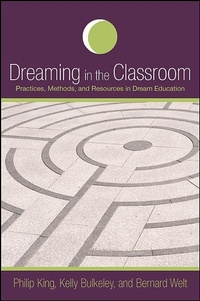
Dreaming in the Classroom
Description
Alles über E-Books | Antworten auf Fragen rund um E-Books, Kopierschutz und Dateiformate finden Sie in unserem Info- & Hilfebereich.
More details
Other editions
Additional editions

Persons
Now retired, Philip King was Professor of Quantitative Methods and Psychology at Hawaii Pacific University. Kelly Bulkeley is Visiting Scholar at the Graduate Theological Union. He has written and edited many books, including The Wilderness of Dreams: Exploring the Religious Meanings of Dreams in Modern Western Culture; Visions of the Night: Dreams, Religion, and Psychology; and Among All These Dreamers: Essays on Dreaming and Modern Society, all published by SUNY Press. Bernard Welt is Professor of Arts and Humanities at the Corcoran College of Art and Design and the author of Mythomania: Fantasies, Fables, and Sheer Lies in Contemporary American Popular Art.
Content
Preface
Acknowledgments
Introduction
1. Practical Guidelines for Dream Education
2. Dreaming as a Fundamental Academic Skill
3. Psychology
4. Anthropology
5. Philosophy and Religious Studies
6. General Humanities
7. Film Studies
8. Psychotherapy and Counseling
9. Community and Alternative Education
10. Primary and Secondary Education
11. The Future of Dream Education
Appendices
Note
Bibliography
Index

System requirements
File format: ePUB
Copy protection: Watermark-DRM (Digital Rights Management)
System requirements:
- Computer (Windows; MacOS X; Linux): Use a reading software that can process the file format ePUB: e.g., Adobe Digital Editions or FBReader – both free (see eBook Help).
- Tablet/Smartphone (Android; iOS): Before downloading, install the free app Adobe Digital Editions (see eBook Help).
- E-reader: Bookeen, Kobo, Pocketbook, Sony, Tolino and many more (not Kindle).
The file format ePUB works well for novels and non-fiction books – i.e., „flowing” text without complex layout. On an e-reader or smartphone, line and page breaks automatically adjust to fit the small displays.
This eBook uses Watermark-DRM, a „soft” copy protection. This means that there are no technical restrictions to prevent illegal distribution. However, there is a personalised watermark embedded in the eBook that can be used to identify the purchaser of the eBook in the event of misuse and to provide evidence for legal purposes.
For more information, see our eBook Help page.