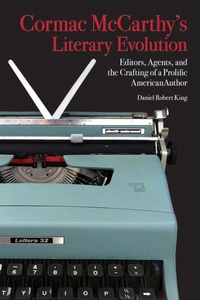
Cormac McCarthy's Literary Evolution
Description

When the New York Times published the first print interview with Cormac McCarthy in 1992, the author was barely known outside a small group of academics, writers, and devoted readers. None of his books, up to that point, had sold more than five thousand copies in hardcover. But that same year McCarthy's All the Pretty Horses made the best-seller lists, and over the next two decades, with the publication of such books as No Country for Old Men, the basis for the Coen brothers' Oscar-winning film, and The Road, a Pulitzer Prize winner and an Oprah's Book Club selection, McCarthy became a household name.
In Cormac McCarthy's Literary Evolution, Daniel Robert King traces McCarthy's journey from cult figure to literary icon. Drawing extensively on McCarthy's papers and those of Albert Erskine, his editor and devoted advocate at Random House, as well as the latest in McCarthy scholarship, King investigates the changes that McCarthy's work as a novelist, his writing methods, and the reception of his novels have undergone over the course of his career. Taking several of McCarthy's major novels as case studies, King explores the lengthy process of their composition through multiple drafts and revisions, the signal contributions of the author's agents and publishers, and McCarthy's growing confidence as a writer who is strongly attentive to tone and repeated metaphors and images. This work also reveals the wide range of McCarthy's reading and research, especially of historical and scientific materials, as well as key intertextual connections between the novels.
Part literary biography, part archival investigation, and part study of print culture, this book is particularly revealing of how one talented writer, properly nurtured by dedicated allies, went on to gain a huge measure of recognition and respect, which has become increasingly difficult for serious authors to achieve in today's profit-driven publishing world.
DANIEL ROBERT KING currently resides and teaches in Britain. His articles have appeared in the International Journal of Comic Art, Literature and Medicine, and Comparative American Studies.
More details
Other editions
Additional editions