

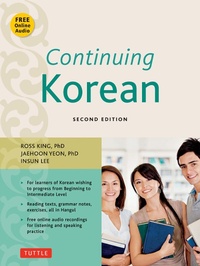
Continuing Korean
Second Edition (Online Audio Included)
Published on 16. June 2015
448 pages
978-1-4629-1492-0 (ISBN)
Description

This is a complete and effective intermediate-level Korean textbook and Korean language learning package
It is the next book in the Elementary Korean series and takes student's abilities to read comprehend Korean, speak Korean, read Korean, and write Korean to the next level. Continuing Korean is designed for learners who have achieved basic proficiency and wish to progress to the more complex structures of the Korean language. It offers a full range of field-tested exercises that will help readers build their confidence and fluency in the Korean language. Each lesson includes Korean dialogues, vocabulary, lesson notes and detailed breakdowns of the grammatical structure under discussion, and exercises. The downloadable audio is another great way to learn Korean and ensures correct pronunciation and helps to build listening comprehension.
It is the next book in the Elementary Korean series and takes student's abilities to read comprehend Korean, speak Korean, read Korean, and write Korean to the next level. Continuing Korean is designed for learners who have achieved basic proficiency and wish to progress to the more complex structures of the Korean language. It offers a full range of field-tested exercises that will help readers build their confidence and fluency in the Korean language. Each lesson includes Korean dialogues, vocabulary, lesson notes and detailed breakdowns of the grammatical structure under discussion, and exercises. The downloadable audio is another great way to learn Korean and ensures correct pronunciation and helps to build listening comprehension.
More details
Other editions
Additional editions
Book
06/2015
2nd Edition
Tuttle Publishing
€28.50
Shipment within 10-20 days
Persons
Ross King, Ph.D., is Professor of Korean and Head of the Department of Asian Studies at the University of British Columbia. He completed his B.A. in Linguistics at Yale and his doctorate in Linguistics (Korean) at Harvard. Dr. King taught Korean language and linguistics at the School of Oriental and African Studies, University of London, from 1990 to 1994, before accepting his current position. Dr. King's research interests range from Korean historical grammar, dialectology and pedagogy to the language, culture and history of the ethnic Korean minority in the former Soviet Union. He also serves as Dean of the Korean Language Village at Concordia Language Villages, a Korean language and culture summer immersion program for young people ages 7 to 18 that is based in northern Minnesota.
Jaehoon Yeon, Ph.D., is Professor of Korean Language and Linguistics and Chair of the Centre of Korean Studies at the School of Oriental and African Studies (SOAS), University of London. He is the author of Korean Grammatical Constructions: Their Form and Meaning (Saffron Books, London) and the co-author of Korean: A Comprehensive Grammar (Routledge), Complete Korean: Teach Yourself (Hodder Education) and Integrated Korean: Advanced I, II (University of Hawaii Press). He has published many articles on Korean grammar and linguistics. He has been teaching Korean language and linguistics at SOAS since 1989. Dr. Yeon's research interests include a wide range of Korean linguistics (especially morpho-syntax) and linguistic typology, Korean language pedagogy, and translation.
Insun Lee is Senior Instructor of Korean at the University of British Columbia. She received her BA in English Language and Literature from Sacred Heart College for Women, Korea. She also has a Graduate Diploma in Teaching English as a Second Language from the University of Alberta, and an MA in Language Education from the University of British Columbia.
Jaehoon Yeon, Ph.D., is Professor of Korean Language and Linguistics and Chair of the Centre of Korean Studies at the School of Oriental and African Studies (SOAS), University of London. He is the author of Korean Grammatical Constructions: Their Form and Meaning (Saffron Books, London) and the co-author of Korean: A Comprehensive Grammar (Routledge), Complete Korean: Teach Yourself (Hodder Education) and Integrated Korean: Advanced I, II (University of Hawaii Press). He has published many articles on Korean grammar and linguistics. He has been teaching Korean language and linguistics at SOAS since 1989. Dr. Yeon's research interests include a wide range of Korean linguistics (especially morpho-syntax) and linguistic typology, Korean language pedagogy, and translation.
Insun Lee is Senior Instructor of Korean at the University of British Columbia. She received her BA in English Language and Literature from Sacred Heart College for Women, Korea. She also has a Graduate Diploma in Teaching English as a Second Language from the University of Alberta, and an MA in Language Education from the University of British Columbia.
Content
- Cover
- Title Page
- Copyright
- Contents
- Preface
- About This Book
- Cast of Characters
- LESSON 16: Sorry l'm late
- Korean Dialogues
- Vocabulary
- Lesson Notes
- 16.1. Verbs: The - Form
- 16.2.Verbs: More on the Infinitive Form - /-
- 16.3. Unfinished Sentences and Afterthoughts with - and -
- 16.4. Descriptive Verb + - : so . . . / I could die
- 16.5. NOUN , NOUN : about, concerning
- 16.6. - : . . . , you see?
- Exercises
- LESSON 17: Have you ever tried yukkaejang and kimchee?
- Korean Dialogues
- Vocabulary
- Lesson Notes
- 17.1. Uses of the Infinitive III: Turning Descriptive Verbs into Processive Verbs with -
- 17.2. Uses of the Infinitive IV: Compound Verbs
- 17.3. The Exploratory Pattern in -
- 17.4. Doing Favors with ( )
- 17.5. Verbs: Nominalizer Form -
- 17.6. Other Nounlike Uses of - Forms
- 17.7. Plain Base + - -: Begin to
- 17.8. Any Base + - : Because
- 17.9. Plain Base + - : Before
- Exercises
- LESSON 18: Where can I rent a car?
- Korean Dialogues
- Vocabulary
- Lesson Notes
- 18.1. Uses of the Infinitive V: with Particle Only if
- 18.2. Uses of the Infinitive VI: with Even though
- 18.3. Some Idiomatic - Expressions
- 18.4. Infinitive - + ( -): Get/Become
- 18.5. Can/Cannot Do: -( )? -/
- 18.6. Expressing and with -( )
- 18.7. NOUN ( ) ( ) through the agency of NOUN
- 18.8. Decides/agrees to do with - -
- Exercises
- LESSON 19: What's the music you're listening to?
- Korean Dialogues
- Vocabulary
- Lesson Notes
- 19.1. The -( )? Modifiers
- 19.2. The Processive Modifier -
- 19.3. Modifier Clauses
- 19.4. Postmodifier Patterns
- 19.5. The Retrospective Modifier -
- 19.6. The Particle
- 19.7. Words for Young and Old
- 19.8. Modifiers with : the fact of . . . ing
- . . . ing.
- Exercises
- LESSON 20: REVIEW 3
- Summary of Lesson Notes
- 20.1. Pattern Review
- English to Korean Translation
- Korean to English Translation
- LESSON 21: How about if I come to collect them on Friday?
- Korean Dialogues
- Vocabulary
- Lesson Notes
- 21.1. Verbs: Conditional Form in -( )
- 21.2. Uses of -( ) (1): If . . . , When(ever)
- 21.3. Uses of -( ) (2): Hopes and Wishes
- 21.4. Uses of -( ) (3): Polite Requests
- 21.5. Other Uses of the Conditional
- 21.6. The Intentive -( ) ( ): intending to
- 21.7. -( ) : if one intends to
- 21.8. The Adverb
- 21.9. First Realizations with -( ) !
- Exercises.
- LESSON 22: It seems you're really overdoing it lately!
- Korean Dialogues
- Vocabulary
- Lesson Notes
- 22.1. Expressing While with -( ) ( )
- 22.2. Contrasted Topics with -( )
- 22.3. Mild Exclamations in -
- 22.4. Abbreviated Verbs of Manner
- 22.5. Verbs: Transferentive - ( )
- 22.6. More on the Auxiliary Verb
- 22.7. As long as you're at it . . . with -
- 22.8. Modifiers with : Seems
- Exercises
- LESSON 23: I have a friend visiting from England-is it OK if I bring him along?
- Korean Dialogues
- Vocabulary
- Lesson Notes
- 23.1. Imminent Elaboration with Circumstantial - ( ), -( )? ( )
- 23.2. In spite of . . . ing with - /- , -?
- 23.3. Other Uses of
- 23.4. The Postnoun - and Diminutive -
- 23.5. Modifiers (2): The Prospective Modifier -( )?
- 23.6. Prospective Modifier Clauses
- 23.7. Plain/Past Base + -( )? When
- 23.8. More on -( )? Time When
- 23.9. Seems like it will . . . with -( )?
- 23.10. was going to . . . , but with -( )
- Exercises
- LESSON 24: Would you mind watching the house while I pop over to the police station?
- Korean Dialogues
- Vocabulary
- Lesson Notes
- 24.1. Modifier Clauses: -( )? After . . . ing
- 24.2. Modifier Clauses: While . . . ing
- 24.3. -( )?/- : Because of . . . ing
- 24.4. Verbs: Adverbative Form -
- 24.5. Causatives in -
- 24.6. - : gets so that . . . , turns out so that
- 24.7. - : It would be best to
- 24.8. Expressing Intentions
- 24.9. -( )?/- : as soon as . . .
- in accordance with
- Exercises
- LESSON 25: REVIEW 4
- Summary of Lesson Notes
- 25.1. Pattern Review
- Review Exercises
- LESSON 26: I was up until late last night drinking with friends from work
- Korean Dialogues
- Vocabulary
- Lesson Notes
- 26.1. The Plain Style
- 26.2. Plain Style Questions
- 26.3. Plain Style: Suggestions in -
- 26.4. Plain Style Commands
- 26.5. Plain Style: The Copula
- 26.6. Intimate Style
- 26.7. Because of . . . ing with - ( )
- 26.8. The Copula Transferentive: Special Uses
- Exercises
- LESSON 27: He says he wants to go to the States to study
- Korean Dialogues
- Vocabulary
- Lesson Notes
- 27.1. Quotations: Direct and Indirect
- 27.2. More on Quoted Questions
- 27.3. More on Quoted Suggestions
- 27.4. More on Quoted Commands
- 27.5. The Copula in Quotations
- 27.6. Special Uses of the Quoted Copula
- 27.7. - . . . According to
- 27.8. Using ( ) - to Quote Give me
- 27.9. The Particle : More Meanings
- Exercises
- LESSON 28: Are they still selling it in bookstores?
- Korean Dialogues
- Vocabulary
- Lesson Notes
- 28.1. Retrospective Aspect
- 28.2. More on Retrospective Modifiers in -
- 28.3. - ( )
- 28.4. Retrospective Conditionals in -
- 28.5. Additional Uses of the Quotation Pattern in -
- 28.6. Errand Reporting
- 28.7. -( )? ( ): To the extent that
- 28.8. - : after VERBing
- 28.9. NOUN( / ) ( ): for the sake of NOUN
- Exercises
- LESSON 29: Honey, do you know where the car keys are?
- Korean Dialogues
- Vocabulary
- Lesson Notes
- 29.1. More Summative Forms: - -, - -, - -
- 29.2. Is on the . . . ing side
- Is fairly ~ pretty . . . with -( )?/- -
- 29.3. The postmodifier : [TIME] since
- 29.4. The postmodifier : Oblique Questions in
- 29.5. Polite Questions with . . . and . . .
- Exercises
- LESSON 30: REVIEW 5
- Review of Lesson Notes
- 30.1. Pattern Review
- 30.2. Verb Forms: Summary
- 30.3. Particles, Particle Phrases, Postnouns, and Suffixes: Summary
- 30.4. Auxiliary Verbs: Summary
- Review Exercises
- Korean-English Vocabulary
- English-Korean Vocabulary
- Korean-English Pattern Glossary
- English-Korean Pattern Glossary
- English Equivalents to the Korean Dialogues
- Answer Key to Written Exercises
- About the Authors
