

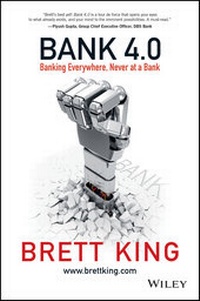
Bank 4.0
Description

Winner of best book by a foreign author (2019) at the Business Book of the Year Award organised by PwC Russia
The future of banking is already here - are you ready?
Bank 4.0 explores the radical transformation already taking place in banking, and follows it to its logical conclusion. What will banking look like in 30 years? 50 years? The world's best banks have been forced to adapt to changing consumer behaviors; regulators are rethinking friction, licensing and regulation; Fintech start-ups and tech giants are redefining how banking fits in the daily life of consumers. To survive, banks are having to develop new capabilities, new jobs and new skills. The future of banking is not just about new thinking around value stores, payment and credit utility - it's embedded in voice-based smart assistants like Alexa and Siri and soon smart glasses which will guide you on daily spending and money decisions. The coming Bank 4.0 era is one where either your bank is embedded in your world via tech, or it no longer exists.
In this final volume in Brett King's BANK series, we explore the future of banks amidst the evolution of technology and discover a revolution already at work. From re-engineered banking systems, to selfie-pay and self-driving cars, Bank 4.0 proves that we're not on Wall Street anymore. Bank 4.0 will help you:
- Understand the historical precedents that flag a fundamental rethinking in banking
- Discover low-friction, technology experiences that undermine the products we sell today
- Think through the evolution of identity, value and assets as cash and cards become obsolete
- Learn how Fintech and tech "disruptors" are using behaviour, psychology and technology to reshape the economics of banking
- Examine the ways in which blockchain, A.I., augmented reality and other leading-edge tech are the real building blocks of the future of banking systems
If you look at individual technologies or startups disrupting the space, you might miss the biggest signposts to the future and you might also miss that most of we've learned about banking the last 700 years just isn't useful.
When the biggest bank in the world isn't any of the names you'd expect, when branch networks are a burden not an asset, and when advice is the domain of Artificial Intelligence, we may very well have to start from scratch. Bank 4.0 takes you to a world where banking will be instant, smart and ubiquitous, and where you'll have to adapt faster than ever before just to survive. Welcome to the future.
More details
Other editions
Additional editions
Person
Brett King is an international bestselling author, a renowned commentator and globally respected speaker on the future of business. He has spoken in over 50 countries, to more than a million people, on how technology is disrupting business, changing behavior and influencing society. He advised the Obama White House, the FED and the National Economic Council on the future of banking in the United States, and advises governments and regulators around the world. He appears regularly on US TV networks like CNBC, where he contributes on Future Tech and FinTech.
King hosts Breaking Banks, the world's leading dedicated radio show and podcast on technology impact in banking and financial services (150-plus countries, 6.5 million listeners). He is also the founder of the neo-bank Moven, a globally recognized mobile start-up, which has raised over US$42 million to date, with the world's first mobile, downloadable bank account.
Named "King of the Disruptors" by Banking Exchange magazine, King was voted American Banker's "Innovator of the Year," "The world's #1 Financial Services Influencer" by The Financial Brand, and was nominated by Bank Innovation as one of the top 10 "coolest brands in banking." He was shortlisted for the 2015 Advance Global Australian of the Year Award for being one of the most influential Australians living offshore.
Content
Preface 13
Acknowledgements 16
PART ONE: Bank 2050
Chapter 1: Getting Back to First Principles 20
First principles design thinking 23
Applying first principles to banking 27
A bank that is always with you 32
Is it too late for the banks? 39
Feature: Ant Financial-The First Financial Firm for the Digital Age by Chris Skinner 44
The Alibaba stories 46
Ant Financial: Building a better China 58
Chapter 2: The Regulator's Dilemma by Brett King and Jo Ann Barefoot 64
The risk of regulation that inhibits innovation 66
A flawed approach to fi nancial crime and KYC 72
The future form and function of regulation 82
Elements of reform 86
Feature: How Technology Reframes Identity by David Birch 93
PART TWO: Banking reimagined for a real-time world
Chapter 3: Embedded Banking 102
Friction isn't valuable in the new world 104
New experiences don't start in the branch 106
Advice, when and where you need it 109
Mixed reality and its impact on banking 114
Feature: Contextual Engagement and Money Moments by Duena Blomstrom 118
Are banking chatbots the future? 118
Chapter 4: From Products and Channels to Experiences 124
The new "network" and "distribution" paradigms 124
Bye-bye products, hello experiences 131
The Bank 4.0 organisation chart looks very different 140
Onboarding and relationship selling in the new world 151
Feature: Future Vision: Your Personal Voice-Based AI Banker by Brian Roemmele 156
Chapter 5: DLT, Blockchain, Alt-Currencies and Distributed Ecosystems 160
Emerging digital currencies 161
Bitcoin and cryptocurrencies on a surge 166
The structural implications of DLT 176
PART THREE: Why FinTech companies are proving banks aren't necessary
Chapter 6: FinTech and TechFin: Friend or Foe? 185
"For me? Two servers" 189
Where the new players are dominating 191
Partner, acquire or mimic? 199
Killing FinTech partnerships-the barriers to cooperation 204
If you can't beat them, join them 209
Feature: Why Banks Should Care About FinTech by Spiros Margaris 212
Feature: The Speed Advantage by Michael Jordan 214
Chapter 7: The Role of AI in Banking 219
Deep learning: How computers mimic the human brain 225
Robo-advisors, robo-everything 230
A bank account that is smarter than your bank 233
Where automation will strike first 242
Redefining the role of humans in banking 245
Chapter 8: The Universal Experience 252
The expectations of the post-millennial consumer 253
The new brokers and intermediaries 261
Ubiquitous banking 267
Feature: Going Beyond Digital Banking by Jim Marous 269
Going beyond digital banking basics 270
Amazon model provides a guide for banking 271
Feature: Digitise to Lead: Transforming Emirates NBD by Suvo Sarkar 278
PART FOUR: Which banks survive, which don't
Chapter 9: Adapt or Die 286
Key survival techniques 295
Survival starts at the top 306
Chapter 10: Conclusion: The Roadmap to Bank 4.0 311
Technology first, banking second 315
Experience not products 323
The Bank 4.0 roadmap 333
Conclusion 333
Glossary 337
About Brett King 344
1
Getting Back to First Principles
Everybody has a plan until they get punched in the mouth.
-Mike Tyson
Banking isn't rocket science, but as it turns out, rocket science is a great analogy for the future state of banking. Putting men on the moon is, to date, perhaps the greatest endeavour mankind has committed to. It inspired generations and, until we successfully put boots on the surface of Mars, will likely remain the single most significant technological and scientific achievement of the last 100 years. Getting men to the moon required massive expenditure, incredible advances in engineering, a fair bit of good old fashion luck and the "right stuff".
Before the US could get Neil Armstrong all the way up to the moon, they needed the right stuff in a different area-in figuring out the science.
At the end of World War II there was a very serious plan that would set the foundation for the entire Space Race and Cold War. It was the race for the best German scientists, engineers and technicians of the disintegrating Nazi regime. The predecessor to the CIA, the United States' OSS (Office of Strategic Services), were instrumental in bringing more than 1,500 German scientists and engineers back to America at the conclusion of World War II. The highly secretive operation responsible for this mass defection was codenamed "Overcast" (later to be renamed Operation "Paperclip"). The primary purpose of this operation was denying access to the best and brightest Nazi scientists to both the Russians and the British, who were both allies of the US at this time. "Paperclip" was based on a highly secretive document known within OSS circles as "The Black List", and there was one single name that was right at the top of that list: Wernher von Braun.
In the final stages of World War II, von Braun could see that the Germans were ultimately going to lose the war, and so in 1945 he assembled his key staff and asked them the question: who should they surrender to? The Russians, well known for their cruelty to German prisoners of war, were too much of a risk-they could just as easily kill von Braun's team as utilise them. Safely surrendering to the US became the focus for von Braun's own covert planning in the closing days of World War II. The question he faced was how to surrender without the remnants of the Nazi regime getting tipped off and putting an end to his scheme.
For this von Braun had to, twice, manipulate his superiors, forge paperwork, travel incognito and disguise himself as an SS officer to create a very small window of opportunity for surrender. Convincing his superior that he and his team needed to divert from Berlin to Austria, so that the V-2 rocket team was not at risk by invading Soviet forces, von Braun engineered an opportunity to surrender himself and his brother to the Americans. In the end, Magnus von Braun just walked up to an American private from the 44th Infantry Division on the streets of Austria and presented himself as the brother of the head of Germany's most elite secret weapons program1.
Suddenly a young German came to members of Anti-Tank Company, 324th Infantry and announced that the inventor of the deadly V-2 rocket bomb was a few hundred yards away-and wanted to come through the lines and surrender. The young German's name was Magnus von Braun, and he claimed that his brother Wernher was the inventor of the V-2 bomb. Pfc Fred Schneikert, Sheboygan, Wis., an interpreter, listened to the tale and said just what the rest of the infantrymen were thinking: "I think you're nuts," he told von Braun, "but we'll investigate."
-The Battle History of the 44th Infantry Division:
"Mission Accomplished"
Private First Class Fred Schneikert likely presided over the single greatest intelligence coup of World War II, save maybe for the capture of U-570 and its Enigma cipher machine.
To understand von Braun and his willingness to work on a WWII weapon of mass destruction like the V-2 rocket (which is estimated to have killed 2,754 civilians in London, with another 6,523 injured2), it needs to be understood that he simply saw the Nazi ballistic missile program as a means to an end. In von Braun's mind, the V2 was simply a prototype of rockets that would one day carry men into space-that was his end game.
The images and engineering principles of spacecraft we have from the 1950s we owe largely to von Braun's designs. The three-stage design of modern rockets, the chosen propellants and fuel, the recovery ship system for returning capsules, the initial NASA designs for space stations and Mars programs, all came from von Braun's early musings and engineering drawings. Sixteen years after von Braun's surrender to Allied forces, President John F. Kennedy Jr announced that by the end of the decade the US would put a man on the moon. It would be in a rocket built by Wernher von Braun.
The Saturn V was an astounding piece of engineering. Today, it remains the largest and most complex vehicle ever built. A total of 13 Saturn Vs were launched between 1967 and 1973 carrying the Apollo and Skylab missions. The Saturn V first stage carried 203,400 gallons (770,000 litres) of kerosene fuel and 318,000 gallons (1.2 million litres) of liquid oxygen needed for combustion. At lift-off, the stage's five F-1 rocket engines produced an incredible 7.5 million pounds of thrust, or about 25 times that of an Airbus A380's four engines at take-off. In today's money, each Apollo launch and flight cost around $1.2 billion.
However, despite the incredible advances of von Braun's program in the 1950s and 1960s, manned spaceflight hasn't progressed significantly since. In fact, one could argue that the US' capabilities in this area have been declining ever since Apollo. On 20 July 1969, the Americans landed Neil Armstrong and Buzz Aldrin on the lunar surface, but after December 1972 no further manned missions were launched. In the 1980s the US had the Space Shuttle and could get to low-earth orbit, but today they are renting seats on Russian Soyuz vehicles to get NASA astronauts to the International Space Station.
First principles design thinking
While the cost of launching commercial payloads into space has decreased by some 50-60 percent since the Apollo days, the core technology behind the space industry has simply gone through multiple derivative iterations of von Braun's initial V-2 work. The rocket design, production process, and mechanics all are essentially based on the work of NASA in the Apollo era, which itself was based on the V-2 design. This process of iterative design, or engineering, is known to engineers as "design by analogy"3.
Design by analogy works on the philosophy that as engineering capabilities and knowledge improve, engineers find better ways to iterate on a base design, perhaps finding technical solutions to previous limitations. But design by analogy creates limitations in engineering thinking, because you're starting with a template-the work is derivative. To create something truly revolutionary you have to be prepared to start from scratch.
Enter Elon Musk. Like von Braun, Musk has an unyielding vision for space travel. Musk isn't interested in just returning to the Moon though, he has his sights set on Mars. For Musk, this is about nothing short of the survival of humanity. In discussing his obsession with Mars, Musk refers to the fact that on at least five occasions the Earth has faced an extinction level event, and that we're due for another one at any moment. We've had dinosaur-killer scale asteroids sail past Earth on near collision courses on multiple occasions in recent years, too. Thus, Musk argues, we must build the "insurance policy" of off-world colonies.
After his successful exit from PayPal, Musk created three major new businesses: Tesla, SpaceX and Solar City4. Instrumental in Musk's approach to each of these businesses was his belief in the engineering and design concept called first principles. Unlike design-by-analogy or derivative design, first principles take problems back to the constituent components, right back to the physics of the design-what the design was intended to do. A great example of first principles design is the motor vehicle. At the time that Carl Benz invented the first two-seater lightweight gasoline car in 1885, everyone else was trying to optimise carriage design for use with horses. Benz took the fundamentals of transport and applied the capabilities of the combustion engine to create something new.
I think it's important to reason from first principles rather than by analogy. The normal way we conduct our lives is we reason by analogy. [With analogy] we are doing this because it's like something else that was done, or it is like what other people are doing. [With first principles] you boil things down to the most fundamental truths.and then reason up from there.
-Elon Musk, YouTube video, First Principles5
To get to Mars, Musk has reckoned that we need to reduce the cost to orbit by a factor of 10. A tall order for NASA, a seemingly impossible task for a software engineer who had never built a rocket before. As noted in Musk's recent biography (Vance, 2015), Musk has the unique ability to learn new...
