

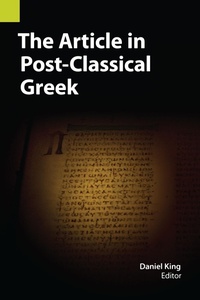
The Article in Post-Classical Greek
Description

More details
Other editions
Additional editions
Person
Daniel King is research fellow in Syriac studies and Semitic languages, Cardiff University, UK, and a translation consultant with SIL International. His research is principally concerned with methods and techniques of translation in antiquity especially between Greek and Syriac in the fields of philosophy and theology. He has published an edition of The Earliest Syriac Translation of Aristotle's Categories (Brill, 2010) as well as many articles in the field.
Content
Contents
Contributors
Figures
Tables
Abbreviations
1 Introduction (Daniel King)
1.1 Previous studies on the article
1.2 Brief summary of studies in this volume
References
2 Functions of the Definite Article from Classical Greek to New Testament Greek (Maria Napoli)
2.1 Introduction
2.2 (In)definiteness in the history of the Greek language
2.3 A map of definiteness: The main uses of definite articles across
languages
2.4 Obligatoriness and optionality in Greek: definite article versus zero article
2.5 The definite article in New Testament Greek
2.6 Conclusions
References
3 The History of Greek Articles: A Syntactic Approach (Cristina Guardiano)
3.1 Introduction
3.2 Background
3.3 Articles in Classical and New Testament Greek
3.4 Homeric Greek
3.5 Conclusion
References
4 A Discourse-Functional Approach to the Greek Article(Ronald D. Peters)
4.1 Introduction
4.2 A systemic-functional description of the Greek article
4.3 Matthew 13:44
4.4 Acts 5:1â 11
4.5 1 Timothy 4:11â 14
4.6 Conclusion
References
5 The Use of the Greek Article in 1 Peter: A Case Study (Stephen H. Levinsohn and Mark Dubis)
5.1 Preliminaries
5.2 Thematic prominence(salience) versus focal prominence
5.3 Application to 1 Peter
5.4 Conclusions
References
6 Towards a Unified Understanding of the Greek Article from a Diachronic, Cognitive Perspective (Steven E. Runge)
6.1 Introduction
6.2 Less prototypical uses: Stage III development of the article
6.3 Conclusions
References
7 The Function of the Article with Proper Names: The New
Testament Book of Acts as a Case Study (Jenny Read-Heimerdinger)
7.1 Introduction
7.2 Names of persons
7.3 Names of places
7.4 General conclusions
References
