

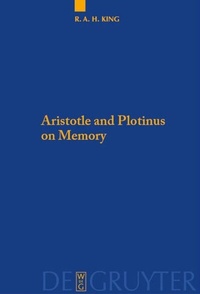
Aristotle and Plotinus on Memory
Description

Two treatises on memory which have come down to us from antiquity are Aristotle's "On memory and recollection" and Plotinus' "On perception and memory" (IV 6); the latter also wrote at length about memory in his "Problems connected with the soul" (IV 3-4, esp. 3.25-4.6). In both authors memory is treated as a 'modest' faculty: both authors assume the existence of a persistent subject to whom memory belongs; and basic cognitive capacities are assumed on which memory depends. In particular, both theories use phantasia (representation) to explain memory.
Aristotle takes representations to be changes in concrete living things which arise from actual perception. To be connected to the original perception the representation has to be taken as a (kind of) copy of the original experience - this is the way Aristotle defines memory at the end of his investigation.
Plotinus does not define memory: he is concerned with the question of what remembers. This is of course the soul, which goes through different stages of incarnation and disincarnation. Since the disembodied soul can remember, so he does not have Aristotle's resources for explaining the continued presence of representations as changes in the concrete thing. Instead, he thinks that when acquiring a memory we acquire a capacity in respect of the object of the memory, namely to make it present at a later time.
More details
Other editions
Additional editions
Person
Content
2 - Preface - Abbreviations and conventions [Seite 10]
3 - Contents [Seite 14]
4 - 1 Introduction [Seite 16]
5 - 2 Aristotle [Seite 35]
6 - 3 Plotinus [Seite 121]
7 - 4 General conclusion: Aristotle and Plotinus on memory [Seite 237]
8 - Select Bibliography [Seite 256]
9 - Index locorum [Seite 267]
10 - General Index [Seite 276]
