

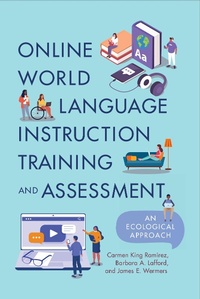
Online World Language Instruction Training and Assessment
Description

This new guide provides a much-needed critical pedagogical approach to computer-assisted language learning (CALL) teacher education (CTE). By combining best CTE training and evaluation practices with assessment tools to address all facets of learning online, the authors explain how teachers can use technology to build successful online programs.
More details
Other editions
Additional editions
Persons
Carmen King Ramírez is an associate professor of Spanish and the director of the Online Spanish Program at the University of Arizona. She has published work on CALL and languages for specific purposes, designed and launched numerous online Spanish programs, and hosts the academic podcast series, World Languages 21. She coedited the volume Transferable Skills for the 21st Century: Preparing Students for the Workplace through World Languages for Specific Purposes with Barbara A. Lafford.
Barbara A. Lafford is a professor emerita of Spanish at Arizona State University who has published widely on CALL, Spanish sociolinguistics, second language acquisition, and languages for specific purposes. She has coauthored, edited, or coedited fourteen volumes, including Spanish Second Language Acquisition and The Art of Teaching Spanish (both published by Georgetown University Press).
James E. Wermers is a clinical faculty member in the humanities at Arizona State University and formerly coordinated training, development, and deployment of digital pedagogy and initiatives in the College of Integrative Sciences and Arts.
Content
Introduction
1. The Challenges of Moving Online
2. CALL Teacher Education for Online Environments
3. Online Language Instructor Training Challenges and Strategies
4. Core Competencies and Skills for Online Language Instructors
5. Online Language Instructor Assessment
6. Instruments for the Assessment of Online Language Instructors
7. Self-Evaluation Practices in Formative Assessment
8. The Mentoring Relationship in Formative Assessment Processes
9. Debriefing and Goal Setting in Instructor Assessment
10. An Ecological Approach to the Normalization of a Critical CTE
Appendix A: Checklists for Online Language Instructor Training and Assessment
Appendix B: Rubrics for Evaluation of Online Language Instructor Training and Assessment
Appendix C: Online Language Instructor Student Evaluation Rubric and Modular Rubric
Bibliography
Glossary
