

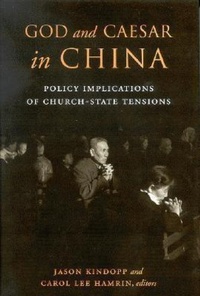
God and Caesar in China
Policy Implications of Church-State Tensions
1st Edition
Published on 21. April 2004
200 pages
978-0-8157-9646-6 (ISBN)
Description

In the late 1970s when Mao's Cultural Revolution ushered in China's reform era, religion played a small role in the changes the country was undergoing. There were few symbols of religious observance, and the practice of religion seemed a forgotten art. Yet by the new millennium, China's government reported that more than 200 million religious believers worshiped in 85,000 authorized venues, and estimates by outside observers continue to rise. The numbers tell the story: Buddhists, as in the past, are most numerous, with more than 100 million adherents. Muslims number 18 million with the majority concentrated in the northwest region of Xinjiang. By 2000 China's Catholic population had swelled from 3 million in 1949 to more than 12 million, surpassing the number of Catholics in Ireland. Protestantism in China has grown at an even faster pace during the same period, multiplying from 1 million to at least 30 million followers. China now has the world's second-largest evangelical Christian population¿behind only the United States. In addition, a host of religious and quasi-spiritual groups and sects has also sprouted up in virtually every corner of Chinese society. Religion's dramatic revival in post-Mao China has generated tensions between the ruling Communist Party state and China's increasingly diverse population of religious adherents. Such tensions are rooted in centuries-old governing practices and reflect the pressures of rapid modernization. The state's response has been a mixture of accommodation and repression, with the aim of preserving monopoly control over religious organization. Its inability to do so effectively has led to cycles of persecution of religious groups that resist the party's efforts. American concern over official acts of religious persecution has become a leading issue in U.S. policy toward China. The passage of the 1998 International Religious Freedom Act, which institutionalized concern over religious freedom abroad in U.S. foreig
More details
Edition
1. Auflage
Language
English
Place of publication
New York
United States
Publishing group
Bloomsbury Publishing Plc
ISBN-13
978-0-8157-9646-6 (9780815796466)
DOI
10.5771/9780815796466
Copyright in bibliographic data and cover images is held by Nielsen Book Services Limited or by the publishers or by their respective licensors: all rights reserved.
Schweitzer Classification
Other editions
Additional editions
Jason Kindopp | Carol Lee Hamrin
God and Caesar in China
Policy Implications of Church-State Tensions
Book
04/2004
Brookings Institution
€65.87
Article exhausted; check different version
Content
- Intro
- 4936-8 CH00 Frontmatter
- 4936-8 CH01 Kindopp
- 4936-8 CH02 Bays
- 4936-8 CH03 Spiegel
- 4936-8 CH04 Chan
- 4936-8 CH05 Wiest
- 4936-8 CH06 Madsen
- 4936-8 CH07 Xu
- 4936-8 CH08 Kindopp
- 4936-8 CH09 Liu
- 4936-8 CH10 Hamrin
- 4936-8 CH11 suggested readi
- 4936-8 CH12 Contributors
