

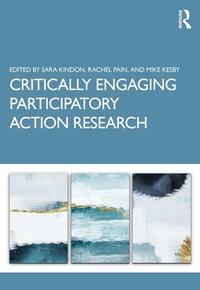
Critically Engaging Participatory Action Research
1st Edition
Published on 23. September 2024
190 pages
978-0-429-68237-7 (ISBN)
Description

This timely and informative book reasserts the value of Critical Participatory Action Research (CPAR): an approach to participatory action research (PAR) that is informed by critical theories attending to questions of privilege and power, and that generates collaborations focused on challenging structural inequality.
The authors, writing explicitly from Minority World perspectives, are experienced researcher-practitioners who have worked with communities in the UK, USA, South Africa, Australia, India, and Colombia over many years. They offer an assessment, exploration, and illustration of CPAR at this point in time, outlining how the approach has evolved over time and space. Exploring its roots in strands of critical thought including postcolonialism, anti-imperialism, feminism, antiracism, queer theory, and Indigenous ontologies, the book asks how PAR is being critically re-engaged to maintain its commitment to greater justice and transformational change. Each chapter provides a rich case study of how these theories inform current collaborations and offers reflection on the entanglements of power that come with attempting CPAR in different institutional and geopolitical contexts. Their examples show that critical interrogation of PAR practices may lead to innovative and impactful outcomes for those involved, as well as new theoretical and substantive research findings.
The collection will be of especial interest to students and researchers across the social sciences and humanities, as well as those working outside universities, who are interested in developing or extending their use of CPAR.
The authors, writing explicitly from Minority World perspectives, are experienced researcher-practitioners who have worked with communities in the UK, USA, South Africa, Australia, India, and Colombia over many years. They offer an assessment, exploration, and illustration of CPAR at this point in time, outlining how the approach has evolved over time and space. Exploring its roots in strands of critical thought including postcolonialism, anti-imperialism, feminism, antiracism, queer theory, and Indigenous ontologies, the book asks how PAR is being critically re-engaged to maintain its commitment to greater justice and transformational change. Each chapter provides a rich case study of how these theories inform current collaborations and offers reflection on the entanglements of power that come with attempting CPAR in different institutional and geopolitical contexts. Their examples show that critical interrogation of PAR practices may lead to innovative and impactful outcomes for those involved, as well as new theoretical and substantive research findings.
The collection will be of especial interest to students and researchers across the social sciences and humanities, as well as those working outside universities, who are interested in developing or extending their use of CPAR.
More details
Edition
1. Auflage
Language
English
Place of publication
London
United Kingdom
Publishing group
Taylor & Francis Ltd
Target group
College/higher education
Illustrations
3 Tables, black and white; 23 Halftones, black and white; 23 Illustrations, black and white
ISBN-13
978-0-429-68237-7 (9780429682377)
Copyright in bibliographic data and cover images is held by Nielsen Book Services Limited or by the publishers or by their respective licensors: all rights reserved.
Schweitzer Classification
Other editions
Additional editions
Sara Kindon | Rachel Pain | Mike Kesby
Critically Engaging Participatory Action Research
Book
09/2024
1st Edition
Routledge
€207.30
Shipment within 15-20 days
Sara Kindon | Rachel Pain | Mike Kesby
Critically Engaging Participatory Action Research
Book
09/2024
1st Edition
Routledge
€59.70
Shipment within 15-20 days

Book
09/2024
Routledge
Unfortunately, price unknown
Available (delivery time upon request)
Persons
Sara Kindon has worked for thirty years in community-based, participatory projects with Indigenous communities, women, young people, migrants, and former refugees. She has worked in a range of places, including Costa Rica, Indonesia, Aotearoa, and Oceania. Since 2006, she has provided research support to refugee-background communities and refugee-led organisations advocating for educational equity in the tertiary sector, improved service delivery, and more holistic approaches to refugee resettlement in New Zealand. Using creative and arts-based approaches, this work informed the establishment of the New Zealand National Tertiary Network to Support Refugee Background Learners and the New Zealand government's new Community Organisation Refugee Sponsorship Programme. She is the first female Professor of Human Geography and Development Studies at Te Herenga Waka Victoria University of Wellington, as well as a wife, mother, occasional dancer, and poet.
Rachel Pain is a Professor of Human Geography at Newcastle University in the UK. Her research focuses on violence, fear, and trauma, with a particular interest in gender-based violence, and analyses connections between intimate, community, and international scales. Her work is informed by feminist theory and participatory action research. She collaborates on this research with public and voluntary sector organisations and survivor groups.
Mike Kesby is a Senior Lecturer in Geography at the University of St Andrews, Scotland, UK. His research focuses on a range of health issues in Southern and Eastern Africa (HIV, sexual health, gender relations, and antimicrobial resistance in UTIs). His work is informed by participatory action research, feminist, post-structuralist, and new materialist theory. He uses participatory video and other creative methods in collaborations with a range of academic, governmental and non-governmental organisations, and grassroots citizens.
Rachel Pain is a Professor of Human Geography at Newcastle University in the UK. Her research focuses on violence, fear, and trauma, with a particular interest in gender-based violence, and analyses connections between intimate, community, and international scales. Her work is informed by feminist theory and participatory action research. She collaborates on this research with public and voluntary sector organisations and survivor groups.
Mike Kesby is a Senior Lecturer in Geography at the University of St Andrews, Scotland, UK. His research focuses on a range of health issues in Southern and Eastern Africa (HIV, sexual health, gender relations, and antimicrobial resistance in UTIs). His work is informed by participatory action research, feminist, post-structuralist, and new materialist theory. He uses participatory video and other creative methods in collaborations with a range of academic, governmental and non-governmental organisations, and grassroots citizens.
Content
'1. Critically Engaging Participatory Action Research. 2. "Can We Track Human Dignity?": Critical Participatory Ethics and Care. 3. We Sing the Land: Researching for, with and as Country in North East Arnhem Land, Australia. 4. Radical Imaginings: Queering the Politics and Praxis of Participatory Arts-based Research. 5. Mapping Our Home: Using Participatory Mapping to Challenge Police Violence in the South Bronx. 6. Using Participatory Action Research for Performing Stories and Imagining Inclusive Communities. 7. 'You Think Too Much!': Emotional Geographies of Participatory Action Research. 8. Pathways to Scaling Social Inclusion Innovation through Participatory Action Research. 9. Movement Memories in the Afterlife of Participatory Action Research (PAR): Dreaming and Forgiveness Beyond the Non-Profit Industrial Complex (NPIC)?.
