

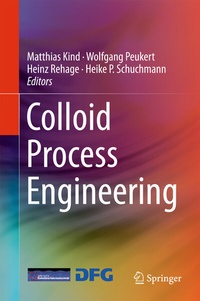
Colloid Process Engineering
Description

The future challenges to colloidal process engineering are the development of appropriate equipment and processes for the production and obtainment of multi-phase structures and energetic interactions in market-relevant quantities. The book explores the relevant processes and for controlled production and how they can be used across all scales.
More details
Other editions
Additional editions
Persons
Matthias Kind, born 1957, studied Mechanical Engineering at Universität Karlsruhe (TH) and Chemical and Process Engineering at Technische Universität München. During his studies he spent a practical internship at Siemens India Ltd. in Bombay. His diploma thesis was about mechanisms of Homogeneous Nucleation from Solutions. After graduation in 1982 he joined the research group of William N. Gill at State University of New York at Buffalo, USA, where he worked on mixed convection effects of Dendritic Growth from Melts. From 1984 to 1989 he joined the research group of Alfons Mersmann at Technische Unversität München and received his Dr.-Ing. degree with a thesis about modeling of Secondary Nucleation from Solution. From 1989 to 1997 he joined BASF AG in Ludwigshafen and took responsibility for process engineering and development in the field of Formation and Separation of Solids. In 1984 he received the Arnold-Eucken-Preis from Verein Deutscher Ingenieure - Gesellschaft für Verfahrenstechnik und Chemieingenieurwesen. Since 1989 he is professor of Thermal Process Engineering at Karlsruhe Institute of Technology (former Universität Karlsruhe (TH)). His principal research interest is about Formation of Solids (crystallization, precipitation, polymerization, granulation) and about Heat and Mass Transfer in Multi Phase Flow. He is member of the several boards of working groups. He is member of the editorial board of the VDI-Heat Atlas. He was dean of his faculty and currently is member of the senate of his university. He is member of the Heidelberg Academy of Sciences and Humanities.
