

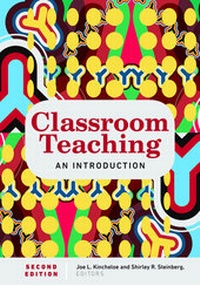
Classroom Teaching
Description

Classroom Teaching is an introductory text that challenges the antiquated ways that teaching and curriculum have been presented. By adding chapters to Joe L. Kincheloe's original volume, this second edition gives a fresh, politicized viewpoint of power and politics in an era of corporatized education. The authors set the scene to introduce cutting-edge notions of teaching, knowledge-making, and ways of seeing the world. The essays included in this second edition of Classroom Teaching present a critical pedagogical approach to a socially-just praxis of schooling and being in schools. This edition also includes essential essays on diversity, sexuality, and media which are contemporaneous with today's concerns in society. Pre-service teachers, interns, and teacher educators in North America will find Classroom Teaching engaging and unique as they commit to an informed vision of educating our children and youth.
More details
Other editions
Additional editions
Persons
Content
Shirley R. Steinberg: Introduction: And So, We Teach - Part I: Teaching: Becoming and Doing - Joe L. Kincheloe and Shirley R. Steinberg: What Are We Doing Here? How Do We Build a Framework for Teaching? - Philip M. Anderson: The Meaning of Pedagogy - Shirley R. Steinberg and Joe L. Kincheloe: About Power and Critical Pedagogy - Part II: How Do We Teach? Why Do We Teach? - Joe L. Kincheloe: Curriculum: Understanding What We Teach and Where We Teach It - George J. Sefa Dei and Marlon Simmons: Indigenous Knowledge and the Challenge for Rethinking Conventional Educational Philosophy: A Ghanaian Case Study - Tricia Kress: The Teacher as Mediator between Schools and Students - Elizabeth E. Heilman: The "Social" Dimensions of Classroom Teaching - Nina Zaragoza: Including Families in the Teaching and Learning Process - Part III: Different Kids, Different Classrooms - Virginia Lea: Unmasking Whiteness in the Teacher Education College Classroom: Critical and Creative Multicultural Practice - Nelson M. Rodriguez: (Still) Making Whiteness Visible: Implications for (Teacher) Education - Shirley R. Steinberg: Creating a Third Wave Islamophobia: Formulating Prejudices Through Media - Elizabeth J. Meyer: Creating Schools That Value Sexual Diversity - sj Miller: (Dis)Embedding Gender Diversity in the Preservice - Part IV: More than Methods: Authentic Teaching - Brian Mooney: Breakbeat Pedagogy Brian Mooney - Shirley R. Steinberg: Contextualizing the Possible for Transformative Youth Leadership - Venus Evans-Winters and Christie Ivie: Lost in the Shuffle: Re-calling a Critical Pedagogy for Urban Girls - Curry Malott and Brad Porfilio: Punk Rock, Hip-Hop, and the Politics of Human Resistance: Reconstituting the Social Studies Through Critical Media Literacy - Zack Furness: Alternative Media: The Art of Rebellion - Contributors - Index.
