

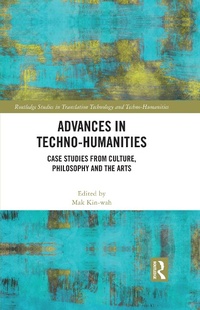
Advances in Techno-Humanities
Case Studies from Culture, Philosophy and the Arts
1st Edition
Published on 10. October 2023
170 pages
978-1-000-97023-4 (ISBN)
Description

This book is a pioneering attempt to explore the relationships between technology and the humanities through case studies and specific contexts in the areas of language, theatre, literature, translation, philosophy, music, home designations, learning environment, and artificial intelligence.
Written by scholars and specialists across various fields, the chapters explore the emerging field of techno-humanities. This book examines the development of language and society by means of Big Data, how technology is integrated into the theatres of Hong Kong and the ensuing results of such integration. The authors also highlight how technology is able to analyse, understand, and visualise literary works and to bring drastic changes to translation in the past seven decades. Long-standing philosophical issues are re-examined, linkages between technology and theoretical concepts are illuminated, and the emotional aspects of computational applications are investigated. This book also delves into insightful case studies such as providing suggestions to train novice translators through corpus-assisted translation teaching, analysing patterns of housing names, and discovering a new online method to acknowledge acquisition through authentic learning experiences. Overall, this book serves as a point of departure for us to go deeper into the role of technology in transforming the humanities in this digital age.
This is a useful read for students and scholars interested in learning more about the cross section between humanities and technology.
Written by scholars and specialists across various fields, the chapters explore the emerging field of techno-humanities. This book examines the development of language and society by means of Big Data, how technology is integrated into the theatres of Hong Kong and the ensuing results of such integration. The authors also highlight how technology is able to analyse, understand, and visualise literary works and to bring drastic changes to translation in the past seven decades. Long-standing philosophical issues are re-examined, linkages between technology and theoretical concepts are illuminated, and the emotional aspects of computational applications are investigated. This book also delves into insightful case studies such as providing suggestions to train novice translators through corpus-assisted translation teaching, analysing patterns of housing names, and discovering a new online method to acknowledge acquisition through authentic learning experiences. Overall, this book serves as a point of departure for us to go deeper into the role of technology in transforming the humanities in this digital age.
This is a useful read for students and scholars interested in learning more about the cross section between humanities and technology.
More details
Series
Edition
1. Auflage
Language
English
Place of publication
London
United Kingdom
Publishing group
Taylor & Francis Ltd
Target group
College/higher education
Product notice
Reflowable
Illustrations
23 Tables, black and white; 14 Line drawings, black and white; 18 Halftones, black and white; 32 Illustrations, black and white
ISBN-13
978-1-000-97023-4 (9781000970234)
Copyright in bibliographic data and cover images is held by Nielsen Book Services Limited or by the publishers or by their respective licensors: all rights reserved.
Schweitzer Classification
Other editions
Additional editions
Book
01/2025
1st Edition
Routledge
€62.80
Shipment within 10-20 days
Book
10/2023
1st Edition
Routledge
€195.80
Shipment within 10-20 days

Book
10/2023
Routledge
Unfortunately, price unknown
Article exhausted; check different version
Person
Mak Kin-wah is President of Caritas Institute of Higher Education, which strongly supports Techno-Humanities teaching and hosts a research centre dedicated to this purpose. He holds the degrees of PhD and MPhil from Cambridge University, an MBA from City University London, and a Bachelor of Engineering from the University of Western Australia.
Content
Table of Contents
List of Figures
List of Tables
List of Contributors
Introduction
Mak Kin-wah
Chapter 1
Towards the Identification and Tracking of Salient Traits and Their Developments in
Chinese Society via Big Data
Benjamin Tsou Ka Yin, Kelly Mak, and Kenny Mok
Chapter 2
Techno-Humanities: Some Trends of the Portrayal of Science in Art on the Hong Kong
Stage
Thomas Luk Yun-tong
Chapter 3
Densities and Fugitive Vectors
Grant Hamilton
Chapter 4
Revisiting the Future of Translation Technology
Chan Sin-wai
Chapter 5
The Idea of "Techno-Philosophy" and "Philosophy-aided Technology, with Social
Networking as an Example
Ying Koon Kau
Chapter 6
Corpus-assisted Translation Learning: Attitudes and Perceptions of Novice
Translation Students
Su Yanfang, Liu Jianwen, and Liu Kanglong
Chapter 7
What Is an "Ideal" Home? A Multimodal Discourse Analysis of the Housing Names and
TV Advertisements in Hong Kong
Lam Yee Man, Benson Lam Shu Yan, and Ng Kwan-kwan
Chapter 8
A Conceptual Framework for Integrated Immersive Learning with Metaverse and
Student-generated Media
Paulina Wong Pui Yun, Gary Wong Wai Chung, and Daniel Shen Jiandong
Chapter 9
Problems of Exacerbation to Dasein in the Modern Technological World by Use of the
Early Heidegger's Theories: Readiness-to-hand and Presence-at-hand
Jeff Lau Hok-yin
Chapter 10
Ethically Speaking: Opportunities and Risks of AI Chatbots Showing Empathy to
Customers during Service Encounters
Yeung Wing Lok
Index
List of Figures
List of Tables
List of Contributors
Introduction
Mak Kin-wah
Chapter 1
Towards the Identification and Tracking of Salient Traits and Their Developments in
Chinese Society via Big Data
Benjamin Tsou Ka Yin, Kelly Mak, and Kenny Mok
Chapter 2
Techno-Humanities: Some Trends of the Portrayal of Science in Art on the Hong Kong
Stage
Thomas Luk Yun-tong
Chapter 3
Densities and Fugitive Vectors
Grant Hamilton
Chapter 4
Revisiting the Future of Translation Technology
Chan Sin-wai
Chapter 5
The Idea of "Techno-Philosophy" and "Philosophy-aided Technology, with Social
Networking as an Example
Ying Koon Kau
Chapter 6
Corpus-assisted Translation Learning: Attitudes and Perceptions of Novice
Translation Students
Su Yanfang, Liu Jianwen, and Liu Kanglong
Chapter 7
What Is an "Ideal" Home? A Multimodal Discourse Analysis of the Housing Names and
TV Advertisements in Hong Kong
Lam Yee Man, Benson Lam Shu Yan, and Ng Kwan-kwan
Chapter 8
A Conceptual Framework for Integrated Immersive Learning with Metaverse and
Student-generated Media
Paulina Wong Pui Yun, Gary Wong Wai Chung, and Daniel Shen Jiandong
Chapter 9
Problems of Exacerbation to Dasein in the Modern Technological World by Use of the
Early Heidegger's Theories: Readiness-to-hand and Presence-at-hand
Jeff Lau Hok-yin
Chapter 10
Ethically Speaking: Opportunities and Risks of AI Chatbots Showing Empathy to
Customers during Service Encounters
Yeung Wing Lok
Index
