

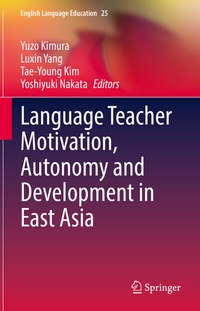
Language Teacher Motivation, Autonomy and Development in East Asia
1st Edition
Published on 16. May 2022
VIII, 226 pages
978-3-030-93467-5 (ISBN)
Description

This volume highlights unique features of L2 teachers' motivation, autonomy and career development in Far East counties (including Japan, South Korea and China), using diverse methodological research approaches incorporating both quantitative and qualitative paradigms. While much of current research focuses on students' psychology, this volume looks into EFL teachers' motivation and autonomy. Both discussions of theoretical issues of teacher motivation and autonomy and practical, classroom-based investigations are included and written to appeal to researchers, as well as applied teacher audiences. The theoretical chapters give readers a solid grounding in the issues of interest to the field. The practical chapters offer cutting edge insights and can also serve as templates on which postgraduate and postdoctoral researchers can base future studies. This helps the book to offer a dual service to the research community, addressing both issues of theorization of research and the practice of conducting research investigations.
More details
Series
Language
English
Place of publication
Cham
Switzerland
Publishing group
Springer International Publishing
Target group
Professional and scholarly
Product notice
Reflowable
Illustrations
VIII, 226 p. 1 illus.
File size
3,34 MB
ISBN-13
978-3-030-93467-5 (9783030934675)
DOI
10.1007/978-3-030-93467-5
Schweitzer Classification
Other editions
Additional editions
Yuzo Kimura | Luxin Yang | Tae-Young Kim
Language Teacher Motivation, Autonomy and Development in East Asia
Book
05/2022
Springer
€160.49
Shipment within 7-9 days
Persons
Yuzo Kimura, a professor of English language teaching at the School of Medicine, University of Toyama, Japan, is interested in L2 teaching and learning motivation in three countries in the Far East. He is a long-time government-fund recipient and has been conducting longitudinal fieldwork studies at three sites in Japan, China and South Korea.
Yoshiyuki Nakata is a Professor of English Language Education in the Faculty of Global Communications at Doshisha University, Kyoto, Japan. He has been involved mainly in in-service (as well as pre-service) language teacher education in Japan for over a quarter century. His research interests include self-regulated language learning, language learning motivation, learner/teacher autonomy in the school context and language teacher education.
Luxin Yang is a Professor of Applied Linguistics in the National Research Centre for Foreign Language Education and Graduate School of Education at Beijing Foreign Studies University, China. She has been involved in in-service and pre-service foreign language teacher education in China over a decade. Her research interests include foreign language teacher education, second language writing, and academic literacy development.
Tae-Young Kim is a Professor and Chair of the Department of English Education at Chung-Ang University, Seoul, South Korea. His main area of research interest is L2 learning/teaching (de)motivation particularly in the context of English as a foreign language. He has published over 180 academic journal articles and book chapters on L2 learning/teaching (de)motivation and recently published a book entitled Historical Development of English Learning Motivation Research: Cases of South Korea and Its Neighboring Countries in East Asia at Springer.Yoshiyuki Nakata is a Professor of English Language Education in the Faculty of Global Communications at Doshisha University, Kyoto, Japan. He has been involved mainly in in-service (as well as pre-service) language teacher education in Japan for over a quarter century. His research interests include self-regulated language learning, language learning motivation, learner/teacher autonomy in the school context and language teacher education.
Content
Chapter1.Introduction( Yuzo Kimura, Luxin Yang and Tae-Young Kim).- Part 1: Theoretical studies: chapter2. Complexity Theory as a Conceptual Framework for Language Phil HiverToward Teacher Autonomy: Encouraging Socially Shared Regulation in the Classroom ( Yoshiyuki Nakata ).- Chapter3. Shifts of Theoretical Paradigms in Second Language Teacher Education and Development: A Critical Review( Lian Zhang).- Part 2: Empirical studies L2 Teacher Motivation/Autonomy as Complex Systems: Chapter4. Across the Boundaries of L2 Classrooms in the Far East( Yuzo Kimura).- Chapter5.Dynamics of South Korean EFL Teachers' Initial Career Motives and Demotivation( Tae-Young Kim and Yongmi Kim).- Chapter6. Exploring the Impact of Group Lesson Discussions on Beliefs and Practices of Three High School EFL Teachers in China( Luxin Yang).- Chapter7. EFL Teacher Learning in Japan: Joining a Digital Technology Community of Practice( Keiko Sakui & Neil Cowie ).- Chapter8. From Darkness to Light: Teacher Immunity and the Emergence of Relatedness with Students ( Richard Sampson).- Chapter9. Teacher Enthusiasm: The Key to Unlocking Teacher and Student Motivation in the L2 Classrooms in East Asia( Peng DING).- Chapter10. Learning to Teach English Reading Through True Concept Formation: A Case Study of a Pre-service English Teacher's Professional Development ( Eunju Kim).- Chapter11. A Case Study of Teacher Autonomy in College English Classrooms(Lina Qian ).- Chapter12. Concluding Chapter (Magdalena Kubanyiova ).
