

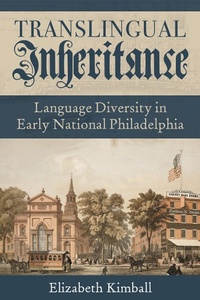
Translingual Inheritance
Language Diversity in Early National Philadelphia
Published on 16. March 2021
224 pages
978-0-8229-8813-7 (ISBN)
Description

Honorable Mention, 2022 Rhetoric Society of America Book Award
Translingual Inheritance tells a new story of the early days of democracy in the United States, when English had not yet become the only dominant language. Drawing on translingual theory, which exposes how language use contrasts with the political constructions of named languages, Elizabeth Kimball argues that Philadelphians developed complex metalinguistic conceptions of what language is and how it mattered in their relations. In-depth chapters introduce the democratically active communities of Philadelphia between 1750 and 1830 and introduce the three most populous: Germans, Quakers (the Society of Friends), and African Americans. These communities had ways of knowing and using their own languages to create identities and serve the common good outside of English. They used these practices to articulate plans and pedagogies for schools, exercise their faith, and express the promise of the young democracy. Kimball draws on primary sources and archival texts that have been little seen or considered to show how citizens consciously took on the question of language and its place in building their young country and how such practice is at the root of what made democracy possible.
Translingual Inheritance tells a new story of the early days of democracy in the United States, when English had not yet become the only dominant language. Drawing on translingual theory, which exposes how language use contrasts with the political constructions of named languages, Elizabeth Kimball argues that Philadelphians developed complex metalinguistic conceptions of what language is and how it mattered in their relations. In-depth chapters introduce the democratically active communities of Philadelphia between 1750 and 1830 and introduce the three most populous: Germans, Quakers (the Society of Friends), and African Americans. These communities had ways of knowing and using their own languages to create identities and serve the common good outside of English. They used these practices to articulate plans and pedagogies for schools, exercise their faith, and express the promise of the young democracy. Kimball draws on primary sources and archival texts that have been little seen or considered to show how citizens consciously took on the question of language and its place in building their young country and how such practice is at the root of what made democracy possible.
More details
Other editions
Additional editions
Book
03/2021
University of Pittsburgh Press
€53.50
Article not available at the moment
Person
Elizabeth Kimball is assistant professor of English at Drexel University. She is co-chair of the Philadelphia Writing Program Administrators, an affiliate of the Council of Writing Program Administrators. She is also a member of Rhetoric Society of America and the Conference on College Composition and Communication. Her work involves history, memory, language, and collaborative public life.
Content
- Intro
- Contents
- Acknowledgments
- 1. Learning to See a Translingual Past
- 2. Toward a Translingual Historiography
- 3. Language and Education among Philadelphia Germans: The Hermeneutics of Context
- 4. Quakerly Genres and the Language of Liberal Learning
- 5. African American Language: Sameness and Difference in the Democratic Space
- 6. Making and Doing Language History
- Notes
- References
- Index
