

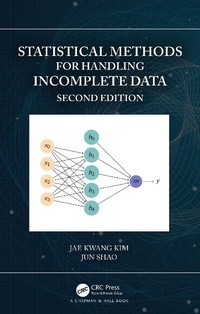
Statistical Methods for Handling Incomplete Data
2nd Edition
Published on 18. November 2021
380 pages
978-1-000-46629-4 (ISBN)
Description

Due to recent theoretical findings and advances in statistical computing, there has been a rapid development of techniques and applications in the area of missing data analysis. Statistical Methods for Handling Incomplete Data covers the most up-to-date statistical theories and computational methods for analyzing incomplete data.
Features
Uses the mean score equation as a building block for developing the theory for missing data analysis
Provides comprehensive coverage of computational techniques for missing data analysis
Presents a rigorous treatment of imputation techniques, including multiple imputation fractional imputation
Explores the most recent advances of the propensity score method and estimation techniques for nonignorable missing data
Describes a survey sampling application
Updated with a new chapter on Data Integration
Now includes a chapter on Advanced Topics, including kernel ridge regression imputation and neural network model imputation
The book is primarily aimed at researchers and graduate students from statistics, and could be used as a reference by applied researchers with a good quantitative background. It includes many real data examples and simulated examples to help readers understand the methodologies.
Features
Uses the mean score equation as a building block for developing the theory for missing data analysis
Provides comprehensive coverage of computational techniques for missing data analysis
Presents a rigorous treatment of imputation techniques, including multiple imputation fractional imputation
Explores the most recent advances of the propensity score method and estimation techniques for nonignorable missing data
Describes a survey sampling application
Updated with a new chapter on Data Integration
Now includes a chapter on Advanced Topics, including kernel ridge regression imputation and neural network model imputation
The book is primarily aimed at researchers and graduate students from statistics, and could be used as a reference by applied researchers with a good quantitative background. It includes many real data examples and simulated examples to help readers understand the methodologies.
Reviews / Votes
"As a general comment, I must say that it is probably one of the most extensive, detailed and complete sources of information on the most up-to-date methods to deal with missing data, from simple imputation methods to more complex analysis techniques that take missingness into account. The book is well organized in 12 chapters that although could be read independently based on the readers needs/interest, it does have a hierarchy that makes sense going from more simple early chapters to more complex subjects later in the book."~David Manteigas, ISCB Book Reviews
More details
Edition
2nd edition
Language
English
Place of publication
London
United Kingdom
Publishing group
Taylor & Francis Ltd
Target group
College/higher education
Illustrations
28 Tables, black and white; 6 Line drawings, black and white; 6 Illustrations, black and white
ISBN-13
978-1-000-46629-4 (9781000466294)
Copyright in bibliographic data and cover images is held by Nielsen Book Services Limited or by the publishers or by their respective licensors: all rights reserved.
Schweitzer Classification
Other editions
Additional editions
Jae Kwang Kim | Jun Shao
Statistical Methods for Handling Incomplete Data
Book
01/2024
2nd Edition
Chapman & Hall/CRC
€72.70
Shipment within 10-20 days
Jae Kwang Kim | Jun Shao
Statistical Methods for Handling Incomplete Data
Book
11/2021
2nd Edition
Chapman & Hall/CRC
€171.30
Shipment within 15-20 days
Persons
Jae Kwang Kim is a LAS dean's professor in the Department of Statistics at Iowa State University. He is a fellow of American Statistical Association (ASA) and Institute of Mathematical Statistics (IMS). He is the recipient of 2015 Gertude M. Cox award, sponsored by Washington Statistical Society and RTI international.
Jun Shao is a professor in the Department of Statistics at University of Wisconsin - Madison. He is a fellow of ASA and IMS, a former president of International Chinese Statistical Association and currently the founding editor of Statistical Theory and Related Fields.
Jun Shao is a professor in the Department of Statistics at University of Wisconsin - Madison. He is a fellow of ASA and IMS, a former president of International Chinese Statistical Association and currently the founding editor of Statistical Theory and Related Fields.
Content
1. Introduction
2. Likelihood-based Approach
3. Computation
4. Imputation
5. Multiple Imputation
6. Fractional Imputation
7. Propensity Scoring Approach
8. Nonignorable Missing Data
9. Longitudinal and Clustered Data
10. Application to Survey Sampling
11. Data Integration
12. Advanced Topics
2. Likelihood-based Approach
3. Computation
4. Imputation
5. Multiple Imputation
6. Fractional Imputation
7. Propensity Scoring Approach
8. Nonignorable Missing Data
9. Longitudinal and Clustered Data
10. Application to Survey Sampling
11. Data Integration
12. Advanced Topics
