

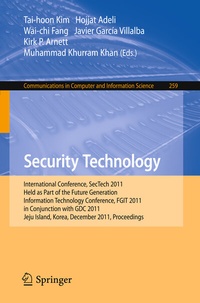
Security Technology
International Conference, SecTech 2011, Held as Part of the Future Generation Information Technology Conference, FGIT 2011, in Conjunction with GDC 2011, Jeju Island, Korea, December 8-10, 2011. Proceedings
Published on 2. December 2011
252 pages
978-3-642-27189-2 (ISBN)
Description

This book comprises selected papers of the International Conferences, SecTech 2011, held as Part of the Future Generation Information Technology Conference, FGIT 2011, in Conjunction with GDC 2011, Jeju Island, Korea, in December 2011.
The papers presented were carefully reviewed and selected from numerous submissions and focuse on the various aspects of security technology.
More details
Other editions
Additional editions
Tai-hoon Kim | Hojjat Adeli | Wai-Chi Fang
Security Technology
International Conference, SecTech 2011, Held as Part of the Future Generation Information Technology Conference, FGIT 2011, in Conjunction with GDC 2011, Jeju Island, Korea, December 8-10, 2011. Proceedings
Book
11/2011
Springer
€53.49
Shipment within 7-9 days
Content
- Intro
- Title page
- Foreword
- Preface
- Organization
- Table of Contents
- On Fast Private Scalar Product Protocols
- Introduction
- Private Scalar Product Protocols
- PSPPs with Cryptographic Primitives
- PSPPs with Linear Algebraic Techniques
- Insecurity of Protocol by Trinca and Rajasekaran
- Insecurity of Protocol by Amirbekyan and Estivill-Castro
- Conclusion
- References
- A Survey on Access Control Deployment
- Introduction
- Access Control Policies and Models
- Role-Based Access Control (RBAC)
- Usage Control (UCONABC)
- Risk-Based Access Control
- Enforcing Access Control with Flexibility
- Overriding Permissions
- Break-Glass Mechanism
- Violation Management
- Conclusion
- References
- Data Anonymity in Multi-Party Service Model
- Introduction
- Related Work
- Privacy Notion
- k-Anonymity
- l-Diversity
- Privacy Requirement
- Service Model
- Anonymization Table
- Multi-Party Service Model
- Proposal
- Adversary Model
- Approach
- Algorithm for Modification
- Concluding Remarks
- References
- A Noise-Tolerant Enhanced Classification Method for Logo Detection and Brand Classification
- Introduction
- Research Background
- Introduction to Logo Detection and Brand Classification
- The Design of the N-TEC Training Approach
- N-TEC Cascade Training System
- Stage Training Approach
- Training Adjustment Unit
- Stage Selection Optimization
- Experiments of Logo Detection and Brand Classification
- Conclusion
- Future Work
- References
- A Family Constructions of Odd-Variable Boolean Function with Optimum Algebraic Immunity
- Introduction
- Preliminaries
- Boolean Function
- Algebraic Immunity of Boolean Function
- The Concatenation Operation of Boolean Function
- The Transformation of Boolean Function
- Construction of Odd-Variable Boolean Function with Optimum Algebraic Immunity
- Examples and Further Work
- Conclusion
- References
- Design of a Modular Framework for Noisy Logo Classification in Fraud Detection
- Introduction
- Logo Detection Problem on Merchandise Images
- Framework and System Design
- Design of Internal Modules
- Segmentation
- Feature Description - Shape-Based
- Feature Description - Region-Based
- Multi-class Classifier - Support Vector Machine (SVM)
- Binary Class Classifier - Principal Component Analysis (PCA)
- Decision Algorithm
- Experiments
- Conclusion
- References
- Using Agent in Virtual Machine for Interactive Security Training
- Introduction
- Related Work
- System Requirements
- System Design and Implementation
- System Overview
- Security Design and Implementation
- Design and Implementation of Interactivity Support
- Platform Application Example
- Conclusion
- References
- Information Technology Security Governance Approach Comparison in E-banking
- Introduction
- Literature Review
- ITSG Approach Comparison
- Sherwood Applied Business Security Architecture
- Control Objectives for Information and Related Technology
- Capability Maturity Model
- ISO/IEC 27002:2005
- National Cyber Security Summit Task Force Corporate Governance Framework
- Basel Committee on Banking Supervision
- The Joint Forum
- Operationally Critical Threat, Asset and Vulnerability Assessment
- Conclusion
- References
- A Fast and Secure One-Way Hash Function
- Introduction
- Related Works
- Description of the Proposed Hash Function
- Bit Strings and Integers
- Operations on Words
- Message Padding
- Functions and Constants Used
- Computing the Message Digest
- Experimental Results
- Conclusions
- References
- CLAPTCHA- A Novel Captcha
- Introduction
- How Claptcha Works?
- Testing Our Claptcha
- Dos Attack v/s Claptcha
- Evaluation
- Conclusion
- References
- An Approach to Provide Security in Wireless Sensor Network Using Block Mode of Cipher
- Introduction
- Various Attacks on Wireless Sensor Network
- Denial of Service Attack
- Sinkhole Attack
- Wormhole Attack
- Sybil Attack
- Passive Information Gathering
- Security on Wireless Sensor Network
- Data Encryption Standard (DES)
- Encryption
- Key Generation
- Decryption in DES
- Blowfish Algorithm
- Encryption
- Decryption
- Cipher Block Chaining (CBC) Mode
- Results
- Based on Speed
- Based on Battery Consumption
- Conclusion
- References
- Microscopic Analysis of Chips
- Introduction
- Obtaining the Chips
- Decapsulation
- Chip Preparation
- Chip Package Decapsulation
- Process Results
- Other Methodologies of Decapsulation
- Introduction to Analysis
- Application
- Conclusion
- References
- An ID-Based Broadcast Signcryption Scheme Secure in the Standard Model
- Introduction
- Preliminaries
- Bilinear Pairings
- Complexity Assumptions
- ID-Based Broadcast Signcryption Scheme(IBBSC Scheme)
- Concrete IBBC Scheme
- Correctness
- Security
- Conclusions
- References
- Robust Audio Watermarking Scheme Based on Short Time Fourier Transformation and Singular Value Decomposition
- Introduction
- Short Time Fourier Transformation
- Singular Value Decomposition
- Proposed Watermarking Scheme
- Watermark Embedding Process
- Watermark Detection Process
- Simulation Results and Discussion
- Imperceptibility Test
- Robustness Test
- Conclusion
- References
- A Study on Domain Name System as Lookup Manager for Wireless/Mobile Systems in IPv6 Networks
- Introduction
- Related Work
- Standard Mobile IPv6 (MIPv6)
- DNS
- Reverse DNS Look-Up
- DNS Look-Up in MIPv6
- Advantages DNS Look-Up in MIPv6
- Conclusion
- References
- An Information-Theoretic Privacy Criterion for Query Forgery in Information Retrieval
- Introduction
- Background
- Statistical and Information-Theoretic Preliminaries
- Entropy and Divergence as Measures of Privacy
- Rationale behind the Maximum Entropy Method
- Measuring the Privacy of User Profiles
- Conclusion
- References
- A Distributed, Parametric Platform for Constructing Secure SBoxes in Block Cipher Designs
- Introduction
- Background
- Nonlinearity of a Boolean Function
- Strict Avalanche Criterion
- Bent Functions
- Distributed Sbox Construction
- Implementation of the Distributed Algorithm on a Computing Cluster
- Experimental Results
- Conclusions
- References
- Cryptanalysis of an Enhanced Simple Three-Party Key Exchange Protocol
- Introduction
- Review of Enhanced S-3PAKE Protocol
- Cryptanalysis of ES-3PAKE Protocol
- Undetectable On-Line Dictionary Attack 1
- Undetectable On-Line Dictionary Attack 2
- Off-Line Dictionary Attack
- Real Applications for the Proposed Dictionary Attacks
- Conclusions
- References
- An Effective Distance-Computing Method for Network Anomaly Detection
- Introduction
- A Distance-Computing Method
- Anomaly Detection Framework Based on TCM-KNN Algorithm
- Experimental Results
- Dataset and Preprocess
- Experimental Results
- Conclusions
- References
- Formalization and Information-Theoretic Soundness in the Development of Security Architecture for Next Generation Network Protocol - UDT
- Introduction
- Framework Objectives
- Contributions
- Overview
- HIP (Host Identity Protocol)
- CGA (Cryptographically Generated Addresses)
- Combination of HIP-CGA
- GSS-API (Generic Security Service Application Program Interface)
- DTLS - Data Transport Layer Security
- IPsec - Internet Protocol Security
- AO -Authentication Option
- Architecture
- Conclusion and Future Work
- References
- Bi-Layer Behavioral-Based Feature Selection Approach for Network Intrusion Classification
- Introduction
- An Overview
- Data Reduction: Feature Selection
- Information Gain
- Proposed Approach: Bi-Layer Behavioral-Based Feature Selection
- Experiments and Analysis
- Network Intrusion Dataset Characteristics
- Performance Measurements
- Bi-Layer Behavioral-Based Feature Selection Approach Results and Analysis
- Conclusion
- References
- A Parameterized Privacy-Aware Pub-sub System in Smart Work
- Introduction
- Related Works
- Context-Awareness in Smart Environment
- Publish/Subscribe System
- Parameterized Subscription
- System Architecture
- Parameterized Publish/Subscribe Subscription and Event
- Static Privacy-Aware Subscription
- Parameterized Privacy-Aware Subscription
- A Parameterized Privacy-Aware Event
- Conclusion
- References
- A Lightweight Access Log Filter of Windows OS Using Simple Debug Register Manipulation
- Introduction
- Related Work
- Proposed System Overview
- Modification of Windows OS
- Modificaiton of VMM
- DR Based VM Introspection
- Debug Register
- Modification of Debug Register Handler
- Transmission by Virtualized Register
- Byte-by-Byte Transmission
- Windows Kernel Space Modification
- DLL Injection
- Filter Driver
- Driver-Supplied Callback Function
- Registry Access Log Filter
- Experimental Results
- Performance Measurements
- Filtering Registry Access for Malware Infection
- Conclusions
- References
- Diversity-Based Approaches to Software Systems Security
- Introduction
- Diversity as a Software Security Enabler
- Diversity-Based Approaches to Software Security
- System Integration and Middlware
- SoftwareDiversity throughAutomatedProgramTransformations
- Dynamic Behavior Monitoring
- Towards a Diversity-Based Approach for Dynamic Generation of Lightweight Traces
- Conclusion
- References
- Author Index
