

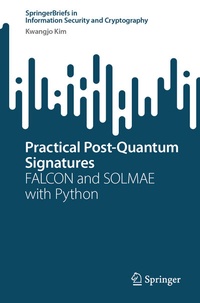
Practical Post-Quantum Signatures
Description

The current digital signature methods like RSA, DSA, and ECDSA are relatively simple to understand, and their signing and verification processes operate in comparable time frames. However, in the quantum computing era, cryptographic methods must be designed to withstand both classical and quantum attacks. This requires an in-depth understanding of advanced mathematical concepts like algebraic geometry, lattice theory, Gaussian sampling, and efficient polynomial computation techniques such as FFT and NTT, which are essential for lattice-based cryptosystems.
The FALCON algorithm, chosen as a finalist in the NIST Post-Quantum Cryptography (PQC) standardization project, is a lattice-based, hash-and-sign digital signature scheme known for its efficiency and compactness compared to other quantum-resistant signatures like Dilithium and SPHINCS+. Following FALCON's development, the SOLMAE algorithm was introduced in 2021, offering a simplified signing process within the same GPV framework and also implemented in Python for easier accessibility.
This monograph provides a practical and educational introduction to post-quantum digital signatures, focusing on the FALCON and SOLMAE algorithms. The material aims to bridge the gap between theory and practice, offering hands-on knowledge of post-quantum cryptographic techniques. With a focus on clear, practical examples using Python, this book is a valuable resource for anyone looking to understand or implement quantum-secure digital signatures.
More details
Other editions
Additional editions
Person
Professor Kwangjo Kim, an influential figure in cryptography, earned his B.Sc. and M.Sc. from Yonsei University and a Ph.D. from Yokohama National University. He worked at ETRI from 1979 to 1997 and held visiting professorships at prestigious institutions like MIT and UCSD. After his retirement from KAIST in 2021, where he had served since 1998, he became President of the International Research Institute for Cyber Security (IRCS) and remains an Emeritus Professor at KAIST. Professor Kim has been a key contributor to the global cryptographic community, notably serving as a board member of the IACR, chairing the Asiacrypt Steering Committee, and organizing multiple high-profile conferences. Honored as the first Korean IACR Fellow, he co-authored key texts on deep learning and privacy-preserving technologies and was recognized among Stanford's Top 2% of Scientists in 2023. He has significantly advanced post-quantum cryptography with the development of the SOLMAE signature scheme and boasts an H-index of 48 with over 10,000 citations. His research spans cryptography, cybersecurity, and applications, with numerous patents to his name.Currently, appointment as, Adjunct Faculty at Cleveland State Univ, Ohio, USA from FY2025 to FY2028.
Content
Chapter.1. Introduction.- Chapter.2. Notations and Definitions.- Chapter.3. Falcon Algorithm.- Chapter 4. SOLMAE Algorithm.- Chapter.5. Basics of Python.- Chapter.6.Checking Falcon with Python.- Chapter.7.Checking SOLMAE with Python.- Chapter.8 Concluding Remarks.
