

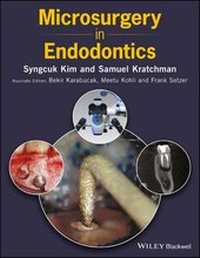
Microsurgery in Endodontics
Description

More details
Other editions
Additional editions
Persons
Content
Contributors xiii
Preface xv
Acknowledgements xvii
1 The Dental Operating Microscope 1
Frank Setzer
1.1 Benefits of the Operating Microscope 1
1.2 Key Features of Operating Microscopes 1
1.3 Customizing a Microscope 3
1.3.1 Light Source 3
1.3.2 Documentation 5
1.3.3 Individual Microscope Adjustment (Parfocaling) 5
Suggested Readings 7
2 Microsurgical Instruments 9
SeungHo Baek and Syngcuk Kim
2.1 Examination Instruments 9
2.2 Incision and Elevation Instrument 9
2.3 Tissue Retraction Instruments 11
2.4 Osteotomy Instruments 14
2.5 Curettage Instruments 14
2.6 Inspection Instruments 15
2.7 Ultrasonic Units and Tips for Root End Preparation 17
2.8 Microplugger Instruments 20
2.9 Suturing Instruments 20
2.10 Miscellaneous Instruments 22
3 Medication-Related Osteonecrosis of the Jaw and Endodontic Microsurgery 25
Chafic Safi and Bekir Karabucak
Suggested Readings 29
4 Indications and Contraindications 31
Bekir Karabucak and Garrett Guess
4.1 Introduction 31
4.2 Surgical Success Dependent on Ability to Perform Ideal Protocols 31
4.3 Etiology Assessment through Examination and Treatment 31
4.4 Periodontal Considerations and Surgery 33
4.5 Influential Patient Factors 33
4.6 Condition of Previous Endodontic Treatment 37
Suggested Readings 38
5 Anesthesia and Hemostasis 39
Siva Rethnam-Haug, Aleksander Iofin, and Syngcuk Kim
5.1 Armamentarium 39
5.1.1 Epinephrine 39
5.2 Presurgical Phase 40
5.2.1 Administration of Local Anesthetic 40
5.2.2 Injection Techniques 40
5.2.3 Topical Anesthesia 41
5.2.4 Additional Techniques 41
5.2.5 Maxillary Anesthesia 41
5.2.6 Mandibular Anesthesia 43
5.2.7 Bilateral Mandibular Surgery 43
5.3 Surgical Phase 44
5.3.1 Topical Hemostatic Agents 44
5.3.1.1 Epinephrine Pellets 45
5.3.1.2 Ferric Sulfate 45
5.4 Summary of Hemostatic Techniques in Endodontic Microsurgery 46
5.5 Postsurgical Phase 46
Suggested Readings 48
6 Flap Design in Endodontic Microsurgery 49
Francesco Maggiore and Frank Setzer
6.1 Armamentarium 49
6.1.1 Flap Outline 49
6.1.2 Papilla Management 52
6.1.3 Incision 54
6.1.4 Flap Elevation 54
6.1.5 Flap Retraction 55
Suggested Readings 56
7 Osteotomy 57
Francesco Maggiore and Syngcuk Kim
7.1 Armamentarium 57
7.2 Osteotomy 57
7.2.1 Distinction between Bone and Root Tip 57
7.2.2 Clinical Situations for Endodontic Microsurgery 58
7.3 Intact Cortical Plate without a Radiographic Periapical Lesion 59
7.4 Intact Cortical Plate with a Periapical Lesion 60
7.5 Fenestration through the Cortical Plate Leading to the Apex 60
7.5.1 Optimal Osteotomy Size 61
7.5.2 Key Hole Osteotomy Modification 61
7.5.3 BoneWindow Technique 61
8 Root End Resection 67
Spyros Floratos, Fouad Al-Malki, and Syngcuk Kim
8.1 Armamentarium 67
8.2 Root End Resection 67
8.3 Root End Resection: Steep Bevel versus Shallow Bevel 69
Suggested Readings 72
9 Inspection of the Resected Root Surface: Importance of Isthmus 73
Spyros Floratos, Jorge Vera, Fouad Al-Malki, and Syngcuk Kim
9.1 Armamentarium 73
9.1.1 Methylene Blue Staining (MBS) 73
9.1.2 Isthmus 77
9.1.3 Types of Isthmus 77
9.1.4 Incidence 77
9.1.5 Histological Findings of Isthmus 79
9.1.6 Clinical Significance and Management 81
Suggested Readings 82
10 Ultrasonic Root End Preparation 83
Spyros Floratos and Syngcuk Kim
10.1 Armamentarium 83
Suggested Readings 89
11 MTA and Bioceramic Root End Filling Materials 91
Sujung Shin, Ian Chen, Bekir Karabucak, SeungHo Baek, and Syngcuk Kim
11.1 Mineral Trioxide Aggregate (MTA) 92
11.1.1 Advantages of MTA 92
11.1.1.1 Sealing Ability 92
11.1.1.2 Biocompatibility and Bioactivity 92
11.1.2 Drawbacks of MTA 93
11.2 Bioceramics 93
11.3 MTA and Bioceramic Application During Apicoectomy 95
11.4 Other Types of Cements for Root End Filling 96
11.4.1 Intermediate Restorative Material (IRM) 97
11.4.2 Super Ethoxybenzoic Acid (SuperEBA) 97
11.4.3 Geristore and Retroplast 98
11.4.4 New Types of Cements for Root End Filling 98
Suggested Readings 98
12 Flap Reposition and Suturing 101
Francesco Maggiore and Meetu Kohli
12.1 Suture Removal 101
Suggested Readings 111
13 PeriapicalWound Healing 113
Ingrida Dapkute, Georges Bandelac, Chafic Safi, and Frank Setzer
13.1 Principles ofWound Healing 113
13.2 Healing after Apical Microsurgery 113
13.3 Incomplete Healing/Scar Formation 113
13.4 Evaluation of Healing after Apical Surgery 114
13.5 Healing Evaluation Using CBCT 115
Suggested Readings 118
14 Cone Beam Computed Tomography 119
Garrett Guess, Fouad Al-Malki,Meetu Kohli, Bekir Karabucak, and Samuel Kratchman
14.1 How CBCT Works 120
14.2 Indications and Clinical Applications 120
Suggested Readings 142
15 Mental Nerve Management 143
Paula Mendez-Montalvo, Fouad Al-Malki, and Syngcuk Kim
15.1 Armamentarium 143
15.1.1 Mental Foramen and Nerve 143
15.1.1.1 Location 143
15.1.1.2 Anterior Loop 143
15.1.1.3 Number of Mental Foramina 144
15.1.2 Mental Foramen Detection on Radiographs 144
15.1.2.1 Periapical Radiograph 144
15.1.2.2 Panoramic Films 145
15.1.2.3 Cone Beam Computed Tomography (CBCT) 145
15.1.3 Neurosensory Alteration 145
15.1.3.1 Surgical Technique to Avoid Iatrogenic Mental Nerve Trauma and Injury 146
15.1.4 Groove Technique Using Piezoelectric Surgery 146
Suggested Readings 150
16 Maxillary Posterior Surgery, the Sinus, andManaging Palatal Access 151
Garrett Guess and Samuel Kratchman
16.1 Maxillary Premolars 151
16.1.1 Access 151
16.1.2 Instrumentation 151
16.2 Sinus Exposure 151
16.3 Maxillary First Molars 153
16.3.1 Access 153
16.3.2 Palatal Approach 155
16.4 Second Molars 159
16.4.1 Periodontal Aspects 161
Suggested Readings 162
17 Surgical Root Perforation Repair 163
Raed Kasem, Samuel Kratchman, and Meetu Kohli
17.1 Possible Challenges to Non-surgical Perforation Repair 163
17.2 Factors that Enhance Positive Long-Term Prognosis for Perforation Repair 164
17.3 Surgical Perforation Repair Techniques 166
17.4 Surgical Treatment for External Root Resorption 168
Suggested Readings 177
18 Intentional Replantation 179
David Li and Samuel Kratchman
18.1 Armamentarium 179
18.1.1 Success Rate 179
18.1.2 Indications 179
18.1.3 Replantation or Apicoectomy 179
18.1.4 Extraction 182
18.1.5 Extraoral Phase 183
18.1.6 Storage Medium 183
18.1.7 Replantation 183
18.1.8 Splinting 185
18.1.9 Postop Instructions 186
18.1.10 Cone Beam CT Scan 186
18.1.11 Repairing Procedural Mishaps 186
Suggested Readings 191
19 Guided Tissue Regeneration in Endodontic Microsurgery 193
Garrett Guess and Samuel Kratchman
Suggested Readings 202
20 Implants versus Endodontic Microsurgery 205
Frank Setzer and Syngcuk Kim
20.1 Historical Perspective 205
20.2 Benefits of Implants 205
20.3 Long-Term Prognosis of Dental Implants 205
20.4 Implant Complications 206
20.5 Long-Term Prognosis of Endodontically Treated Teeth with Root End Surgery 207
20.6 Conclusion 209
Suggested Readings 210
21 Prognosis of Endodontic Microsurgery 213
Meetu Kohli and Euiseong Kim
21.1 Best Available Evidence 213
21.2 Parameters for Success: Clinical and Radiographic 2D 214
21.3 Parameters for Success: "Penn 3D Criteria" for Assessing Healing on CBCT 215
21.4 Reversal of Success 215
21.5 TraditionalMethods 217
21.6 Modern Technique versus the Complete Microsurgical Approach 218
21.7 Root End Filling Materials 218
21.8 Case Selection 219
21.9 Resurgery 219
21.10 Summary 219
Suggested Readings 219
22 Positioning 221
Samuel Kratchman and Syngcuk Kim
22.1 Armamentarium 221
Suggested Readings 226
Index 227
1
The Dental Operating Microscope
Frank Setzer
Key Concepts
- Parts and functions of the dental operating microscope.
- Advancements in dental microscopy.
- Applications of the dental operating microscope in endodontic microsurgery.
- Individual adaptation of the dental operating microscope (parfocaling).
Endodontic therapy is performed in a naturally dark and confined working space. Operating microscopes were introduced into Endodontics in the early 1990s, and then into endodontic specialty programs in the United States. Since then, operating microscopes have become widely accepted by endodontists and are also increasingly being used by other specialists. The American Association of Endodontists made teaching the operating microscope a required standard for postgraduate endodontic education in 1998. The standard now requires the instruction in using magnification devices "beyond the scope of head worn magnification devices", at an in-depth level, which is the highest of the levels of knowledge described by CODA.
Higher magnification was demonstrated to significantly increase the successful outcome of endodontic surgery. Both the operating microscope and endo-scope provide appropriate magnification and illumination that is required to perform surgical and non-surgical endodontic procedures with high success rates. Moreover, from an ergonomic perspective, a microscope can allow the clinician to maintain an upright position, which can help avoid long-term back and neck problems that may range from general discomfort to disability (see Chapter 22).
1.1 Benefits of the Operating Microscope
Loupes and microscopes offer different ranges of magnification (Figure 1.1). An increase in magnification decreases the focal depth. Wearing loupes, especially at magnifications higher than ×4, requires the practitioner to stay in a narrow range from the object to stay in focus. In contrast, even at high magnifications, a microscope remains stable and the practitioner can work in an upright and ergonomically non-stressful position. Moreover, microscope use reduces strain on eye muscles, fatigue, and soreness compared to loupes. Through a microscope the light reaching the left and right eyes appears to be essentially parallel, achieving the effect of far distance observation (Figure 1.2) and avoiding short accommodation stress as with the naked eye. Binoculars of loupes and thus the viewing direction are convergent, resulting in similar eye strain. In addition, microscopes provide imaging virtually free of shadows, allowing excellent image quality for clinical operations and documentation.
Figure 1.1 Comparison of magnification ranges: loupes versus microscopes.
Figure 1.2 Comparison of ocular angles and viewing directions of loupes and microscope.
Figure 1.3 Key microscope features (Penn Dental Endodontic Clinic).
1.2 Key Features of Operating Microscopes
Basic components of an operating microscope are binoculars, microscope body with magnification and fine focus adjustments, and a light source (Figure 1.3). Depending on usage and preferences of the practitioner, a microscope can be further configured to individual specifications. For non-surgical and surgical endodontics, different magnification ranges are required (Table 1.1). In addition, surgical procedures will require more angulations to view resected root surfaces and other anatomical details. At a minimum, a microscope being used for surgical endodontics should be equipped with 180°-tiltable binoculars to address the angulation requirements and an eyepiece with a reticle. A reticle is a set of fine lines that provide proper centering on the object in focus and allows for individual calibration (parfocaling) of the microscope, most commonly in the shape of cross-hairs or concentric rings.
Table 1.1 Recommended magnification ranges for different stages of non-surgical and surgical endodontic treatment.
Non-surgical Endodontics Surgical Endodontics Low Magnification ~ ×5-8× -Orientation
Inspection of surgical site
Initial osteotomy
Ultrasonic tip alignment
Suturing (6.0+)
Suture removal
Mid Magnification ~ ×8-×16Access
Orifice identification
Fracture identification
Obturation
Hemostasis
Tissue removal
Root tip identification
Root tip resection
Root surface inspection
Root end preparation
Root end filling
Root amputation
High Magnification ~ ×16-×30Orifice identification
Fracture identification
Calcified canal location
Identification of fine anatomical details
Documentation
Root surface inspection
Root end preparation inspection
Root end filling inspection
Identification of fine anatomical details
Documentation
1.3 Customizing a Microscope
Microscopes are available as floor-standing, wall- or ceiling-mounted units, depending on personal preferences and possible locations in the operatory. Modern microscope innovations allow for upgrades or modifications of standard microscopes. For example, in the past, a microscope was delivered with a fixed focal distance, typically 200 mm, 250 mm, or 300 mm, depending on the height of the practitioner and his or her most comfortable and appropriate working position. However, top of the line microscopes today include a variable focal distance that can be adjusted to practitioner and patient, often in conjunction with electrical zoom and fine focus options that allow smooth and step-less adjustments of both magnification and focus. Recently, mechanical focal distance adjusters were introduced to upgrade microscopes with a fixed focal distance (Figure 1.4).
Figure 1.4 Variable focal distance adjuster (ZEISS Varioskop®; Penn Dental Endodontic Clinic).
Optional ergonomic upgrades allow a left/right swivel of the main body of the microscope. This will allow the practitioner to tilt the microscope in a vertical angulation without changing the horizontal level of the eyepieces. In particular, for endodontic surgery, this is a valuable feature to observe root tips and resected root surfaces in the posterior arches. Other major potential upgrades include extendable (foldable) binoculars for better visualization and ergonomics (Figure 1.3), magnetic arrest functions (clutch) for increased stability, as well as different light sources and documentation options, which are described in greater detail in Figure 1.5).
Figure 1.5 Top of the line microscope with electrical zoom, fine focus, and magnetic arrest functions, 3-chip HD video camera (TRIO 610) attached to right documentation port (ZEISS PROergo; Penn Dental Endodontic Clinic, Surgical Suite).
1.3.1 Light Source
Halogen lighting was the first dental microscope light source introduced. It is still available for standard applications and basic microscopes and displays a yellowish hue. Xenon and the more recent LED light sources were developed to deploy better illumination to the operating field. All three light sources differ from each other in light intensity, peak wavelengths, color temperature, heat emission, and lifetime.
Xenon light sources appear almost as natural as daylight while providing the highest light intensity. This ensures the best illumination for fine anatomical details and allows shorter documentation exposure times, which will provide sharper images.
LED light sources are similar to xenon in color temperature and appear close to natural daylight. In comparison to xenon and halogen the heat emission from LED radiates from the back of the light source, resulting in a greatly reduced temperature surrounding the microscope. Table 1.2 provides an overview of the light spectra, appearance, color temperatures, intensities, and average lifetimes of the three light sources. Most microscopes provide additional orange and green filters for restorative work or surgical procedures with increased blood flow. Recent developments include depolarization and daylight UV filters, as well as fluorescence for caries detection.
Table 1.2 Comparison of microscope light sources.
Xenon LED Halogen Light spectrum range and peak(s) Homogenous spectrum from 400 to 700 nm Green part of emission spectrum under represented Peaks: 450 nm and 550 nm Peak: 600-700 nm Appearance Like daylight Comparable to xenon Yellowish...