

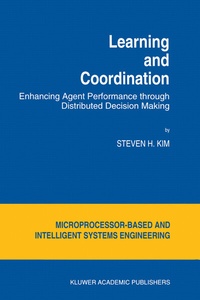
Learning and Coordination
Enhancing Agent Performance through Distributed Decision Making
Published on 6. December 2012
XII, 188 pages
978-94-011-1016-7 (ISBN)
Description

Intelligent systems of the natural kind are adaptive and robust: they learn over time and degrade gracefully under stress. If artificial systems are to display a similar level of sophistication, an organizing framework and operating principles are required to manage the resulting complexity of design and behavior.
This book presents a general framework for adaptive systems. The utility of the comprehensive framework is demonstrated by tailoring it to particular models of computational learning, ranging from neural networks to declarative logic.
The key to robustness lies in distributed decision making. An exemplar of this strategy is the neural network in both its biological and synthetic forms. In a neural network, the knowledge is encoded in the collection of cells and their linkages, rather than in any single component. Distributed decision making is even more apparent in the case of independent agents. For a population of autonomous agents, their proper coordination may well be more instrumental for attaining their objectives than are their individual capabilities.
This book probes the problems and opportunities arising from autonomous agents acting individually and collectively. Following the general framework for learning systems and its application to neural networks, the coordination of independent agents through game theory is explored. Finally, the utility of game theory for artificial agents is revealed through a case study in robotic coordination.
Given the universality of the subjects -- learning behavior and coordinative strategies in uncertain environments -- this book will be of interest to students and researchers in various disciplines, ranging from all areas of engineering to the computing disciplines; from the life sciences to the physical sciences; and from the management arts to social studies.
This book presents a general framework for adaptive systems. The utility of the comprehensive framework is demonstrated by tailoring it to particular models of computational learning, ranging from neural networks to declarative logic.
The key to robustness lies in distributed decision making. An exemplar of this strategy is the neural network in both its biological and synthetic forms. In a neural network, the knowledge is encoded in the collection of cells and their linkages, rather than in any single component. Distributed decision making is even more apparent in the case of independent agents. For a population of autonomous agents, their proper coordination may well be more instrumental for attaining their objectives than are their individual capabilities.
This book probes the problems and opportunities arising from autonomous agents acting individually and collectively. Following the general framework for learning systems and its application to neural networks, the coordination of independent agents through game theory is explored. Finally, the utility of game theory for artificial agents is revealed through a case study in robotic coordination.
Given the universality of the subjects -- learning behavior and coordinative strategies in uncertain environments -- this book will be of interest to students and researchers in various disciplines, ranging from all areas of engineering to the computing disciplines; from the life sciences to the physical sciences; and from the management arts to social studies.
More details
Other editions
Additional editions
Book
10/2012
Springer
€160.49
Shipment within 15-20 days
Book
09/1994
Kluwer Academic Publishers
€160.49
Shipment within 15-20 days
Content
1 Introduction and Framework.- General Framework for Learning Systems.- Application to Production-Rule Systems.- Application to Neural Networks.- Explicit vs. Implicit Representation.- Software Structure.- Illustrative Applications.- Discussion.- Scope of the Book.- References.- 2 Learning Speed in Neural Networks.- Neural Nets.- Biological Systems.- Conclusion.- References.- 3 Principles of Coordination.- Limitations of Centralized Control.- Decentralization based on Explicit Valuation.- Games and Strategies.- Deadlock among Independent Systems.- Concurrent Design.- Cooperative Systems.- Characteristic Functions.- Imputations.- Essential and Inessential Games.- Strategic Equivalence.- Zero Game.- Binary Game.- Geometric Interpretation.- Games with Few Players.- Dominance of Imputations.- Core of a Game.- Examples of Cores.- Solution Principles.- Assumptions of the Shapley Solution.- Properties of Shapley Vector.- Application to Supervisor and Workers.- Learning systems and Nested Agents.- Conclusion and discussion.- References.- 4 Case Study in Coordination.- Analytical models.- Simulation Model.- Simulation Specifics.- Deployment Rules.- Conclusion.- References.- 5 Conclusion.- Summary.- Implications.- Appendix Dynamic Models in Statistical Physics.- Emergence.- Statistical Mechanics.- Use of the Exponential Distribution.- References.
