


Interpreting Korean Communication and Narrative
Description

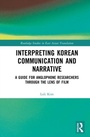
Interpreting Korean Communication and Narrative presents a ground-breaking framework for the cross-cultural analysis of Korean multimodal communication and narrative within its own cultural and linguistic contexts.
By combining rigorous formal methods rooted in Segmented Discourse Representation Theory (SDRT) with culturally grounded Korean socio-pragmatic primitives, the book provides Anglophone (culturally Western) researchers with the tools to decode the intricate interplay of verbal, non-verbal, and prosodic modalities that shape meaning in Korean narrative. Through extensive analysis and data collection of 169 extracts from South Korean films, this study shows how these socio-pragmatic expressions function systematically within Korean social hierarchies and cultural contexts, revealing conventions of communication which are often invisible to foreign viewers. The development of the Korean Segmented Film Discourse Representation Theory (K-SFDRT) and its system of graphical representation in Korean Segmented Film Discourse Structures (K-SFDRS) represents a major advance in multimodal research, offering a formal, replicable, and culturally contextualised methodology that decolonises research of Korean media, arts, and communication. It sets a new standard for multimodal research, providing a pioneering approach to understanding the dynamics of narrative and interaction in culturally rich contexts.
Making visible the role of multimodal honorifics in South Korean narrative cohesion, Interpreting Korean Communication and Narrative offers key insights to researchers and graduate students of film, translation, Korean studies, and multimodal communication.
More details
Other editions
Additional editions
Person
Loli Kim lectures on Korean and East Asian popular culture and media at the University of Oxford, UK, where she completed her DPhil and Postdoctoral Research in East Asian and Middle Eastern Studies, and at Oxford Brookes University. Dr Kim is also Lecturer in Film Production at the SAE Institute in London. She is a multimodalist, with much of her work concerned with the semantics and pragmatics of East Asian communication, spanning linguistics, gesture, media, and its translation.
Content
Prologue
1. INTRODUCTION
2. THE LOGIC OF KOREAN FILM DISCOURSE INTERPRETATION
3. SOCIO-PRAGMATIC PRIMITIVES IN ANALYSIS
4. COMPARATIVE ANALYSIS SFDRS AND K-SFDRS
5. CONCLUSION AND OUTLOOK
