

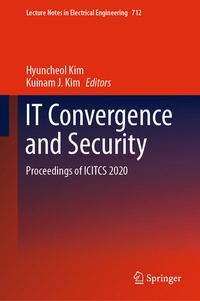
IT Convergence and Security
Description

This volume comprises the proceedings of ICITCS 2020. It aims to provide a snapshot of the latest issues encountered in IT convergence and security. The book explores how IT convergence and security is core to most current research, industrial and commercial activities. Topics covered in this volume include machine learning & deep learning, communication and signal processing, computer vision and applications, future network technology, artificial intelligence and robotics, software engineering and knowledge engineering, intelligent vehicular networking and applications, healthcare and wellness, web technology and applications, internet of things, and security & privacy. Through this volume, readers will gain an understanding of the current state-of-the-art information strategies and technologies in IT convergence and security. The book will be of use to researchers in academia, industry and other research institutes focusing on IT convergence and security.
More details
Other editions
Additional editions
Persons
Hyuncheol Kim is a Professor in the Department of Computer Science at Nam Seoul University, Korea. He is the Associate Editor of Software Networking Journal. He received his B.S., M.S., and Ph.D. degrees in Computer Engineering from Sungkyunkwan University, Korea. His research interests include mobile and wireless networking, software-defined networking (SDN), and network function virtualization (NFV) and artificial intelligence.
Kuinam J. Kim is a Professor and Chairman of the Convergence Security Department at Kyonggi University, Korea. He is the founding Editor-in-Chief of Software Networking and the Journal of Industrial Engineering and Management Science. He is currently on the advisory editorial board of the Convergence Security Journal. His research interests include cloud computing, wireless and mobile computing, digital forensics, video surveillance, information and convergence security. He has published extensively in these areas and received several journal and conference best paper awards. He received his B.S. degree in Mathematics from the University of Kansas. He earned his Ph.D. in Industrial Engineering from Colorado State University in 1994. He is the Executive General Chair of the Institute of Creative and Advanced Technology, Science, Engineering (ICATSE). He is a senior member of the IEEE.
Content
Machine Learning & Deep Learning.- Communication and Signal Processing.- Computer Vision and Applications.- Future Network Technology.- Artificial Intelligence and Robotics.- Software Engineering and Knowledge Engineering.- Intelligent Vehicular Networking and Applications.- Healthcare and Wellness.- Web Technology and Applications.- Internet of Things.- Security and Privacy
