

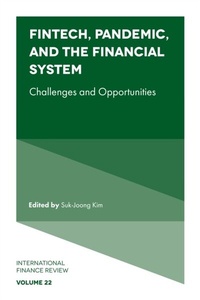
Fintech, Pandemic, and the Financial System
Challenges and Opportunities
1st Edition
Published on 17. January 2023
384 pages
978-1-80262-947-7 (ISBN)
Description

Financial institutions are facing unprecedented challenges brought on by the coronavirus Pandemic, less than a decade after recovering from the Global Financial Crisis and the Eurozone debt crisis. The causes of these challenges differ greatly from the previous crises that financial institutions, to a large extent, had contributed to. The current challenges were exogenous and unpredictable, and their consequences will reshape the financial system architecture around the world.
Fintech, once dismissed as no more than a novel approach to servicing the segment of the population often overlooked by established financial intermediaries, is now challenging the traditional models of commercial and investment banking. The inevitable future introduction of digital currencies that could replace national currencies in many business transactions has the potential to fundamentally change the business models of financial institutions and how the financial system functions. Volume 22, Fintech, Pandemic, and the Financial System, examines systemic challenges faced by a wide range of financial market participants and the continued disruptions introduced by financial innovations (Fintech).
International Finance Review publishes theme-oriented volumes on various issues in international finance, such as international business finance, international investment and capital markets, global risk management, international corporate governance and institution, currency markets, emerging market finance, international economic integration, and related issues.
Fintech, once dismissed as no more than a novel approach to servicing the segment of the population often overlooked by established financial intermediaries, is now challenging the traditional models of commercial and investment banking. The inevitable future introduction of digital currencies that could replace national currencies in many business transactions has the potential to fundamentally change the business models of financial institutions and how the financial system functions. Volume 22, Fintech, Pandemic, and the Financial System, examines systemic challenges faced by a wide range of financial market participants and the continued disruptions introduced by financial innovations (Fintech).
International Finance Review publishes theme-oriented volumes on various issues in international finance, such as international business finance, international investment and capital markets, global risk management, international corporate governance and institution, currency markets, emerging market finance, international economic integration, and related issues.
More details
Series
Language
English
Place of publication
Bingley
United Kingdom
Target group
Professional and scholarly
File size
10,98 MB
ISBN-13
978-1-80262-947-7 (9781802629477)
Copyright in bibliographic data and cover images is held by Nielsen Book Services Limited or by the publishers or by their respective licensors: all rights reserved.
Schweitzer Classification
Other editions
Additional editions
Book
01/2023
Emerald Publishing Limited
€162.30
Shipment within 3-4 weeks
Person
Suk-Joong Kim is Professor of International Finance and Banking at the Discipline of Finance, The University of Sydney Business School, The University of Sydney, NSW, Australia.
Content
Part I: An Overview
Chapter 1. An overview of fintech, pandemic and the financial system: Challenges and opportunities; Suk-Joong Kim
Part II: Fintech and Pandemic
Chapter 2. Banks' patenting as an answer to emerging fintech and bigtech competition: A cross-country empirical study; Oskar Kowalewski and Pawel Pisany
Chapter 3. Digital financial inclusion: its role in mitigating GDP losses during the pandemic; Chen Zheng and Zhiyue Sun
Chapter 4. The role fintech in the PPP Program; Blake Rayfield, Hasib Ahmed, Nicolas Duvernois, and Lois Rayfield
Chapter 5. Gender gap in consumer loan performance: Evidence from fintech lending in an emerging economy; Tanseli Savaser, Murat Tinic, Gunseli Tumer-Alkan, and Hakki Deniz Karaman
Part III: Cryptocurrency and the Financial System
Chapter 6. Cryptocurrencies meet equities: Risk factors and asset pricing relationships; Victoria Dobrynskaya and Mikhail Dubrovskiy
Chapter 7. Got crypto? Evidence from Markowitz, Kataoka, and conditional Value-at-Risk models; Lanqing Du, Jinwook Lee, Namjong Kim, Paul Moon Sub Choi, and Matthew J. Schneider
Chapter 8. International financial regulation of cryptoassets and Asset-Backed Tokens; Sylvia Gottschalk
Part IV: Central Bank Digital Currency
Chapter 9. Central bank digital currencies: The motivation; Bert Van Roosebeke and Ryan Defina
Chapter 10. A review of the proposed Bank of England's 'Retail' central bank digital currency as a cryptocurrency competitor; Kelly-Ann Coulter
Chapter 11. The digital euro from a geopolitical perspective: Will Europe lag behind?; Philipp Sandner and Jonas Gross
Part V: Economy and the Financial System
Chapter 12. The journey of an exchange traded fund: Becoming a unicorn or zombie; Fei Gao and Bingqiao Li
Chapter 13. Does finance benefit society? Financial sector size and labour market performance; Marc Steffen Rapp and Iuliia Udoieva
Chapter 14. On the effectiveness of capital controls: A synthetic control method approach; Meng-Ting Chen and Richard J Nugent III
Chapter 15. Determinants in the development of financial centers: Evolution around the world; Giang Phung, Ha Truong, and Hai Hong Trinh
Chapter 1. An overview of fintech, pandemic and the financial system: Challenges and opportunities; Suk-Joong Kim
Part II: Fintech and Pandemic
Chapter 2. Banks' patenting as an answer to emerging fintech and bigtech competition: A cross-country empirical study; Oskar Kowalewski and Pawel Pisany
Chapter 3. Digital financial inclusion: its role in mitigating GDP losses during the pandemic; Chen Zheng and Zhiyue Sun
Chapter 4. The role fintech in the PPP Program; Blake Rayfield, Hasib Ahmed, Nicolas Duvernois, and Lois Rayfield
Chapter 5. Gender gap in consumer loan performance: Evidence from fintech lending in an emerging economy; Tanseli Savaser, Murat Tinic, Gunseli Tumer-Alkan, and Hakki Deniz Karaman
Part III: Cryptocurrency and the Financial System
Chapter 6. Cryptocurrencies meet equities: Risk factors and asset pricing relationships; Victoria Dobrynskaya and Mikhail Dubrovskiy
Chapter 7. Got crypto? Evidence from Markowitz, Kataoka, and conditional Value-at-Risk models; Lanqing Du, Jinwook Lee, Namjong Kim, Paul Moon Sub Choi, and Matthew J. Schneider
Chapter 8. International financial regulation of cryptoassets and Asset-Backed Tokens; Sylvia Gottschalk
Part IV: Central Bank Digital Currency
Chapter 9. Central bank digital currencies: The motivation; Bert Van Roosebeke and Ryan Defina
Chapter 10. A review of the proposed Bank of England's 'Retail' central bank digital currency as a cryptocurrency competitor; Kelly-Ann Coulter
Chapter 11. The digital euro from a geopolitical perspective: Will Europe lag behind?; Philipp Sandner and Jonas Gross
Part V: Economy and the Financial System
Chapter 12. The journey of an exchange traded fund: Becoming a unicorn or zombie; Fei Gao and Bingqiao Li
Chapter 13. Does finance benefit society? Financial sector size and labour market performance; Marc Steffen Rapp and Iuliia Udoieva
Chapter 14. On the effectiveness of capital controls: A synthetic control method approach; Meng-Ting Chen and Richard J Nugent III
Chapter 15. Determinants in the development of financial centers: Evolution around the world; Giang Phung, Ha Truong, and Hai Hong Trinh
