

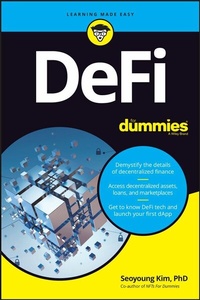
DeFi For Dummies
Description

Get to know the building blocks of a new economy
The promise of decentralized finance (DeFi for those up on their financial lingo) as a disruptor to financial institutions makes it must-know for anyone involved in finance. DeFi For Dummies provides an easy-to-understand option for unraveling the past, present, and future of DeFi. Understand current DeFi applications, including how to build basic applications on the leading platforms, and get a look into the future's most promising new DeFi solutions. Staying ahead of the game is critical for finance professionals these days, and this Dummies guide makes it possible, with full coverage of how DeFi affects asset management, lending and borrowing, and investment markets. Wrap your mind around DeFi and start getting hands on, the Dummies way.
- Learn how the DeFi revolution started and where it's going
- Get insight into opportunities for getting started and building value with DeFi
- Discover the leading assets, exchanges, and marketplaces built on DeFi principles
- Create secure DeFi applications on established platforms
This book is great for current pros or active investors in the world of finance who need to get up to speed on the world of DeFi as quickly and clearly as possible.
More details
Other editions
Additional editions
Person
Seoyoung Kim, PhD, is an Associate Professor of Finance and Business Analytics at Santa Clara University and bestselling co-author of NFTs For Dummies. Seoyoung's expertise lies in innovative financial instruments, crypto-assets, and blockchain-based ventures, on which she has consulted and written extensively. She regularly gives workshops and talks to academic, legal, and financial institutions, both domestically and internationally.
Content
Introduction 1
Part 1: Getting Started with DeFi 5
Chapter 1: Introducing Decentralized Finance 7
Chapter 2: Discovering the DeFi Lingo 21
Chapter 3: Dabbling in DeFi: Getting Your Hands Dirty 29
Chapter 4: Making Your First DeFi Transactions 55
Part 2: Diving into the Burgeoning DeFi Space 75
Chapter 5: Decentralized Assets 77
Chapter 6: Decentralized Exchanges and Marketplaces 87
Chapter 7: Decentralized Lending and Borrowing 103
Chapter 8: Decentralized Metaverses 119
Part 3: Developing Your Own DApp: A Step-by-Step Guide 129
Chapter 9: DeFi Building Blocks 131
Chapter 10: Smart-Contract Platforms 163
Chapter 11: Launching a Smart Contract on Ethereum 183
Chapter 12: Launching a Smart Contract on the Binance Smart Chain 229
Chapter 13: Launching Your First DeFi Product 255
Part 4: The Part of Tens 297
Chapter 14: Top Ten DeFi Applications 299
Chapter 15: Top Ten Smart-Contract Platforms 305
Index 313
Chapter 1
Introducing Decentralized Finance
IN THIS CHAPTER
Defining decentralized finance
Comparing CeFi and DeFi processes
Considering the cons of a DeFi world
Exploring promising DeFi implementations
The modern decentralized finance (DeFi) era truly began with Bitcoin, the first widespread implementation of a decentralized method of recordkeeping that is permissionless yet reliable and secure. Bitcoin effectively provides a currency that doesn't rely on the stability of a central authority.
The implications of such a technology are huge for developing economies where faith in central government is low and bank runs are a serious risk, if not a reality. Moreover, much of the world's population is, at most, one generation removed from being forcibly chased from their homes. Just 70 years ago, Seoul, the capital of Korea, was captured and recaptured four times, and families were permanently separated in a war that ultimately resulted in two separate nations. The fall of Saigon 50 years ago resulted in a mass exodus of Vietnamese refugees seeking asylum; and more recently, the fall of Kabul (2021) and the Russian invasion of Ukraine earlier this year (2022) led to more waves of emigrants who found themselves in sudden exile.
But aside from more dire circumstances - like the collapse of a banking system or the fall of your government - it's natural to question what true value Bitcoin's underlying technology adds in a stable and wealthy nation. After all, I trust that Bank of America won't maliciously siphon funds from my account, and despite the infamous Wells Fargo fake account scandal (for which it was ultimately fined $3 billion), I would even entrust my money to a Wells Fargo checking account. Nonetheless, reliable economies still have submarkets that are inherently rife with distrust of the central operator, with dark pools (securities exchanges in which participants can trade anonymously and with less transparency) being a case in point. (Try Googling "dark pool lawsuit"!) This trust issue naturally goes away if there is no central operator to distrust, and with the advent of Bitcoin, a proven technology now exists to implement modern DeFi processes across many use cases in finance.
This book isn't about touting the next big cryptocurrency or NFT. It's about the promise of the underlying technology, and where and how that technology can be elegantly applied in ways that truly add value to the situation at hand.
Demystifying DeFi
The idea of decentralized processes is certainly not new. After all, before centralized finance (CeFi) arose to establish trusted intermediaries, primitive DeFi was the status quo. Transactions were all peer-to-peer, and you were constrained by your local neighborhood to gain access to capital and to obtain goods by bartering one item for another. Recordkeeping was minimal, and ownership was determined by physical possession.
In modern markets, transactions require confidence in the validity of the agreement, which is provided by reliable and secure recordkeeping systems. After all, when you sell your car, you are really transferring the legal right to access the car. Without a reliable recordkeeping system in place, chaos would ensue. (Imagine the return of Finders Keepers as a rule of law!)
What's truly exciting now is the distributed-ledger technology that provides a reliable and secure method of recordkeeping that is not maintained by a trusted intermediary, such as Bank of America or the DMV. Behold the dawn of the modern DeFi era!
From autonomous collectives to trillion-dollar DAOs
Well-functioning, leaderless communities are all around us, and in each circumstance, an inherent governance mechanism incentivizes and gels the group to act in concert - all without an elected official to assign roles and lead the process. From homework teams to neighborhoods to informal potlucks, small groups can effectively and efficiently self-govern when there are grades to maintain, property prices to protect, or reputational concerns at stake.
These small-scale examples probably feel reasonable and natural. But what if I told you that a trillion-dollar organization could autonomously validate, execute, secure, and provide ongoing updates to an entire system without an elected leader to assign tasks? The concept sounds naïve at best, and possibly crazy.
And yet, Bitcoin has provided a battle-tested case in point for the underlying technology that enables it to function in a decentralized and autonomous fashion. Yes, Bitcoin is indeed a trillion-dollar decentralized autonomous organization (DAO)! Of course, at this scale and with the value at stake, a DAO can't rely solely on simple mechanisms like reputational concerns to incentivize participants to behave honestly and in a way that upholds the values of the system. Instead, the underlying protocol must be foolproofed against malicious players who may work hard to cheat the system. I explain these protocols in greater depth in Chapter 9, "DeFi Building Blocks."
Transacting in DeFi versus CeFi
By this point in the chapter, DeFi may still seem rather abstract. Comparing examples of DeFi versus CeFi processes for certain types of transactions can help to demystify the distinction.
Borrowing assets
Suppose you want to borrow money. How would this transaction be implemented in primitive DeFi versus modern CeFi versus modern DeFi?
- Under a primitive DeFi process: You hit up everyone you know within reasonable geographic proximity - a neighbor, a friend, a family member - and hope that someone will lend you something that you can barter with at your local marketplace.
- Under a modern CeFi process: People have checking accounts, savings accounts, CDs, and so on with the bank, which means that all these people have lent money to the bank. In turn, the bank lends some of this money to you.
- Under a modern DeFi process: People lock up funds in a smart-contract account, which is a software program on a public blockchain that automatically enforces and executes the rules in the smart-contract code. This smart-contract account is programmed to function as a lending pool from which you can borrow funds. (See Chapter 7 for details on how decentralized loans work.)
Selling assets
Suppose that instead of borrowing assets, you have assets that you want to sell. Comparing the three types of processes again, here's how this transaction would be implemented:
- Under a primitive DeFi process: You again hit up everyone you know within reasonable geographic proximity - a neighbor, friend, family member - and attempt to barter by trial and error.
- Under a modern CeFi process: Liquidity providers stand by, waiting to buy the asset from those who want to sell and to sell the asset to those who want to buy. These liquidity providers commit to buy and sell a certain quantity of assets at varying prices on designated exchanges that serve as official marketplaces for the assets in question. In turn, you place an order to sell the asset through your brokerage firm (who has custody of the asset).
- Under a modern DeFi process: Liquidity providers lock up assets and funds in a smart-contract account. This smart-contract account serves as a liquidity pool and is programmed to function as an automated market maker. (See Chapter 6 for details on how automated market makers work.) In turn, you can swap your assets for funds from this smart-contract account.
Check out Chapter 4, "Making Your First DeFi Transactions," for a quick, hands-on tutorial if you want to get your hands dirty without learning the technical underpinnings.
Dispelling harmful DeFi myths
Of course, both the CeFi and DeFi worlds have some bad actors, but DeFi activity is not synonymous with illicit activity. The misconception that DeFi applications primarily facilitate or promote criminal activity is untrue and harmful to the DeFi community.
In contrast to cash transactions, which typically aren't recorded, crypto transactions (such as in bitcoins or ether) are memorialized for all time on a public recordkeeping system known as a blockchain. In fact, any legitimate entity that touches crypto must employ the services of at least one blockchain analytics firm (such as Chainalysis) to credibly convey that it is serious about adhering to anti-money laundering (AML) provisions.
As the lowest-hanging fruit, blacklisted accounts (such as those associated with ransomware attacks or on the OFAC list) are barred from transacting with legitimate institutions. From there, blockchain analytics firms assign risk scores to graylisted accounts based on suspicious activity that suggests a possible connection to other graylisted or blacklisted accounts. Chapter 9, "DeFi Building Blocks," introduces you to tracing activity on a block explorer, and Chapter 11, "Launching a Smart Contract on Ethereum," delves more deeply into this process.
Just as it's (nearly) impossible to spend $10 million in ill-gotten cash (you can't show up with suitcases of cash to buy a home), it's (nearly) impossible to spend $10 million in ill-gotten crypto.
