

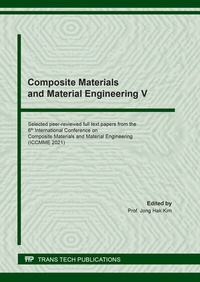
Composite Materials and Material Engineering V
Published on 16. June 2021
202 pages
978-3-0357-3819-3 (ISBN)
Description

This volume introduces readers to the papers presented at the 6th International Conference on Composite Materials and Material Engineering (ICCMME 2021, 12-14 January 2021), which was held as a virtual conference. Materials of the conference reflect the latest advances in the area of materials science and materials processing technologies.
More details
Series
Language
English
Place of publication
Zurich-Durnten
Switzerland
Target group
Professional and scholarly
Illustrations
Illustrations
File size
26,87 MB
ISBN-13
978-3-0357-3819-3 (9783035738193)
DOI
10.4028/b-EQ60Ws
Copyright in bibliographic data and cover images is held by Nielsen Book Services Limited or by the publishers or by their respective licensors: all rights reserved.
Schweitzer Classification
Other editions
Additional editions

Jong Hak Kim
Composite Materials and Material Engineering V
Book
07/2021
Trans Tech Publications Ltd
€195.60
Shipment within 10-20 days
Content
Preface
Chapter 1: Bio-Based and Biodegradable Composite Materials
Mechanical Properties and Thermal Analysis of Salago and Coir Hybrid Fiber Reinforced Epoxy Resin Composites
Fabrication of All-Cellulose Composite from Cotton Fabric via NaOH/Urea Solvent Using Vacuum Bagging-Assisted Process
An Environmentally Friendly Recycled-Polyethylene Composite Reinforced by Diatomaceous Earth and Wood Fiber
Eco-Friendly Composites Based on Bitter Tea Oil Meal and Polylactic Acid
Investigation of Mechanical Properties of Silk and Epoxy Composite Materials
Biocomposites Based on Agar and Cellulose Nanofibers Prepared from Carrot Slag
Influence of Internal Mixing Condition on Properties of Conductive Biocomposites between Poly(Lactic Acid) and Hybrid Graphene
The Development of Thermostatically Biodegradable Composite
Chapter 2: Mechanical Properties of Composite Structures
Passive Morphing in Aerospace Composite Structures
Improvement of Impact Energy Absorption of Curved Thin Chopped Tape CFRP Shell by Adding Submicron Glass Fiber into Matrix
Insertion of a Viscoelastic Layer to Reduce the Propagation of Energy by Vertical Impacts of Slamming in Planing Hull Vessels
Chapter 3: Materials and Technologies of Chemical Production
Effect of Valley Beater Refining on Tensile Properties of Molded Pulps from Rice Straws
Effect of Mono- and Bilayer Coating of Nanofibrillated Cellulose, its Modification, and Shellac on Properties of Molded Pulps
Investigation of Different Membrane Porosities on the Permeate Flux of Direct Contact Membrane Distillation
Facile Fabrication of N-Slow Release Fertilizer Hydrogel Beads by Alginate-Based Composites
Preparation and Properties of Urea Slow-Release Fertilizer Hydrogel by Sodium Alginate-Gelatin Biopolymer
Chapter 4: Functional Materials
Formation of Cariogenic Bacterial Biofilm on Vanillin-Incorporated Resin-Based Dental Sealant
Zinc Oxide-Based Pseudocapacitors with Electrospun Poly(Vinylidene Fluoride)/Poly(Ionic Liquid) Nanofibers as Solid Polymer Electrolyte
Chapter 5: Coatings and Adhesives
Compressive Properties of Electroless Ni-P Coating Reinforced Magnesium Alloy Foams
Reinforcing Adhesives Using Carbon Nanotubes for the Carbon Fibre Reinforced Plastic Composite and Metal Joint
EPDM/SBR Blends for Skim Compound of Steel Cord Conveyor Belt: Mechanical Properties, Thermal Stability and Adhesion Level
Chapter 6: Corrosion and Forming of Steel
3-Dimensional Microstructure Investigation of High Temperature Corrosion of Boiler Tube Material
Analysis and Correction of Defects for Deep Drawing Process of Stainless Sink by Use of Finite Element Simulation
Chapter 7: Building Materials and Technology
Elastic Properties of Polymer Modified Steel Fibre Reinforced High Strength Concrete
The Technique of Single-Component Synchronous Grouting Allocation to Resist Floating in High Pressure Water-Rich Formation
Eco-Friendly Innovation of Non-Fired Ceramic Tiles from Rice Husk Ash and Recycled Glass Cullet
Influence of Boric Acid Additive on Physical Properties of Utilizing Wastes for Producing Eco-Friendly Fired Clay Tiles
Chapter 1: Bio-Based and Biodegradable Composite Materials
Mechanical Properties and Thermal Analysis of Salago and Coir Hybrid Fiber Reinforced Epoxy Resin Composites
Fabrication of All-Cellulose Composite from Cotton Fabric via NaOH/Urea Solvent Using Vacuum Bagging-Assisted Process
An Environmentally Friendly Recycled-Polyethylene Composite Reinforced by Diatomaceous Earth and Wood Fiber
Eco-Friendly Composites Based on Bitter Tea Oil Meal and Polylactic Acid
Investigation of Mechanical Properties of Silk and Epoxy Composite Materials
Biocomposites Based on Agar and Cellulose Nanofibers Prepared from Carrot Slag
Influence of Internal Mixing Condition on Properties of Conductive Biocomposites between Poly(Lactic Acid) and Hybrid Graphene
The Development of Thermostatically Biodegradable Composite
Chapter 2: Mechanical Properties of Composite Structures
Passive Morphing in Aerospace Composite Structures
Improvement of Impact Energy Absorption of Curved Thin Chopped Tape CFRP Shell by Adding Submicron Glass Fiber into Matrix
Insertion of a Viscoelastic Layer to Reduce the Propagation of Energy by Vertical Impacts of Slamming in Planing Hull Vessels
Chapter 3: Materials and Technologies of Chemical Production
Effect of Valley Beater Refining on Tensile Properties of Molded Pulps from Rice Straws
Effect of Mono- and Bilayer Coating of Nanofibrillated Cellulose, its Modification, and Shellac on Properties of Molded Pulps
Investigation of Different Membrane Porosities on the Permeate Flux of Direct Contact Membrane Distillation
Facile Fabrication of N-Slow Release Fertilizer Hydrogel Beads by Alginate-Based Composites
Preparation and Properties of Urea Slow-Release Fertilizer Hydrogel by Sodium Alginate-Gelatin Biopolymer
Chapter 4: Functional Materials
Formation of Cariogenic Bacterial Biofilm on Vanillin-Incorporated Resin-Based Dental Sealant
Zinc Oxide-Based Pseudocapacitors with Electrospun Poly(Vinylidene Fluoride)/Poly(Ionic Liquid) Nanofibers as Solid Polymer Electrolyte
Chapter 5: Coatings and Adhesives
Compressive Properties of Electroless Ni-P Coating Reinforced Magnesium Alloy Foams
Reinforcing Adhesives Using Carbon Nanotubes for the Carbon Fibre Reinforced Plastic Composite and Metal Joint
EPDM/SBR Blends for Skim Compound of Steel Cord Conveyor Belt: Mechanical Properties, Thermal Stability and Adhesion Level
Chapter 6: Corrosion and Forming of Steel
3-Dimensional Microstructure Investigation of High Temperature Corrosion of Boiler Tube Material
Analysis and Correction of Defects for Deep Drawing Process of Stainless Sink by Use of Finite Element Simulation
Chapter 7: Building Materials and Technology
Elastic Properties of Polymer Modified Steel Fibre Reinforced High Strength Concrete
The Technique of Single-Component Synchronous Grouting Allocation to Resist Floating in High Pressure Water-Rich Formation
Eco-Friendly Innovation of Non-Fired Ceramic Tiles from Rice Husk Ash and Recycled Glass Cullet
Influence of Boric Acid Additive on Physical Properties of Utilizing Wastes for Producing Eco-Friendly Fired Clay Tiles
