

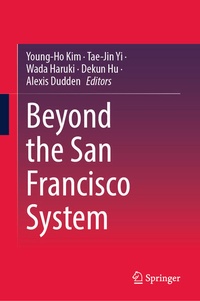
Beyond the San Francisco System
Description

This book, a eight-year interdisciplinary collaboration involving experts in international politics, law, economics, and history from six countries, meticulously analyzes the San Francisco Peace Treaty System and its profound implications. It critically examines how this system reflected the victim-centric approach of the United Nations while offering a crucial counter perspective from colonial and semi-colonial nations such as Korea and China, notably excluded from its initial formulation. The study specifically re-evaluates the treaty's impact through the crucial lens of human rights, addressing issues such as Japanese military sexual slavery and the Okinawa problem. In addition, the book meticulously tracks the subsequent 72-year evolution of this system in direct relation to the significant economic development and dynamic growth of civil society across East Asian regions. It compellingly argues that the ongoing Indo-Pacific collective security regime, strategically encircling China, represents a contemporary iteration, referred to as San Francisco System 2.0, drawing a clear distinction from its predecessor, San Francisco System 1.0. Ultimately, the focus is on an extensive exploration of the essential conditions required for establishing a truly genuine and lasting system of peace in the region.
More details
Other editions
Additional editions
Persons
Young-Ho Kim (???) was born in 1940 in Hap-chun, Korea. After graduating from Kyungpook National University and the University of Tokyo, he received his Ph.D. at Osaka City University. He has served as a professor in the Department of Economics at Kyungpook National University, Dean of the College of Business Administration at Kyungpook National University, and professor at the University of Tokyo in Japan. Additionally, has served as public offices including Minister of Industry and Resources of the South Korean government and President of Yuhan University. Among his major publications are East Asian Industrialization and World Capitalism (??????????????)(Tokyo: Toyo Keizai Inc. ??: ???????, 1988) and Dasan Studies in the World History (??? ?? ???)(Seoul: Knowledge Industry Co., Ltd. ??: ?????, 2021). He has received multiple awards, including the Award of Dasan Economics.
Yi Tae-jin (???, b.1943) is Professor Emeritus of Seoul National University where he had taught since 1973 who was retired in 2009. He is the author of over three hundred articles and over twenty books including Han'guk sahoe saron, Studies on the Social History of Korea (1986), Chosun yugyo sahoe saron, The Social History of Confucianism in Chosun (1989) and Kojong sid'ae ui chaejomyong, Reexamination of the History of the King Kojong Era 1864~1907 (2000). In 2022 he published two books on the Japanese Empire historians' founding of the 'Toyoshi' (???) and 'Tohogaku' (???) in the purpose of the establishment of the East Asian world ruled by the emperor of Japan. He was in charge of Chairman of National Institute of Korean History 2010~2013. In 2007 he was nominated as a member of the National Academy of Sciences Republic of Korea. He was honorably elected as the Bureau member of the Union Académique Internationale(UAI) in 2015. He has also received multiple awards, including the prestigious 3·1 Cultural Award.
Haruki Wada (????) was born in 1938 in Osaka, Japan. After graduating from the University of Tokyo and receiving his Ph.D. there, he served as a professor at the University of Tokyo and was the director of its Institute of Social Sciences. He has published over ten books including A Complete History of the Korean War (??????)(Tokyo: Iwanami Shoten Publishers??: ????????, 2002) and Origins and Outbreak of the Japanese-Russo War (???? ?????(?·?))(Tokyo: Iwanami Shoten Publishers??: ????????, 2009-2010). He is also a recipient of awards such as the Kim Dae-jung Academic Award.
Hu Dekun (???), born in 1946 in Suizhou, Hubei Province, graduated from the Department of History at Wuhan University in 1969 and remained at the university to teach. He was a visiting scholar at Kyoto University, Japan, in 1980, and at Soka University, Japan, in 1991. He was promoted to professor in 1988 and was appointed Senior Professor of Humanities and Social Sciences at Wuhan University in 2010. He previously served as Vice President of Wuhan University, Dean of the School of History, and Director of the Institute of China's Borders and Oceans, among other academic positions. He also served as President of the Chinese Society for the Study of the History of World War II. He has published 15 books and 160 academic papers, including Research on China and the World during the Anti-Fascist War Period (????????????????(???, ??))(Wuhan: Wuhan University Press ??: ???????, 2010) and The Historical Status of China's War of Resistance in the World Anti-Fascist War (???????????????????)(Beijing: Economic Science Press ??: ???????, 2013).
Alexis Dudden is a professor in the Department of History at the University of Connecticut. She is currently on leave and is also serving as a visiting professor in the Department of Japanese Studies at the National University of Singapore from 2024 to 2026. She graduated from Columbia University (B.A.) and the University of Chicago (M.A.), and then completed her Ph.D. at the University of Chicago. Her research focuses on modern Japan, Korea, and East Asian history, with an emphasis on empire, nationalism, and reconciliation. Among her major publications are The Opening and Closing of Japan, 1850-2020 (under contract with Oxford University Press) and Troubled Apologies Among Japan, Korea, and the United States (Columbia University Press, 2008). She has received multiple awards, including the Manhae International Peace Prize.
Content
Chapter 1. Explanation: The Formation, Process and Results of the San Francisco system (Kim).- Part I. The San Francisco System in the Postwar World Order.- Chapter 2. Clientelism For Ever?- Contemplating the San Francisco Peace Treaty Settlement 72 Years On (MaCormack).- Chapter 3. The Core Values of Cairo Declaration and an Exit Strategy to Overcome the Limitations of the San Francisco Peace Treaty (Jang-Hie).- Chapter 4. A Case for the Modifiability of the San Francisco Peace Treaty: Examining the Varying Positions of the U.S. and Britain over South Korean Participation (Yi).- Chapter 5. Challenges to the Post-war Asia-Pacific International Order (Amstrong).- Chapter 6. Hasty Peace, Nasty Greed: Analyzing the Defects of the 1951 Treaty of San Francisco in Comparison with the 1919 Treaty of Versailles (Won).- Part 2. Japanese Historical Position and the San Francisco system.- Chapter 7. The Political Situation Surrounding the "Trans-war Phenomenon" in Postwar Japan and the San Francisco Peace Treaty (Yi).- Chapter 8. A Study on Modern Japanese Colonialism and Ryukyu Restoration (Yong).- Chapter 9. What the Treaty of Peace with Japan(1951) Repudiates: The Discourse of Civilization during the First Sino-Japanese War as the Beginning of 'Violence and Greed' (Oh).- Chapter 10. Japanese Second World War Memory and San Francisco Peace Treaty (Yang).- Part 3. Unsolved Problems in the San Francisco System.- Chapter 11. Beyond the San Francisco System: An Inspiration from Canada (Hara).- Chapter 12. Transcending the San Francisco System requires the elimination of colonial remnants-with a focus on post-war territorial disputes in Northeast Asia (Dekun).- Chapter 13. The San Francisco Peace Treaty and Territorial Issues: Information Pamphlets on Territorial Issues from the Japanese Ministry of Foreign Affairs and Their Impact (JUNG).- Part 4. The San Francisco System and The Human Right.- Chapter 14. Unlawfulness of Japan's Colonization of Korean Peninsula-Korea' Declaration of January 21, 1904 and Japan's Violation of International Law- (Totsuka).- Chapter 15. Remedies for the Victims of Crimes against Humanity: The Case of Comfort Woman and Forced Labor (Baik).- Chapter 16. The Continuity of Statehood and Peoplehood in Modern Korea: How the Republic of Korea Defined its Citizenry (Lee).- Chapter 17. Righting the Wrongs of the Past between the Republic of Korea and Japan as a Retrial of the 'San Francisco System' (Kim).- Part 5. Beyond the San Francisco System.- Chapter 18. Beyond the San Francisco System: A Japanese View (Haruki).- Chapter 19. Beyond the San Francisco System, to Where? Contending Visions for the Region-Building in East Asia (Won).- Chapter 20. Trouble Among East Asian Allies? America's Troubling Past (Dudden).- Chapter 21. From the Joint Statement by Korean and Japanese Intellectuals to the End of the San Francisco System Evaluation Conferences - Toward a Durban Conference of East-Asian Intellectuals (Kim).
