

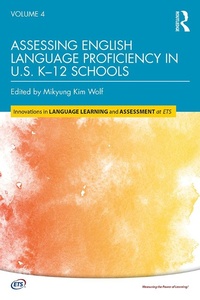
Assessing English Language Proficiency in U.S. K-12 Schools
1st Edition
Published on 31. May 2020
290 pages
978-1-000-05301-2 (ISBN)
Description

Assessing English Language Proficiency in U.S. K-12 Schools offers comprehensive background information about the generation of standards-based, English language proficiency (ELP) assessments used in U.S. K-12 school settings. The chapters in this book address a variety of key issues involved in the development and use of those assessments: defining an ELP construct driven by new academic content and ELP standards, using technology for K-12 ELP assessments, addressing the needs of various English learner (EL) students taking the assessments, connecting assessment with teaching and learning, and substantiating validity claims. Each chapter also contains suggestions for future research that will contribute to the next generation of K-12 ELP assessments and improve policies and practices in the use of the assessments. This book is intended to be a useful resource for researchers, graduate students, test developers, practitioners, and policymakers who are interested in learning more about large-scale, standards-based ELP assessments for K-12 EL students.
Reviews / Votes
"The requirement for the valid and reliable assessment of English language proficiency has grown remarkably since the need initially arose as a consequence of the Civil Rights Act and the U.S. Supreme Court ruling in Lau v. Nichols in 1974. As the English Learner population increased and the nature of Federal assistance to these students evolved, the linguistic theories and the technologies involved also advanced. This book captures the state of the art, telling an important story about how assessment development responds to policies, practices and theories to serve the needs of educators and students. It is a critical resource for graduate students, researchers, test developers and educational leaders."Kenji Hakuta, Stanford University, USA.
"This timely volume expertly tackles the complexity involved in the development, validation, and use of large-scale, standards-based assessments of English proficiency in K-12 education. By addressing research on key assessment development considerations while attending to the diversity of the test taker population and the historical and policy context in which these assessments take place, the authors in this volume offer new insights that will certainly stimulate further discussion and inquiry. Those interested in the assessment of English language proficiency, whether in the U.S. or in other countries, will find this book to be an invaluable resource."
Lorena Llosa, New York University, USA. "The requirement for the valid and reliable assessment of English language proficiency has grown remarkably since the need initially arose as a consequence of the Civil Rights Act and the U.S. Supreme Court ruling in Lau v. Nichols in 1974. As the English Learner population increased and the nature of Federal assistance to these students evolved, the linguistic theories and the technologies involved also advanced. This book captures the state of the art, telling an important story about how assessment development responds to policies, practices and theories to serve the needs of educators and students. It is a critical resource for graduate students, researchers, test developers and educational leaders."
Kenji Hakuta,
Stanford University, USA."This timely volume expertly tackles the complexity involved in the development, validation, and use of large-scale, standards-based assessments of English proficiency in K-12 education. By addressing research on key assessment development considerations while attending to the diversity of the test taker population and the historical and policy context in which these assessments take place, the authors in this volume offer new insights that will certainly stimulate further discussion and inquiry. Those interested in the assessment of English language proficiency, whether in the U.S. or in other countries, will find this book to be an invaluable resource."
Lorena Llosa, New York University, USA.
More details
Series
Edition
1. Auflage
Language
English
Place of publication
London
United Kingdom
Publishing group
Taylor & Francis Ltd
Target group
College/higher education
Professional and scholarly
Product notice
Reflowable
Illustrations
22 Tables, black and white; 27 Line drawings, black and white; 6 Halftones, black and white; 33 Illustrations, black and white
ISBN-13
978-1-000-05301-2 (9781000053012)
Copyright in bibliographic data and cover images is held by Nielsen Book Services Limited or by the publishers or by their respective licensors: all rights reserved.
Schweitzer Classification
Other editions
Additional editions
Mikyung Kim Wolf
Assessing English Language Proficiency in U.S. K-12 Schools
Book
07/2020
1st Edition
Routledge
€69.70
Shipment within 10-20 days
Mikyung Kim Wolf
Assessing English Language Proficiency in U.S. K-12 Schools
Book
07/2020
1st Edition
Routledge
€206.70
Shipment within 10-20 days
Person
Mikyung Kim Wolf is Senior Research Scientist at the Center for English Language Learning and Assessment Research at Educational Testing Service.
Content
Series Editors' Foreword
Acknowledgements
Contributors
Illustrations
Acronyms
Introduction
Chapter 1
Introduction: Assessing K-12 English Learners' English Language Proficiency
Mikyung Kim Wolf
Section I. Contexts and Fundamental Considerations in the Development of K-12 ELP Assessments
Chapter 2
Standards-Based K-12 English Language Proficiency Assessments in the United States: Current Policies and Practices
Edynn Sato & Karen D. Thompson
Chapter 3
The Construct of English Language Proficiency in Consideration of College and Career Readiness Standards
Alison L. Bailey & Mikyung Kim Wolf
Chapter 4
Innovations and Challenges in K-12 English Language Proficiency Assessment Tasks
Ahyoung Alicia Kim, Mark Chapman, & Heidi Liu Banerjee
Chapter 5
A Review of Validity Evidence for K-12 English Language Proficiency Assessments: Current State and Future Direction
Timothy Farnsworth
Section II. Empirical Research and Practical Considerations on the Development of K-12 ELP Assessments
Chapter 6
Collaborating with Educators on the Development of English Language Proficiency Assessments
Maurice Cogan Hauck & Emilie Pooler
Chapter 7
Examining Students' Response Processes in a Computer-Based English Language Proficiency Assessment
Mikyung Kim Wolf, Danielle Guzman-Orth, Cathryn Still, & Phoebe Winter
Chapter 8
Generating Score Reports: Psychometric Issues to Consider
Hanwook (Henry) Yoo, Joyce Wang, David P. Anderson, & Eric Zilbert
Chapter 9
Validating Threshold Scores for English Language Proficiency Assessment Uses
Patricia Baron, Robert Linquanti, & Min Huang
Chapter 10
Accessibility Considerations for English Learners with Disabilities in English Language Proficiency Assessments
Danielle Guzman Orth, Lorraine Sova, & Traci Albee
Section III. Some Future Considerations in K-12 ELP Assessment
Chapter 11
Using Automated Scoring in K-12 English Language Proficiency Assessments
Keelan Evanini, Yoko Futagi, & Maurice Cogan Hauck
Chapter 12
Teachers' Perspectives on the Use of Summative English Language Proficiency Assessments for Instructional Purposes
Alexis A. Lopez & Georgia Earnest Garcia
Chapter 13
Towards a Model of Validity in Accountability Testing
Micheline B. Chalhoub-Deville
Subject Index
Acknowledgements
Contributors
Illustrations
Acronyms
Introduction
Chapter 1
Introduction: Assessing K-12 English Learners' English Language Proficiency
Mikyung Kim Wolf
Section I. Contexts and Fundamental Considerations in the Development of K-12 ELP Assessments
Chapter 2
Standards-Based K-12 English Language Proficiency Assessments in the United States: Current Policies and Practices
Edynn Sato & Karen D. Thompson
Chapter 3
The Construct of English Language Proficiency in Consideration of College and Career Readiness Standards
Alison L. Bailey & Mikyung Kim Wolf
Chapter 4
Innovations and Challenges in K-12 English Language Proficiency Assessment Tasks
Ahyoung Alicia Kim, Mark Chapman, & Heidi Liu Banerjee
Chapter 5
A Review of Validity Evidence for K-12 English Language Proficiency Assessments: Current State and Future Direction
Timothy Farnsworth
Section II. Empirical Research and Practical Considerations on the Development of K-12 ELP Assessments
Chapter 6
Collaborating with Educators on the Development of English Language Proficiency Assessments
Maurice Cogan Hauck & Emilie Pooler
Chapter 7
Examining Students' Response Processes in a Computer-Based English Language Proficiency Assessment
Mikyung Kim Wolf, Danielle Guzman-Orth, Cathryn Still, & Phoebe Winter
Chapter 8
Generating Score Reports: Psychometric Issues to Consider
Hanwook (Henry) Yoo, Joyce Wang, David P. Anderson, & Eric Zilbert
Chapter 9
Validating Threshold Scores for English Language Proficiency Assessment Uses
Patricia Baron, Robert Linquanti, & Min Huang
Chapter 10
Accessibility Considerations for English Learners with Disabilities in English Language Proficiency Assessments
Danielle Guzman Orth, Lorraine Sova, & Traci Albee
Section III. Some Future Considerations in K-12 ELP Assessment
Chapter 11
Using Automated Scoring in K-12 English Language Proficiency Assessments
Keelan Evanini, Yoko Futagi, & Maurice Cogan Hauck
Chapter 12
Teachers' Perspectives on the Use of Summative English Language Proficiency Assessments for Instructional Purposes
Alexis A. Lopez & Georgia Earnest Garcia
Chapter 13
Towards a Model of Validity in Accountability Testing
Micheline B. Chalhoub-Deville
Subject Index
