

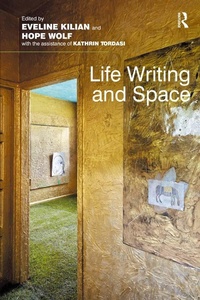
Life Writing and Space
Published on 15. May 2017
224 pages
978-1-317-10521-3 (ISBN)
Description

How does our ability, desire or failure to locate ourselves within space, and with respect to certain places, effect the construction and narration of our identities? Approaching recordings and interpretations of selves, memories and experiences through the lens of theories of space and place, this book brings the recent spatial turn in the Humanities to bear upon the work of life writing. It shows how concepts of subjectivity draw on spatial ideas and metaphors, and how the grounding and uprooting of the self is understood in terms of place. The different chapters investigate ways in which selves are reimagined through relocation and the traversing of spaces and texts. Many are concerned with the politics of space: how racial, social and sexual topographies are navigated in life writing. Some examine how focusing on space, rather than time, impacts upon auto/biographical form. The book blends sustained theoretical reflections with textual analyses and also includes experimental contributions that explore independencies between spaces and selves by combining criticism with autobiography. Together, they testify that life writing can hardly be thought of without its connection to space.
Reviews / Votes
Studies into life writing are a growing field of creative-critical inquiry, and Eveline Killian and Hope Wolf have produced a remarkable addition to existing scholarship. Life Writing and Space brings together a mix of established names and up and coming talent who probe the narration of lives through the prism of space. Drawing on work ranging from cultural critics to hardcore (postmodern) theorists and philosophers, this ambitious volume carves out a new territory for scholars and students interested in the intricacies of (auto)biography. Killian and Wolf's Introduction is exemplary: a work of rigorous and original scholarship that sets the bar very high. The individual contributions are varied, yet each in their own way illuminates the spatial aspects of life writing in new ways.Sebastian Groes, University of Roehampton, UK
Opening itself to multiple resonances of spatial concepts, Life Writing and Space draws on literary criticism, cultural studies, and critical geographies to show how places and spaces are imagined, produced, and experienced through auto/biographical practices. This richly intertextual study demonstrates the productive potential of framing lives in terms of spatiality and explores different topologies and tropologies of life writing.
Eva C. Karpinski, York University, Canada and author of Borrowed Tongues: Life Writing, Migration, Translation
More details
Language
English
Place of publication
London
United Kingdom
Publishing group
Taylor & Francis Ltd
Target group
College/higher education
Product notice
Reflowable
File size
2,56 MB
ISBN-13
978-1-317-10521-3 (9781317105213)
Copyright in bibliographic data and cover images is held by Nielsen Book Services Limited or by the publishers or by their respective licensors: all rights reserved.
Schweitzer Classification
Other editions
Additional editions
Eveline Kilian | Hope Wolf
Life Writing and Space
Book
04/2018
1st Edition
Routledge
€77.03
Shipment within 10-20 days
Eveline Kilian | Hope Wolf
Life Writing and Space
Book
01/2016
1st Edition
Routledge
€231.70
Shipment within 10-20 days
Persons
Eveline Kilian is Professor of English Literature and Culture at Humboldt-UniversitA?t zu Berlin, Germany. Hope Wolf is Lecturer in British Modernist Literature at the University of Sussex, UK.
Content
The Spatial Dimensions of Life Writing
(Eveline Kilian and Hope Wolf)
PART I: RELOCATING AND REIMAGINING THE SELF
1. Multiple Occupancy: Residency and Retrospection in Trollope's Orley Farm and An Autobiography
(Matthew Ingleby)
2. Lost Cities and Found Lives: The 'Geographical Emotions' of Bryher and Walter Benjamin
(Andrew Thacker)
3. Hilary Mantel and the Space of Life Writing
(Neil Vickers)
PART II: TRAVERSING SPACES AND TEXTS
4. Literary Configurations of the Peripatetic
(Helga Schwalm)
5. 'The mystery-magic of foreignness': Mr Isherwood Changes Places
(Eveline Kilian)
6. Critical Topographies in Depression Era Lives
(Martin Klepper and Alexandra Wagner)
PART III: CONTESTED SPACES, PRECARIOUS LIVES
7. Postcolonial Literary Cartography: Writing the Self in Contemporary Algeria
(Elizabeth H. Jones)
8. Inhabiting the In-Between: (Mis)placing Identity in Katherine Mansfield's Notebooks
(Kathrin Tordasi)
9. Isaac Rosenberg's Life in Letters: Between the 'coil of circumstance' and a 'place for poetry'
(Anne-Julia Schoen)
PART IV: SPACE AND THE FORM OF LIFE WRITING
10. Spaces of Intervention: Helene Cixous's Portrait of Jacques Derrida as a Young Jewish Saint
(Frederic Regard)
11. Strandlines: Eccentric Stories, Thoroughfare Poetics and the Future of the Archive
(Hope Wolf)
12. The Columbus of the Near-at-Hand: The Author as Traveller through the Everyday
(James Attlee)
13. There's No Space Like Home
(Clare Brant)
(Eveline Kilian and Hope Wolf)
PART I: RELOCATING AND REIMAGINING THE SELF
1. Multiple Occupancy: Residency and Retrospection in Trollope's Orley Farm and An Autobiography
(Matthew Ingleby)
2. Lost Cities and Found Lives: The 'Geographical Emotions' of Bryher and Walter Benjamin
(Andrew Thacker)
3. Hilary Mantel and the Space of Life Writing
(Neil Vickers)
PART II: TRAVERSING SPACES AND TEXTS
4. Literary Configurations of the Peripatetic
(Helga Schwalm)
5. 'The mystery-magic of foreignness': Mr Isherwood Changes Places
(Eveline Kilian)
6. Critical Topographies in Depression Era Lives
(Martin Klepper and Alexandra Wagner)
PART III: CONTESTED SPACES, PRECARIOUS LIVES
7. Postcolonial Literary Cartography: Writing the Self in Contemporary Algeria
(Elizabeth H. Jones)
8. Inhabiting the In-Between: (Mis)placing Identity in Katherine Mansfield's Notebooks
(Kathrin Tordasi)
9. Isaac Rosenberg's Life in Letters: Between the 'coil of circumstance' and a 'place for poetry'
(Anne-Julia Schoen)
PART IV: SPACE AND THE FORM OF LIFE WRITING
10. Spaces of Intervention: Helene Cixous's Portrait of Jacques Derrida as a Young Jewish Saint
(Frederic Regard)
11. Strandlines: Eccentric Stories, Thoroughfare Poetics and the Future of the Archive
(Hope Wolf)
12. The Columbus of the Near-at-Hand: The Author as Traveller through the Everyday
(James Attlee)
13. There's No Space Like Home
(Clare Brant)
