

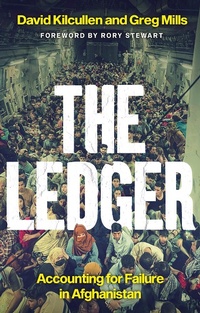
The Ledger
Description

'These things happened. They were glorious and they changed the world,' said Charlie Wilson, of America's role backing the anti-Soviet mujahideen. 'And then we fucked up the endgame.' With no support for Afghanistan after that war, the vacuum was filled by the Taliban and bin Laden. The Ledger assesses the West's similarly failed approach to Afghanistan after 9/11-in military, diplomatic, political and developmental terms.
Dr David Kilcullen and Dr Greg Mills are uniquely placed to reflect backwards and forwards on the Afghan conflict: they worked with the international mission both as advisers and within the Arg, and they have considerable experience of counterinsurgency and stabilisation operations elsewhere in the world. Here these two experts show that there is plenty of blame to go around when explaining the failure to bring peace to Afghanistan after 9/11.
The signs of collapse were conveniently ignored, in favour of political narratives of progress and success. Yet for Afghans, the war and its geopolitical effects are not over because NATO is gone-Afghanistan remains globally connected through digital communications and networks. This vital book explains why and where failings in Afghanistan happened, warning against exceptionalist approaches to future peacebuilding missions around the globe.
More details
Other editions
Additional editions
Persons
Content
- Intro
- Half Title
- Title
- Copyright
- Contents
- Foreword: Rory Stewart
- Preface and Acknowledgements
- About the Authors
- Introduction: The New Sympathisers
- 1. An Evolving Campaign
- Confusion, Compression and Echoes of the Past
- A Question of Politics
- 2. Echoes of Campaigns Past
- Déjà vu All Over Again?
- Trying Everything
- Similarities
- Differences
- Five Common Lessons
- 3. Assessing Four Failures
- The Failure of Politics
- The Failure of Policy on Pakistan
- The Corruption of Recovery
- The Failure of Economic Development
- 4. Endgame
- Slow Disintegration after 2015
- The Selection-Destruction Cycle
- The Collapse of 2021
- Why the Afghan Military Collapsed
- Why the Civil Government Collapsed
- What Could Have Been Done Differently?
- 5. The Ball Keeps Bouncing
- Assessing the Wider Cost and Implications
- From Afghanistan to Africa?
- Reinforcing Success, Rewarding Failure?
- Changing Outside Strategy
- All Peace Missions are Local?
- Conclusion: The Ledger-Lessons from Failure in Afghanistan
- All for Nothing?
- Notes
- Index
- Back Cover
