

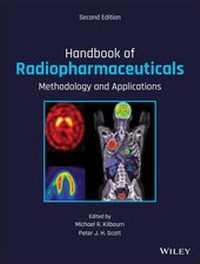
Handbook of Radiopharmaceuticals
Description

The second edition of Handbook of Radiopharmaceuticals is a comprehensive review of the field, presenting up-to-date coverage of central topics such as radionuclide production, synthetic methodology, radiopharmaceutical development and regulations, and a wide range of practical applications. A valuable reference work for those new to the Radiopharmaceutical Sciences and experienced professionals alike, this volume explores the latest concepts and issues involving both targeted diagnostic and therapeutic radiopharmaceuticals. Contributions from a team of experts from across sub-disciplines provide readers with an immersive examination of radiochemistry, nuclear medicine, molecular imaging, and more.
Since the first edition of the Handbook was published, Nuclear Medicine and Radiopharmaceutical Sciences have undergone major changes. New radiopharmaceuticals for diagnosis and therapy have been approved by the FDA, the number of clinical PET and SPECT scans have increased significantly, and advances in Artificial Intelligence have dramatically improved research techniques. This fully revised edition reflects the current state of the field and features substantially updated and expanded content. New chapters cover topics including current Good Manufacturing Practice (cGMP), regulatory oversight, novel approaches to quality control--ensuring that readers are informed of the exciting developments of recent years. This important resource:
* Features extensive new and revised content throughout
* Covers key areas of application for diagnosis and therapy in oncology, neurology, and cardiology
* Emphasizes the multidisciplinary nature of Radiopharmaceutical Sciences
* Discusses how drug companies are using modern radiopharmaceutical imaging techniques to support drug discovery
* Examines current and emerging applications of Positron Emission Tomography (PET) and Single Photon Emission Computed Tomography (SPECT)
Edited by recognized experts in radiochemistry and PET imaging, Handbook of Radiopharmaceuticals: Radiochemistry and Applications, 2 nd Edition is an indispensable reference for post-doctoral fellows, research scientists, and professionals in the pharmaceutical industry, and for academics, graduate students, and newcomers in the field of radiopharmaceuticals.
More details
Other editions
Additional editions

Persons
Edited by
Michael R. Kilbourn, PhD, is Professor Emeritus, Radiology, at the University of Michigan. He retired after 25 years of directing and expanding the University's PET Cyclotron and Radiochemistry program. Professor Kilbourn is the author of over 200 peer-reviewed scientific papers and 31 book chapters, and is the 2009 recipient of the Paul C. Aebersold Award for Outstanding Achievements in Basic Science Applied to Nuclear Medicine.
Peter J. H. Scott, PhD, is Associate Professor, Radiology, and Director of the PET Center at the University of Michigan. His research focuses on developing new methods for radiolabeling bioactive molecules and the design and synthesis of new radiotracers for PET imaging. Professor Scott has published over 100 papers, 170 abstracts, and 30 book chapters, edited 4 books, and is listed as an inventor on multiple patents. In 2019 he received a Distinguished Investigator Award from the Academy for Radiology & Biomedical Imaging Research.
Content
Foreword
Preface
List of Contributors
About the Editors
Abbreviations
PART I: INTRODUCTION TO RADIOPHARMACEUTICALS
1. Targeted Diagnostic Radiopharmaceuticals: Design Options for Small Molecule Radiotracers
Michael R. Kilbourn
2. Concepts and Issues for Therapeutic Radiopharmaceuticals
Alexandra R. Sowa Dumond and Peter J. H. Scott
PART II: PRODUCTION OF RADIONUCLIDES
3. Production of Short Half-life PET Radionuclides
Michael R. Kilbourn, Melissa E. Rodnick and Mara Clark
4. Production of Radionuclides used in SPECT
Salma Jivan and Thomas J. Ruth
5. Production of Therapeutic Radionuclides
C. Shaun Loveless and Suzanne E. Lapi
PART III: SYNTHETIC METHODS FOR RADIOPHARMACEUTICALS
6. Synthesis of 13N- and 15O-labeled Radiopharmaceuticals
Krishna R. Pulagam, Vanessa Gómez-Vallejo, Fernando López-Gallego, Luka Rejc and Jordi Llop
7. Radiochemistry with Carbon-11
Stephen Thompson, Steven Kealey, Selena M. Sephton and Franklin I. Aigbirhio
8. Fluorine-18 Radiochemistry
Allen F. Brooks, Katarina J. Makaravage, Jay Wright, Melanie S. Sanford and Peter J. H. Scott
9. Synthesis of 68Ga-labeled Radiopharmaceuticals
Benjamin P. Burke and Stephen J. Archibald
10. Cu-Mediated Radiohalogenation of Organoboranes
Sean W. Reilly and Robert H. Mach
11. The radiochemistry of zirconium
Jason P. Holland
12. 99mTc Radiopharmaceutical Chemistry
Dionysia Papagiannopoulou
PART IV: PRACTICAL ASPECTS OF RADIOPHARMACEUTICAL PRODUCTION AND USE
13. Automated Synthesis Modules for PET Radiochemistry
Laura Bruton and Peter J. H. Scott
14. Automation of PET Radiopharmaceutical Quality Control
Arkadij Elizarov
15. Moving PET Drugs from the Lab to the Patient in USA
David W. Dick
16. Moving from the Lab to the Patient in Asia
Dae Yoon Chi
17. Moving a radiotracer form bench to bedside in Europe
Koen Vermeulen, Alfons Verbruggen, Guy Bormans and Frederik Cleeren
PART V: MAJOR APPLICATIONS OF RADIOPHARMACEUTICALS
18. Radiopharmaceuticals in Oncology
Jeroen A.C.M. Goos, Outi Keinänen, Brian M. Zeglis and Jason S. Lewis
19. Neurological applications of Radiopharmaceuticals
Mehdi Djekidel and Nicolaas I. Bohnen
20. Cardiac Applications of Radiopharmaceuticals
John P. Bois and Robert J. Gropler
21. Radiopharmaceuticals in Pediatric Nuclear Medicine
Scott E. Snyder, Elizabeth R. Butch and Barry L. Shulkin
22. PET Imaging in Drug Discovery and Development
David J. Donnelly
INDEX
Abbreviations
5-HT1A serotonin 1A receptor ACh acetylcholine AChE acetylcholinesterase AcOH acetic acid ACPC 1-aminocyclopentanecarboxylic acid AD Alzheimer's disease ADC antibody drug conjugate ADM s-adenosyl-L-methionine AI artificial intelligence ALARA as low as reasonably achievable AMDP aminomethylenediphosphonate AMT a-Methyl-L-tryptophan ATP adenosine triphosphate ATTR amyloid transthyretin BACE beta-secretase BAT brown adipose tissue BBB blood-brain barrier Bmax maximum concentration of target binding sites BOx benzoxazole BP binding potential BP British Pharmacopeia Bq becquerel BTA aryl-benzothiazole BZD benzodiazepine CAD coronary artery disease cAMP cyclic adenosine monophosphate CBF cerebral blood flow CBS compton backscattered [11C]ACHC aminocyclohexanecarboxylic acid [11C]DASB [11C]3-amino-4-(2-dimethylaminomethylphenylsulfanyl)-benzonitrile [11C]DOPA [11C dihydroxyphenylalanine [11C]DTBZ [11C]Dihydrotetrabenazine [11C]HED [11C]hydroxyephedrine [11C]PiB [11C]Pittsburgh compound B (PIB ([N-methyl-11C]6-Me-BTA-1) CFR Code of Federal Regulations cGMP current Good Manufacturing Practice Ci curie ClogD calculated distribution coefficient at pH 7.4 ClogP calculated partition coefficient CMC chemistry, manufacturing, and controls CMO contract manufacturing organization CNS central nervous system COMT catecholamine O-methyl transferase CSF cerebrospinal fluid CT computed tomography CTA clinical trial application CV cardiovascular CXCR4 CXC-chemokine receptor-4 Da daltons DAT dopamine transporter DBU 1,8-diazabicyclo[5.4.0]undec-7-ene DDD drug discovery and development DIPE di-isopropyl ether DMA N,N-dimethylacetamide DMF N,N-dimethylformamide DMF drug master file DMSO dimethyl sulfoxide DNA deoxyribose nucleic acid DOTA 1,4,7,10-tetraazacyclododecane-1,4,7,10-tetraacetic acid DPA dipicolylamine DPzA dipyrazolylamine Dx dextran EANM European Association of Nuclear Medicine EC electron capture ECD [99mTc]ethylcysteine dimer eCTD electronic common technical document EGFR epidermal growth factor receptor eLINACS electron linear accelerators EMA European Medicines Agency EOB end-of-bombardment EOS end-of-synthesis EP European Pharmacopeia EPI epinephrine EtOH ethanol EU European Union eV electron volt FA fatty acid FAAH fatty acid amide hydrolase [18F]FACBC 1-amino-3-[18F]fluorocyclobutanecarboxylic acid (Fluciclovine, Axumin) FDA Food and Drug Administration [18F]FDG 2-deoxy-2-[18F]fluoro-D-glucose FDH formate dehydrogenase [18F]FDOPA 6-[18F]fluorodihydroxyphenylalanine [18F]FES [18F]fluoroestradiol [18F]FET 2-[18F]fluoroethyl)-L-tyrosine [18F]FMISO [18F]fluoromisonidazole [18F]FMT [18F]fluoromethyltyrosine [18F]FPEB [18F]3-fluoro-5-(pyridin-2- ylethynyl)benzonitrile [18F]FSPG (S-4-(3-[18F]fluoropropyl)-L-glutamic acid g gram GABA gamma amino butyric acid GC gas chromatography GIST gastrointestinal stromal tumors GLP Good Laboratory Practice GMP Good Manufacturing Practice HBED N,N'-bis(2-hydroxybenzyl)ethylendiamine-N,N'-diacetic acid HDA hexadecanoic acid HER human epidermal growth factor receptor HEU highly enriched uranium HITS high-throughput screening HIV/AIDS human immunodeficiency virus/ acquired immunodeficiency syndrome HMPAO [99mTc]hexamethylpropyleneamine oxime HMR heart mediastinal ratio HPLC high-performance liquid chromatography HSA human serum albumin HYNIC hydrazinonicotinamide IAEA International Atomic Energy Agency IB investigators brochure IBZM iodobenzamide ICH International Council for Harmonization of Technical Requirements for Pharmaceuticals for Human Use ID injected dose ID/g injected dose per gram IHC immunohistochemistry IMPD investigational medicinal product dossier IMZ iomazenil IND investigational new drug iNOS inducible nitric oxide synthase IVS interventricular septum Kd equilibrium dissociation constant, affinity of ligand toward the target LAF laminar air flow LET linear energy transfer LV left ventricular MAA macroaggregated albumin ... mAb monoclonal antibody
