

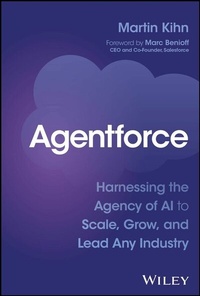
Agentforce
Description

Introducing AI agents, the groundbreaking third wave of AI's integration in the workforce
Agentforce: Harnessing the Agency of AI to Scale, Grow, and Lead Any Industry tells you how companies can create and control their own AI agents and build a virtual workforce. It goes behind-the-scenes on how Salesforce built a platform to drive AI agents, solving problems like hallucinations and bias through a framework that gives agents strict roles, data sources, actions, guardrails and channels to reach customers. This book draws from extensive research and exclusive access to Salesforce's leaders and their ambitious plan to dominate the race to develop and own the AI agent space.
In this book, readers will find information on:
- AI agents as a "third wave" of AI development that goes far beyond simple chatbots and "co-pilots" through harmonized data, Retrieval Augmented Generation (RAG), and Salesforce's innovative Atlas Reasoning Engine
- Steps to develop prompt guidance, topic creation (areas of work), explicit instructions, and a menu of actions allowed
- Salesforce customers, such as Saks and OpenTable, that are already using AI agents with success
- The effects of AI and automation on the job market
Agentforce: Harnessing the Agency of AI to Scale, Grow, and Lead Any Industry is an indispensable, forward-thinking resource on the subject for all leaders in business seeking to supercharge their organizations' initiatives through the latest developments in a rapidly advancing field.
More details
Other editions
Additional editions
Person
MARTIN KIHN is an AI strategist at Salesforce and a former Gartner VP. He is the author of five books including House of Lies, which was adapted into a Showtime series, and Customer 360 (with Andrea Chen Lin). His work has been published in Forbes, GQ, New York, US and the New York Times.
Content
Foreword by Marc Benioff ix
The Five Attributes of an AI Agent xiii
Author's Note xv
Agentforce Kickoff, San Francisco xix
1 Call My Agent! 1
2 What Is Agentforce, Anyway? 5
3 How Does Agentforce Actually Work? 13
4 What Are Some Useful Things You Can Do with Agents? 27
5 Do You Need a Platform to Do Agents (and What's a Platform, Anyway)? 35
6 Are Agents Really Different from Chatbots and Co-pilots? 45
7 What Are the Different Parts of Agentforce? 55
8 What Is the Einstein Trust Layer, and Why Do You Need It? 63
9 Why Do You Need Data Cloud for Agentforce? 69
10 What Is RAG, and Why Should I Care? 81
11 What Is the Atlas Reasoning Engine? 89
12 How Do You Control an Agent and Give It Orders? 99
13 How Do You Test an Agent in a Sandbox? 111
14 What Are Some of the Prebuilt Agentforce Agents? 119
15 How Do You Build a Custom Agent from Scratch? 133
16 What Is the Best Way to Come Up with Ideas for Agents? 143
17 How "Human" Should Your AI Agent Be? 157
18 How Do You Make Sure AI Is Governed? 161
19 How Do You Build a Business Case for Agentforce? 169
20 So What Are We Humans Going to Do Now? 177
21 How Can I Get Started with Agentforce and Learn More? 183
22 So What Was This Book All About, Anyway? 187
Endnotes 193
About the Author 207
Index 209
Agentforce Kickoff, San Francisco
The day after the 2024 presidential election, Salesforce's co-founder Marc Benioff assembles the 500 top leaders of his 80,000-person company in a windowless basement room at the Ritz Carlton San Francisco for an emergency summit.
Security is tight: employees are required to scan their badge at every elevator and hallway; bags are checked; homework is mandated.
The election isn't mentioned. The date is a coincidence. The topic at hand is what Benioff believes is "the biggest thing to happen in any of our lifetimes" - something he's decided to call Agentforce.
It will soon be a recognizable brand: Salesforce is preparing a massive TV campaign, and there's already a billboard on Highway 101 to the SFO airport with the company's trademark cartoon animals, rebuilt as robots in Ray-Bans, attesting "I Chose Agentforce."
In a few months, there would even be a commercial during that strategic conversation between the Chiefs and the Eagles otherwise known as Super Bowl LIX. All of this AI awareness features Salesforce's brand ambassador, Matthew McConaughey, at his Texas-whimsical best, reciting lines he seems to have written himself.
The campaign's tag line morphs to "What AI Was Meant to Be."1
Now the last time you saw an ad during the Super Bowl for a CRM company was . never.i Salesforce's investment in associating its brand with AI and in making this astonishing, unsettling technology seem less frightening is unprecedented.
But this is an unprecedented era, an unanticipated chance. Almost nothing is predictable.
For one thing, when Benioff appears at the basement meeting wearing jeans and a charcoal sport jacket, he's . limping? He wears a plastic boot on his left foot.
This could be an awkward moment, but he turns to his people at the front of the room and says, "I'm wearing a boot."
They relax. All is well at the top.
So I was in French Polynesia, about 400 miles from Tahiti, he starts. And I'm on the fifth day of scuba diving and I jump out of the boat and I hit something on the way down. I walked around on it for a few days, but then I got an MRI . and turns out, I ruptured my Achilles.
And so on . about his decision to avoid surgery and try a nonsurgical technique involving large needles, meditation, and no anesthesia. One doesn't have to spend much time in Benioff's orbit to learn that absolutely everything is a story with him. He's part of a long line of maggidim, itinerant storytellers unfurling inspiring homilies with a message.ii
Later in the day, after much agent-related discussion, Benioff gets back to that message:
So I'm scheduled for a CAT scan . but is there any follow-up? It would have been nice to have somebody reach out and tell me what to do, update me on what happened, keep me informed about the process. But nothing. It would have been a perfect job for an AI agent.
And bing-bang: "Any company that's adding an agentic layer is putting an expert by their side to help deal with customers," he says.
An agentic layer. And agents. And of course Agentforce. That's the point.
Now Agentforce is a way to build, customize, test, deploy, and monitor AI agents. And AI agents are simply very malleable pieces of software that can interact with humans, automate business processes, and make plans and decisions. They're a form of digital labor, or what Agentforce version 2.0, released the following month, would call "A digital labor platform for building a limitless workforce."2
At the time of the emergency conclave, Agentforce is all of four weeks old. It emerges - as most dramatic moments in this founder-led, 25-year-old company do - directly from Benioff's late-night brainstorms.
As usual for Salesforce's top-to-top retreats, the Agentforce Kickoff is held over 12-hour days with few breaks. The hotel may have chandeliers, but they are unremarked on, and the spa is a fragrant, lifeless desert.
And there is a consciously cult-like vibe, in the positive sense of Jim Collins' classic From Good to Great, which said: "A cult-like culture can actually enhance a company's ability to pursue Big Hairy Audacious Goals, precisely because it creates that sense of being part of an elite organization that can accomplish just about anything."3
Just about anything is exactly what needs accomplishing now. It's one of those moments - a call to action, a decisive point, when ability meets opportunity and a historic advantage is won or lost - and Benioff wants to make sure his team is alive to their chance.
There is no ambiguity here. This time will not return.
"All of us have to change our minds and realize," he says, "that this is the single biggest opportunity of our lives."
And: "This is the single most important piece of technology to come along in the history of business."
Obviously, he's had an epiphany. He's seen a future. The development of so-called large-language AI models like OpenAI's GPT and Google's Gemini and High-Flyer's DeepSeek made software conversational and smart. Seemingly overnight, computers could look up information, summarize and organize, make plans and suggestions - do a lot of the things that people do but faster and with better grammar.
But there were still limitations. AI couldn't really do much work, not the kind you and I do when we're, well, at work. Salesforce was going to change that. It was going to put AI to work using virtual agents, AI agents that could work alongside humans, making everything easier.
They already exist. The group sits through a live demonstration of an agent that helps a family of four plan and change a trip on the fly to a theme park, asking questions, making reservations and changes, getting real-time updates on ride status - all using slangy American rat-a-tat without talking to a single human being.
And they're new. Benioff tells a suspenseful story of the build-up to Dreamforce, the company's annual mega-event that takes over downtown San Francisco, held four weeks earlier. Agents weren't originally part of his keynote until some customer meetings and an encounter with a prescient tech-startup CTO rerouted his code.
"We were doing the [customer] demo," he says, mentioning an impressive agentic AI case study of a European luxe customer that trained its customer-service agents to speak in a "luxurious" tone of voice, "and the CTO said, 'That might just be the best software ever made.'"
So he tells the team to "tear up the keynote" and "go all-in on Agentforce."
There's another story, of the time he met with Steve Jobs, years ago, and Jobs was launching the iPad. And Jobs tells Benioff a secret that wasn't really a secret: he only did one thing at a time. Just one.
Benioff decides that from now on Salesforce would only do Agentforce. This is what is called focus.
Two days; 10 in-person customers, talking about their Agentforce adventures on the ground; hands-on Agentforce training for everyone in the room, 500 highly educated, meticulously dressed achievers going back to school to learn to use a tool.
And it's unsettling how good the software already is. It can already mimic human-like call center agents and sales reps. It can already build marketing plans, write campaign briefs and emails, and create websites with personalized images and thousands of product descriptions.
It can write elegant computer code and document it without complaint. And building an agent using Agentforce is almost as easy as writing this sentence. It does not feel like computer programming but rather conversation, which is the future of software it seems.
Across the two days, there is another message as well.
A strong case is made by the head of sales, the heads of product and engineering, a rising sales star, and various customers and sales reps walking through Agentforce deal recaps and post-mortems - from everyone on stage, in fact, in a concerted show of spontaneous conviction - that for various reasons, Salesforce itself is uniquely positioned to take the market.
"Almost by accident," Benioff says at one point, "we built exactly what we needed to do Agentforce."
He is referring to the Salesforce platform itself, with its secure global infrastructure; its flexible architecture, stressing what's called metadata and a low-code user interface - above all, the fact that customers are already using it to do things agents liked to do, such as customer service, sales outreach, e-commerce, and digital marketing.
Competitors would notice, of course. Shortly after Dreamforce, which was "all-in" on Agentforce, Microsoft's CEO Satya Nadella took to the stage himself at Microsoft's UK sales kickoff to demonstrate an email-writing agent. Within weeks, other competitors like HubSpot and ServiceNow announced their agent-forward strategies.
Yet Salesforce undeniably had momentum. A week after the secret conclave, Salesforce's stock hit an all-time high. Formerly...
