

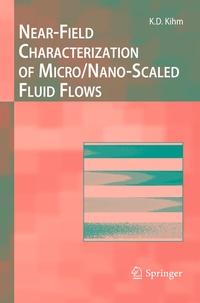
Near-Field Characterization of Micro/Nano-Scaled Fluid Flows
Description

The near-field region within an order of 100 nm from the solid interface is an exciting and crucial arena where many important multiscale transport phenomena are physically characterized, such as flow mixing and drag, heat and mass transfer, near-wall behavior of nanoparticles, binding of bio-molecules, crystallization, surface deposition processes, just naming a few. This monograph presents a number of label-free experimental techniques developed and tested for near-field fluid flow characterization. Namely, these include Total Internal Reflection Microscopy (TIRM), Optical Serial Sectioning Microscopy (OSSM), Surface Plasmon Resonance Microscopy (SPRM), Interference Reflection Contrast Microscopy (IRCM), Thermal Near-Field Anemometry, Scanning Thermal Microscopy (STM), and Micro-Cantilever Near-Field Thermometry. Presentation on each of these is laid out for the working principle, how to implement the system, and its example applications, to promote the readers understanding and knowledge of the specific technique that can be applied for their own research interests.
More details
Other editions
Additional editions
Person
The near-field - the region within 100 nm from a solid interface - is an exciting arena in which several important multi-scale transport phenomena are physically characterized, such as flow mixing and drag, heat and mass transfer, near-wall behavior of nanoparticles, the binding of bio-molecules, crystallization, and surface deposition processes, just to name a few. This book presents a number of microscopicimaging techniques that were implemented and tested for near-field fluidic characterizations. These methods include Total Internal Reflection Microscopy (TIRM), Optical Serial Sectioning Microscopy (OSSM), Confocal Laser Scanning Microscopy (CLSM), Surface Plasmon Resonance Microscopy (SPRM), and Reflection Interference Contrast Microscopy (RICM). The basic principles, specifics of implementation, and example applications of each method are presented in order to promote the reader's understanding of the techniques, so that these may be applied to their own research interests.
