

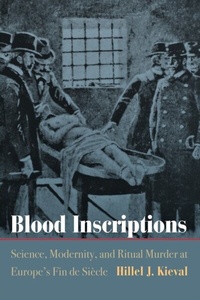
Blood Inscriptions
Science, Modernity, and Ritual Murder at Europe's Fin De Siecle
1st Edition
Published on 15. February 2022
328 pages
978-0-8122-9838-3 (ISBN)
Description

Although the Enlightenment had seemed to bring an end to the widely held belief that Jews murdered Christian children for ritual purposes, charges of the so-called blood libel were surprisingly widespread in central and eastern Europe on either side of the turn to the twentieth century. Well over one hundred accusations were made against Jews in this period, and prosecutors and government officials in Germany, Austria-Hungary, and Russia broke with long established precedent to bring six of these cases forward in sensational public trials. In Blood Inscriptions Hillel J. Kieval examines four cases-the prosecutions that took place at TiszaeszlAr in Hungary (1882-83), Xanten in Germany (1891-92), PolnA in Austrian Bohemia (1899-1900), and Konitz, then Germany, now in Poland (1900-1902)-to consider the means by which discredited beliefs came to seem once again plausible.
Kieval explores how educated elites took up the accusations of Jewish ritual murder and considers the roles played by government bureaucracies, the journalistic establishment, forensic medicine, and advanced legal practices in structuring the investigations and trials. The prosecutors, judges, forensic scientists, criminologists, and academic scholars of Judaism and other expert witnesses all worked hard to establish their epistemological authority as rationalists, Kieval contends. Far from being a throwback to the Middle Ages, these ritual murder trials were in all respects a product of post-Enlightenment politics and culture. Harnessed to and disciplined by the rhetoric of modernity, they were able to proceed precisely because they were framed by the idioms of scientific discourse and rationality.
Kieval explores how educated elites took up the accusations of Jewish ritual murder and considers the roles played by government bureaucracies, the journalistic establishment, forensic medicine, and advanced legal practices in structuring the investigations and trials. The prosecutors, judges, forensic scientists, criminologists, and academic scholars of Judaism and other expert witnesses all worked hard to establish their epistemological authority as rationalists, Kieval contends. Far from being a throwback to the Middle Ages, these ritual murder trials were in all respects a product of post-Enlightenment politics and culture. Harnessed to and disciplined by the rhetoric of modernity, they were able to proceed precisely because they were framed by the idioms of scientific discourse and rationality.
Reviews / Votes
"Blood Inscriptions is a superb contribution to the growing literature on the blood libel in Europe in the modern era. The book is a tour de force of historical research and reasoning that leaves no stone unturned and merits a wide audience...Kieval's analysis sheds light on the inner workings of the conspiratorial mindset and demonstrates how people may not believe in cabals but nonetheless find them politically expedient." (Quest: Issues in Contemporary Jewish History) "Hillel Kieval's Blood Inscriptions examines the turn-of-the-century resurgence and decline of anti-Jewish murder libels...[and] sheds new light on the interplay between elite and non-elite knowledge in a new media environment and the role modern state institutions played in responding to and resisting social pressures." (Isis) "Kieval's cogent new book examines the sudden spate of trials propelled by ritual murder accusations between 1882 and 1902 in Central Europe. This work, the culmination of two decades of research, draws upon interrogation protocols, medical examination reports, trial records, press accounts, polemical tracts, apologetic responses, contemporary reappraisals, and other Czech, German, Hebrew, and Hungarian documents in archives across Europe, Israel, and the United States...Blood Inscriptions is a worthy addition to the extensive scholarship on these trials specifically and on ritual murder accusations more generally." (Central European History) "This long-awaited book brings a wealth of scholarship and sources in German, Czech, and Hungarian to English-speaking audiences, and offers a new argument for how antisemitism and anti-Jewish violence and exclusion are part and parcel of political liberalism and modern epistemologies of forensic science and criminology. While such trials might have collapsed epistemologically by WWI, Kieval highlights the persistence of anti-Jewish violence and discourses of Jewish criminality throughout the twentieth century until today." (Slavic Review) "Blood Inscriptions offers a nuanced and compelling assessment of how and why a medieval religious canard found a receptive home among rational, enlightened, and secular Europeans." (Robert Weinberg, Swarthmore College)All prices
More details
Series
Language
English
Place of publication
Pennsylvania
United States
Target group
College/higher education
Illustrations
13 images
ISBN-13
978-0-8122-9838-3 (9780812298383)
Copyright in bibliographic data and cover images is held by Nielsen Book Services Limited or by the publishers or by their respective licensors: all rights reserved.
Schweitzer Classification
Other editions
Additional editions
Book
02/2022
University of Pennsylvania Press
€60.50
Shipment within 10-20 days
Person
Hillel J. Kieval is Gloria M. Goldstein Professor of Jewish History and Thought at Washington University in St. Louis and coeditor (with Katerina Capkova) of Prague and Beyond: Jews in the Bohemian Lands, also published by the University of Pennsylvania Press.
Content
A Note on Translation, Transliteration, and Orthography
Introduction. The Novelty of the Ritual Murder Trial in Fin de Siecle Europe
Chapter 1. History and Place: Hometown, Local Knowledge, and National Politics
Chapter 2. Hungarian Beginnings: The Tiszaeszlar Affair
Chapter 3. Roads to Prussia: From Tiszaeszlar to Xanten
Chapter 4. The Hilsner Affair
Chapter 5. The Many Trials of Konitz
Conclusion
Notes
Bibliography
Index
Acknowledgments
Introduction. The Novelty of the Ritual Murder Trial in Fin de Siecle Europe
Chapter 1. History and Place: Hometown, Local Knowledge, and National Politics
Chapter 2. Hungarian Beginnings: The Tiszaeszlar Affair
Chapter 3. Roads to Prussia: From Tiszaeszlar to Xanten
Chapter 4. The Hilsner Affair
Chapter 5. The Many Trials of Konitz
Conclusion
Notes
Bibliography
Index
Acknowledgments

