

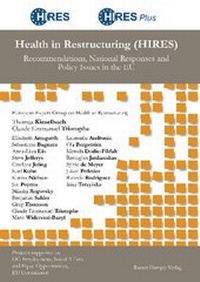
Health in Restructuring (HIRES)
Recommendations, National Responses and Policy Issues in the EU
2nd Edition
Published on 15. November 2010
271 pages
978-3-86618-598-2 (ISBN)
Description

Restructuring has become a daily practice in both private and public sectors in the EU. But often restructuring processes fail to produce the intended effects of secured or increased organizational profi tability. On the contrary restructuring puts the physical and psychosocial health of all organizational members at risk. To limit the risks of enterprise restructuring effectively, several groups of actors at the individual, enterprise and societal level have to collaborate towards the implementation of healthier change procedures and to create a "social convoy" in occupational transitions for workers affected by dismissal. The European Expert Group HIRES on Health in Restructuring was coordinated by Prof. Dr. Thomas Kieselbach from the University of Bremen and supported by DG Employment of the European Commission. It presented with its report a concise overview of the effects of enterprise restructuring and the social frameworks and change procedures that should be considered for "healthier restructuring". With its policy recommendations and the case studies of innovative approaches on a company and regional level the report addresses policy makers, governmental structures like labour inspectorates or federal institutes, unions, managers, occupational health and safety personnel, shareholders and workers alike. The public reception of the HIRES recommendations on Health in Restructuring was impressive all over Europe and across different institutions, stakeholders and professions. They were conceived before the economic crisis started but the development of the economies increased public awareness for the problems addressed in the HIRES report. It was disseminated on an international level within several scientifi c communities as well. The success of HIRES led to the follow-up project HIRES Plus (co-ordinated by Dr. Claude Emmanuel Triomphe (ASTREES, Paris) and Prof. Dr. Thomas Kieselbach, Bremen), which organized in 13 EU countries national workshops in order to increase awareness of main actors, discuss HIRES conclusions and to test them in the light of the national consultation process, discuss possible ways to include health as an issue when restructuring takes place and to develop networks at national and European levels.
More details
Other editions
Additional editions
Thomas Kieselbach | Claude Emmanuel Triomphe
Health in Restructuring (HIRES)
Recommendations, National Responses and Policy Issues in the EU
Book
11/2010
2nd Edition
Edition Rainer Hampp
€24.80
No shipping information available
Content
1 - Table of contents [Seite 5]
2 - Introductory remark [Seite 7]
3 - Executive Summary of the HIRES report [Seite 8]
4 - 1. Introduction [Seite 12]
4.1 - 1.1 The rationale and the actual background of the DG Employment project "Health in Restructuring" (HIRES) [Seite 12]
4.2 - 1.2 Social convoy in occupational transitions [Seite 18]
5 - 2. Restructuring and health: Reviewing present research [Seite 23]
5.1 - 2.1 Definition and typology of restructuring [Seite 23]
5.2 - 2.2 Measuring the prevalence and effects of restructuring on health at the EU level [Seite 26]
5.3 - 2.3 The effects on individual health [Seite 31]
5.4 - 2.4 The organisational health effects of restructuring [Seite 43]
6 - 3. European social frameworks and roles of social actors [Seite 50]
6.1 - 3.1 General policies of prevention and promotion 3.1.1 Origins and definitions [Seite 50]
6.2 - 3.2 Occupational health services: Their role in restructuring [Seite 56]
6.3 - 3.3 The role of social actors [Seite 59]
7 - 4. Tools, instruments, and practices [Seite 73]
7.1 - 4.1 Applying a systems approach to healthy changes in restructuring [Seite 73]
7.2 - 4.2 Labour inspection [Seite 74]
7.3 - 4.3 Regions and territories [Seite 77]
7.4 - 4.4 Public employment services [Seite 79]
7.5 - 4.5 Organisational level change practices [Seite 81]
7.6 - 4.6 Reprioritising health issues in restructuring by unions [Seite 91]
7.7 - 4.7 Individual level activities [Seite 92]
7.8 - 4.8 Core principles of change management [Seite 99]
8 - 5. Lessons from innovative approaches in restructuring andpolicy recommendations [Seite 101]
8.1 - 5.1 Concrete lessons from the case studies [Seite 102]
8.2 - 5.2 Policy recommendations [Seite 104]
8.3 - 1. Monitoring and evaluation [Seite 104]
8.4 - 2. Direct victims of downsizing: The dismissed [Seite 106]
8.5 - 3. Survivor reactions and organisational performance [Seite 107]
8.6 - 4. Managers responsible for the restructuring process [Seite 108]
8.7 - 5. Organisational anticipation and preparation [Seite 109]
8.8 - 6. Experienced justice and trust [Seite 110]
8.9 - 7. Change communication plan [Seite 111]
8.10 - 8. Protecting contingent and temporary workers [Seite 112]
8.11 - 9. ew directions for Labour Inspectorates [Seite 112]
8.12 - 10. Strengthening the role of Occupational Health Services [Seite 113]
8.13 - 11. Specific support for SMEs in restructuring [Seite 114]
8.14 - 12. New initiatives needed in Europe [Seite 114]
9 - References [Seite 116]
10 - About the authors of the HIRES report [Seite 128]
10.1 - Elisabeth Armgarth, B.Sc., [Seite 128]
10.2 - Sebastiano Bagnara, Prof. Dr., [Seite 128]
10.3 - Anna-Liisa Elo, Prof. Dr., [Seite 128]
10.4 - Steve Jefferys, Prof. [Seite 128]
10.5 - Catelijne Joling, Dr., [Seite 128]
10.6 - Thomas Kieselbach, Prof. Dr., [Seite 128]
10.7 - Karl Kuhn, Dr., M.A., [Seite 128]
10.8 - Karina ielsen, Dr., [Seite 128]
10.9 - Jan Popma, Dr., [Seite 129]
10.10 - ikolai Rogovsky, Dr., [Seite 129]
10.11 - Benjamin Sahler, Prof. Dr., [Seite 129]
10.12 - Greg Thomson, Dr., [Seite 129]
10.13 - Claude Emmanuel Triomphe, Dr., [Seite 129]
10.14 - Maria Widerszal-Bazyl, Dr., [Seite 129]
11 - Dissemination and Consultation of the HIRES Recommendations in 13 EU Countries (HIRES PLUS) [Seite 130]
12 - 1. Health and restructuring in the present crisis [Seite 130]
13 - 2. HIRES Plus workshops - national overviews [Seite 134]
14 - 3. Discussions about the HIRES recommendations [Seite 152]
15 - 4. Common policy issues [Seite 163]
16 - 5. Dissemination of the HIRES results [Seite 172]
17 - Annexes: National data and the HIRES case studies [Seite 176]
18 - 6. Empirical background information: ational data on restructuring and related effects on health [Seite 177]
19 - 6.1 Prevalence of restructuring and effects on health in Germany [Seite 177]
20 - 6.2 Consequences of restructuring on employability, health and well-being in [Seite 180]
21 - 6.3 Enterprise restructuring and the health of Dutch employees [Seite 183]
22 - 7.1 The ILO concept of Socially Sensitive Enterprise Restructuring [Seite 196]
23 - 7.2 Health policy in BT under continuous restructuring [Seite 201]
24 - 7.3 Business restructuring, health and well-being at AstraZeneca: HRMtools for personal and business benefit [Seite 208]
25 - 7.4 EDF Energy - Monitoring psychological well-being during change:Change management and resilience enhancement [Seite 214]
26 - 7.5 Restructuring Department A460 of the German pension fund:A BGF Case Study Report [Seite 222]
27 - 7.6 Restructuring and individual health: Ericsson and Manpower HealthPartner/Sweden [Seite 227]
28 - 7.7 Human Resources Management protocol on restructuring [Seite 234]
29 - 7.8 To protect the health of employees during restructuring: Case studiesfrom the pharmaceutical industry in France (ASP) [Seite 239]
30 - 7.9 How to prevent unhealthy effects of job restructuring using the FrenchA^ACT stress prevention toolkit? [Seite 243]
31 - 7.10 Closing of the Voikkaa paper factory: Supporting the health ofemployees [Seite 250]
32 - 7.11 Participative restructuring toward a cascade-based network [Seite 256]
33 - 7.12 Restructuring industry and developing a competitive economy underhealthy conditions with special focus on SMEs: Policy and actions in^orth Rhine-Westphalia (Germany) [Seite 262]
34 - 7.13 Group method for promoting career management and preventingsymptoms of depression in work organisations (FIOH) [Seite 269]
2 - Introductory remark [Seite 7]
3 - Executive Summary of the HIRES report [Seite 8]
4 - 1. Introduction [Seite 12]
4.1 - 1.1 The rationale and the actual background of the DG Employment project "Health in Restructuring" (HIRES) [Seite 12]
4.2 - 1.2 Social convoy in occupational transitions [Seite 18]
5 - 2. Restructuring and health: Reviewing present research [Seite 23]
5.1 - 2.1 Definition and typology of restructuring [Seite 23]
5.2 - 2.2 Measuring the prevalence and effects of restructuring on health at the EU level [Seite 26]
5.3 - 2.3 The effects on individual health [Seite 31]
5.4 - 2.4 The organisational health effects of restructuring [Seite 43]
6 - 3. European social frameworks and roles of social actors [Seite 50]
6.1 - 3.1 General policies of prevention and promotion 3.1.1 Origins and definitions [Seite 50]
6.2 - 3.2 Occupational health services: Their role in restructuring [Seite 56]
6.3 - 3.3 The role of social actors [Seite 59]
7 - 4. Tools, instruments, and practices [Seite 73]
7.1 - 4.1 Applying a systems approach to healthy changes in restructuring [Seite 73]
7.2 - 4.2 Labour inspection [Seite 74]
7.3 - 4.3 Regions and territories [Seite 77]
7.4 - 4.4 Public employment services [Seite 79]
7.5 - 4.5 Organisational level change practices [Seite 81]
7.6 - 4.6 Reprioritising health issues in restructuring by unions [Seite 91]
7.7 - 4.7 Individual level activities [Seite 92]
7.8 - 4.8 Core principles of change management [Seite 99]
8 - 5. Lessons from innovative approaches in restructuring andpolicy recommendations [Seite 101]
8.1 - 5.1 Concrete lessons from the case studies [Seite 102]
8.2 - 5.2 Policy recommendations [Seite 104]
8.3 - 1. Monitoring and evaluation [Seite 104]
8.4 - 2. Direct victims of downsizing: The dismissed [Seite 106]
8.5 - 3. Survivor reactions and organisational performance [Seite 107]
8.6 - 4. Managers responsible for the restructuring process [Seite 108]
8.7 - 5. Organisational anticipation and preparation [Seite 109]
8.8 - 6. Experienced justice and trust [Seite 110]
8.9 - 7. Change communication plan [Seite 111]
8.10 - 8. Protecting contingent and temporary workers [Seite 112]
8.11 - 9. ew directions for Labour Inspectorates [Seite 112]
8.12 - 10. Strengthening the role of Occupational Health Services [Seite 113]
8.13 - 11. Specific support for SMEs in restructuring [Seite 114]
8.14 - 12. New initiatives needed in Europe [Seite 114]
9 - References [Seite 116]
10 - About the authors of the HIRES report [Seite 128]
10.1 - Elisabeth Armgarth, B.Sc., [Seite 128]
10.2 - Sebastiano Bagnara, Prof. Dr., [Seite 128]
10.3 - Anna-Liisa Elo, Prof. Dr., [Seite 128]
10.4 - Steve Jefferys, Prof. [Seite 128]
10.5 - Catelijne Joling, Dr., [Seite 128]
10.6 - Thomas Kieselbach, Prof. Dr., [Seite 128]
10.7 - Karl Kuhn, Dr., M.A., [Seite 128]
10.8 - Karina ielsen, Dr., [Seite 128]
10.9 - Jan Popma, Dr., [Seite 129]
10.10 - ikolai Rogovsky, Dr., [Seite 129]
10.11 - Benjamin Sahler, Prof. Dr., [Seite 129]
10.12 - Greg Thomson, Dr., [Seite 129]
10.13 - Claude Emmanuel Triomphe, Dr., [Seite 129]
10.14 - Maria Widerszal-Bazyl, Dr., [Seite 129]
11 - Dissemination and Consultation of the HIRES Recommendations in 13 EU Countries (HIRES PLUS) [Seite 130]
12 - 1. Health and restructuring in the present crisis [Seite 130]
13 - 2. HIRES Plus workshops - national overviews [Seite 134]
14 - 3. Discussions about the HIRES recommendations [Seite 152]
15 - 4. Common policy issues [Seite 163]
16 - 5. Dissemination of the HIRES results [Seite 172]
17 - Annexes: National data and the HIRES case studies [Seite 176]
18 - 6. Empirical background information: ational data on restructuring and related effects on health [Seite 177]
19 - 6.1 Prevalence of restructuring and effects on health in Germany [Seite 177]
20 - 6.2 Consequences of restructuring on employability, health and well-being in [Seite 180]
21 - 6.3 Enterprise restructuring and the health of Dutch employees [Seite 183]
22 - 7.1 The ILO concept of Socially Sensitive Enterprise Restructuring [Seite 196]
23 - 7.2 Health policy in BT under continuous restructuring [Seite 201]
24 - 7.3 Business restructuring, health and well-being at AstraZeneca: HRMtools for personal and business benefit [Seite 208]
25 - 7.4 EDF Energy - Monitoring psychological well-being during change:Change management and resilience enhancement [Seite 214]
26 - 7.5 Restructuring Department A460 of the German pension fund:A BGF Case Study Report [Seite 222]
27 - 7.6 Restructuring and individual health: Ericsson and Manpower HealthPartner/Sweden [Seite 227]
28 - 7.7 Human Resources Management protocol on restructuring [Seite 234]
29 - 7.8 To protect the health of employees during restructuring: Case studiesfrom the pharmaceutical industry in France (ASP) [Seite 239]
30 - 7.9 How to prevent unhealthy effects of job restructuring using the FrenchA^ACT stress prevention toolkit? [Seite 243]
31 - 7.10 Closing of the Voikkaa paper factory: Supporting the health ofemployees [Seite 250]
32 - 7.11 Participative restructuring toward a cascade-based network [Seite 256]
33 - 7.12 Restructuring industry and developing a competitive economy underhealthy conditions with special focus on SMEs: Policy and actions in^orth Rhine-Westphalia (Germany) [Seite 262]
34 - 7.13 Group method for promoting career management and preventingsymptoms of depression in work organisations (FIOH) [Seite 269]
3. Discussions about the HIRES recommendations (S. 151-152)
The primary aim of the HIRES Plus project was to evaluate the reception of the policy recommendations that had been developed in the HIRES project. Therefore the concrete 12 recommendations played an important role in the national seminars organized in the 13 EU countries involved in HIRES Plus. The debates in all countries showed an overwhelming overall acceptance of the HIRES recommendations, which went beyond anything expected by the coordinators.
There were hardly any participants who did not emphasize the importance of the subject itself and only few doubted the concrete recommendations in regard to their feasibility or viability. Only the Italian seminar mentioned a specific need to include in the risk assessment of restructuring also the small businessmen who go bankrupt due to the crisis as a target group for considerations on health in restructuring. An evaluation by the participants was done at the Bulgarian seminar: all respondents considered it useful, very relevant to the economic situation of the country and that such national fora with international participation were assessed as very pertinent.
Many other seminars stressed the necessity of a continuity of national workshops focussing on recommendations like the HIRES ones. Only two seminars, those in the Netherlands and in Denmark, systematically prioritized the recommendations. The participants in NL considered the recommendations on managers (4), justice and trust (6) and temporary employees (8) as the most important ones, and identified as the least important ones those on OHS (9), direct victims (2) and monitoring (1). The members of the Danish seminar prioritized as well the recommendation on managers as most important (4), followed by communication plan (7), survivors (3), and justice and trust (6).
3.1 Monitoring and evaluation
The lack of empirical data and integrated data collection on a national level was widely mentioned and criticized. Especially on a company level data was rarely collected with specific regard to the restructuring processes. In addition monitoring needs a joint treatment of the two critical dimensions of employment and health in data collection and research. In order to establish causal relationships and to know more about the after-effects of unhealthy restructuring also in-depth studies with a long-term monitoring should be established parallel to short-term approaches that are of more use for immediate evaluations.
A necessary prerequisite is that the psychosocial risks associated with restructuring are integrated in the risk assessment in general, and in the assessment of psychosocial risks specifically. In some countries risk assessment does not even include the psychosocial dimension (like in the Spanish Mutual Societies).
The primary aim of the HIRES Plus project was to evaluate the reception of the policy recommendations that had been developed in the HIRES project. Therefore the concrete 12 recommendations played an important role in the national seminars organized in the 13 EU countries involved in HIRES Plus. The debates in all countries showed an overwhelming overall acceptance of the HIRES recommendations, which went beyond anything expected by the coordinators.
There were hardly any participants who did not emphasize the importance of the subject itself and only few doubted the concrete recommendations in regard to their feasibility or viability. Only the Italian seminar mentioned a specific need to include in the risk assessment of restructuring also the small businessmen who go bankrupt due to the crisis as a target group for considerations on health in restructuring. An evaluation by the participants was done at the Bulgarian seminar: all respondents considered it useful, very relevant to the economic situation of the country and that such national fora with international participation were assessed as very pertinent.
Many other seminars stressed the necessity of a continuity of national workshops focussing on recommendations like the HIRES ones. Only two seminars, those in the Netherlands and in Denmark, systematically prioritized the recommendations. The participants in NL considered the recommendations on managers (4), justice and trust (6) and temporary employees (8) as the most important ones, and identified as the least important ones those on OHS (9), direct victims (2) and monitoring (1). The members of the Danish seminar prioritized as well the recommendation on managers as most important (4), followed by communication plan (7), survivors (3), and justice and trust (6).
3.1 Monitoring and evaluation
The lack of empirical data and integrated data collection on a national level was widely mentioned and criticized. Especially on a company level data was rarely collected with specific regard to the restructuring processes. In addition monitoring needs a joint treatment of the two critical dimensions of employment and health in data collection and research. In order to establish causal relationships and to know more about the after-effects of unhealthy restructuring also in-depth studies with a long-term monitoring should be established parallel to short-term approaches that are of more use for immediate evaluations.
A necessary prerequisite is that the psychosocial risks associated with restructuring are integrated in the risk assessment in general, and in the assessment of psychosocial risks specifically. In some countries risk assessment does not even include the psychosocial dimension (like in the Spanish Mutual Societies).
