

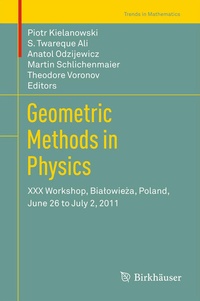
Geometric Methods in Physics
Description

The Bialowieza workshops on Geometric Methods in Physics are among the most important meetings in the field. Every year some 80 to 100 participants from both mathematics and physics join to discuss new developments and to interchange ideas. This volume contains contributions by selected speakers at the XXX meeting in 2011 as well as additional review articles and shows that the workshop remains at the cutting edge of ongoing research.
The 2011 workshop focussed on the works of the late Felix A. Berezin (1931-1980) on the occasion of his 80th anniversary as well as on Bogdan Mielnik and Stanislaw Lech Woronowicz on their 75th and 70th birthday, respectively. The groundbreaking work of Berezin is discussed from today's perspective by presenting an overview of his ideas and their impact on further developments. He was, among other fields, active in representation theory, general concepts of quantization and coherent states, supersymmetry and supermanifolds.
Another focus lies on the accomplishments of Bogdan Mielnik and Stanislaw Lech Woronowicz. Mielnik's geometric approach to the description of quantum mixed states, the method of quantum state manipulation and their important implications for quantum computing and quantum entanglement are discussed as well as the intricacies of the quantum time operator. Woronowicz' fruitful notion of a compact quantum group and related topics are also addressed.
More details
Other editions
Additional editions

Content
- Intro
- Geometric Methods in Physics
- Contents
- Preface
- Address of Professor Krzysztof Maurin
- The Bialowieza Workshop on Geometric Methods in Physics: An Impression of Three Extraordinary Decades
- References
- Part I Quantization, Supergeometry and Representation Theory, the Scientific Legacy of Felix A. Berezin
- Felix Alexandrovich Berezin and His Work
- 1. Preface
- 2. Laplace operators on semisimple Lie groups
- 2.1. Berezin's Ph.D. thesis: characters of complex semisimple Lie groups and classification of irreducible representations
- 2.2. Radialpar ts of Laplace operators
- 3. Method of second quantization
- 3.1. Prehistory
- 3.2. Operators and divergences
- 3.3. Weil representation
- 3.4. Fermionic Fock space
- 3.5. History and references
- 3.6. Berezin's book in physics
- 4. Berezin's generalco ncept of quantization
- 4.1. Poisson bracket and quantization on the dualo f a Lie algebra
- 4.2. Generalcon cept of quantization as deformation
- 4.3. Berezin's quantization using symbols
- 4.4. Influence of Berezin's work
- 5. Supermathematics
- 5.1. Introductory remarks
- 5.2. Analysis on a Grassmann algebra
- 5.3. From Grassmann algebras to supermanifolds
- 5.4. Emergence of supersymmetric models and the explicit introduction of supermanifolds
- 5.5. Berezin's work on supermathematics in 1975-1980
- 5.6. Influence. Later developments
- Acknowledgment
- References
- Some Non-standard Examples of Coherent States and Quantization
- 1. Standard coherent states
- 2. Module-valued coherent states
- 3. MVCS from certain Cuntz algebras
- 4. Matrix-valued and quaternionic MVCS
- 5. Some possible applications
- References
- Classical and Quantum Evolution on the Siegel-Jacobi Manifolds
- 1. Introduction
- 2. Coherent states attached to the Jacobi group GJ1
- 3. The homogeneous Kähler diffeomorphisms for DJ1, XJ1
- 4. Motion on the Siegel-Jacobi DJ1 manifolds XJ1
- 5. The fundamental conjecture for the Siegel-Jacobi manifolds
- Acknowledgment
- References
- Exhausting Formal Quantization Procedures
- 1. Introduction
- 2. The full directed graph complex dfGC
- 3. Stable formality quasi-isomorphisms
- 4. Globalization of stable formality quasi-isomorphisms
- Acknowledgment
- References
- On One Result of F. Berezin
- References
- Berezin Quantization on Para-Hermitian Symmetric Spaces
- 1. Berezin quantization
- 2. Para-Hermitian symmetric spaces
- 3. Maximald egenerate series representations
- 4. Super complete systems and symbols
- 5. Canonical representations and quantization
- 6. Quantization on rank one spaces
- References
- Remarks on Singular Symplectic Reduction and Quantization of the Angular Moment
- 1. Introduction
- 2. Regular symplectic reduction
- 3. Singular reduction
- 4. Poisson bracket in singular surfaces
- 5. Commuting matrices
- 6. Deformation quantization of a singular surface
- 7. Next steps
- References
- Duality and the Abel Map for Complex Supercurves
- 1. Introduction
- 2. Definitions and examples
- 3. Divisors and the dualcur ve
- 4. Differentials, integration, line bundles
- 5. Abel's theorem and Jacobi inversion
- 6. Open problems
- References
- Berezin's Coherent States, Symbols and Transform for Compact Kähler Manifolds
- 1. Introduction
- 2. The geometric setup
- 3. Berezin-Toeplitz operators
- 4. The Berezin-Toeplitz deformation quantization
- 5. The disc bundle
- 6. Coherent vectors and states
- 7. Covariant Berezin symbol
- 8. Berezin transform
- 8.1. Application: Berezin star products
- 8.2. Application: Calculation of the coefficients of the star products
- 9. Contravariant symbols
- References
- Physically Acceptable Solutions of an Eigenvalue Equation in Deformation Quantization
- 1. Introduction
- 2. States in quantum mechanics
- 2.1. A density operator
- 2.2. Wigner functions for systems in the phase space R²
- 3. Physical solutions of an eigenvalue equation
- Acknowledgment
- References
- A Classification Theorem and a Spectral Sequence for a Locally Free Sheaf Cohomology of a Supermanifold
- 1. Main definitions and classification theorems
- 1.1. Main definitions
- 1.2. Classification theorem for locally free sheaves e on supermanifolds with given e
- 2. The spectral sequence
- 2.1. Quasi-derivations
- 2.2. The spectralsequence
- Acknowledgment
- References
- Part II Foundations of Quantum Mechanics
- Bogdan Mielnik: Contributions to Quantum Control
- 1. Introduction
- 2. Controlof systems with time-independent Hamiltonians
- 3. Controlof systems with time-dependent Hamiltonians
- 3.1. One-dimensionalsystems
- 3.2. Three-dimensionalsystems
- 4. Conclusions
- Acknowledgment
- References
- PartialInner Product Spaces, a Unifying Language for Quantum Mechanics
- 1. Introduction
- 2. Partiali nner product spaces
- 2.1. Basic definitions
- 2.2. Lattices of Hilbert or Banach spaces
- 2.3. Examples
- (i) Scales of Hilbert or Banach spaces
- (ii) Sequence spaces
- (iii) Spaces of locally integrable functions
- (iv) The spaces Lp(R, dx)
- 3. Operators on PIP-spaces
- 3.1. Basic idea
- 3.2. Algebraic operations on operators
- 4. Specialc lasses of operators on PIP-spaces
- 4.1. Homomorphisms
- 4.2. Symmetric operators
- 4.3. Orthogonalp rojections
- References
- The Resonance-Decay Problem in Quantum Mechanics
- 1. Introduction
- 2. Decay
- 3. Resonances
- 4. Spectraltheor etic approach to resonances
- 5. Canonicaltr ansfer of the characteristic semigroup to
- 6. Time-dependent characterization of the set of all resonances
- 7. Conclusion
- Acknowledgment
- References
- Geometry of the Set of Mixed Quantum States: An Apophatic Approach
- 1. Introduction
- 2. Classical and quantum states
- 2.1. Classical case: the probability simplex
- 2.2. The Bloch ball
- 2.3. Quantum case:
- 2.4. Duala nd self-dualcon vex sets
- 3. An apophatic approach to the qutrit
- 4. A constructive approach
- 4.1. The duality between projections and cross-sections
- 4.2. Two-dimensionalpr ojections and cross-sections
- 4.3. Exposed and non-exposed faces
- 5. When the dimension matters
- 6. Concluding remarks
- Acknowledgement
- Appendix. Trigonometric curves
- References
- Solution Hierarchies for the Painlev´e IV Equation
- 1. Introduction
- 2. Generalframew ork of SUSY QM and PHA
- 3. Real and complex solutions of PIV with realp arameters
- 4. Reals olution hierarchies
- 4.1. Confluent hypergeometric function hierarchy
- 4.2. Error function hierarchy
- 4.3. Rationalh ierarchy
- 4.4. First kind modified Besself unction hierarchy
- 5. Complex solution hierarchies
- 5.1. Confluent hypergeometric hierarchy
- 5.2. Error function hierarchy
- 5.3. Imaginary error function hierarchy
- 5.4. First kind modified Besself unction hierarchy
- 6. Conclusions
- Acknowledgment
- References
- The Marvelous Consequences of Hardy Spaces in Quantum Physics
- 1. Introduction
- 2. The mathematics of time symmetric quantum mechanics and its conflict with causality
- 2.1. The Hilbert space boundary condition of the dynamical equations
- 2.2. Dirac formalism and the Schwartz space boundary conditions
- 2.3. A causality condition for quantum mechanics
- 3. In-states, out-observables, and the Lippmann-Schwinger kets suggest the Hardy space axiom
- 4. Conclusion: Time asymmetry of quantum physics from the Hardy space axiom
- References
- Factorization Method and the Position-dependent Mass Problem
- 1. Introduction
- 2. Classical position-dependent mass systems
- 3. Quantum position-dependent mass systems
- 4. Concluding remarks
- Acknowledgment
- References
- Quantum Configuration Spaces of Extended Objects, Diffeomorphism Group Representations and Exotic Statistics
- 1. Introduction
- 2. Diffeomorphism group representations and quantum configuration spaces
- 3. Induced representations and particle statistics
- 4. Exotic statistics for extended configurations
- References
- Convex Geometry: A Travelto the Limits of Our Knowledge
- Questions about the structure
- Quantum logic?
- Convex geometry
- Logic of properties
- Counters
- Detection ratios
- The orthodox geometry
- Generalized geometries: are they possible?
- References
- A Time of ArrivalOp erator on the Circle (Variations on Two Ideas)
- 1. Introduction
- 2. A time of arrivalop erator on the circle
- 3. A waiting screen
- Acknowledgment
- References
- Negative Time Delay for Wave Reflection from a One-dimensionalSemi-harmonic Well
- Acknowledgment
- References
- Part III Quantum Groups and Non-commutative Structures
- Characterizing Non-Markovian Dynamics
- 1. Introduction
- 2. Positive linear maps
- 3. Dynamicalmaps
- 4. Markovianity versus divisibility
- 5. Markovianity versus flow of information
- 6. Heisenberg picture
- 7. Conclusions
- References
- Deformation Quantization of a Harmonic Oscillator in a General Non-commutative Phase Space: Energy Spectrum in Relevant Represen
- 1. Introduction
- 2. Deformation Quantization (DQ) in NC phase space
- 2.1. Harmonic oscillator eigenvalue equation in annihilation and creation operator representation
- 2.2. Harmonic oscillator eigenvalue equation in
- representation
- 2.2.1. Case Ø =-Ø
- 2.2.2. Case Ø = Ø
- 2.3. Harmonic oscillator eigenvalue equation in a general (q, ) representation
- Acknowledgment
- References
- Uniqueness Property for C* -algebras Given by Relations with Circular Symmetry
- 1. Introduction
- 2. Uniqueness property, universal C* -algebras and gauge actions
- 3. Gauge actions - exploring the symmetries in the relations
- 4. From relations to Hilbert bimodules
- 5. Applications to crossed products and Cuntz-Krieger algebras
- 5.1. Crossed products by monomorphisms with hereditary range
- 5.2. Cuntz-Krieger algebras
- References
- Part IV GeneralMetho ds
- On Maximal R-split Tori Invariant under an Involution
- 1. Introduction and notation
- 1.1. Notation
- 2. Cartan involutions
- Definition 2.
- Theorem 2 ([3, Lemma 10.2]).
- Theorem 3 ([4, Theorem 10.6]).
- Corollary 4 ([1, Corollary 12.11]).
- 3. Characterizing standard involutions
- 3.1. Standard position
- 3.2. Singular involutions
- 4. H-conjugacy classes of 2( , )
- 5. Hk-conjugacy classes of ()-stable maximal k-split tori
- 5.1. Associated Pairs
- References
- Pencils of Conics as a Classification Code
- 1. Pencils of conics
- 2. Petrov classification
- 3. Integrable quad-graphs
- 4. Discriminantly separable polynomials
- 5. Quantum Yang-Baxter equation
- 6. Quadrirationalma ps
- Acknowledgment
- References
- Geodesic Mappings and Einstein Spaces
- 1. Introduction
- 2. Geodesic mappings theory for Vn Vn of class C1
- 3. Geodesic mappings theory for Vn Vn of class C2
- 4. Geodesic mappings between Vn ? Cr (r & 2) and Vn ? C2
- 5. On geodesic mappings of Einstein spaces
- References
- Racah Operators
- 1. Racah operators for a product of three representations
- 2. Racah operators for a product of many representations
- 3. The case of the motion group
- construction for Racah operators
- 4. Hinge transformation and explicit form for Racah operators for three representations
- 5. Hinge transformation and explicit form for Racah operators for many representations
- References
- q-discord for Generalized Entropy Functions
- 1. Introduction
- 2. q-discord
- 3. Finalre marks
- References
- Pseudopotentials via Moutard Transformations and DifferentialGeometry
- 1. Introduction
- 2. Generali dea of ZRP introduction by dressing procedure
- 3. Two-dimensionalZR P and Moutard transformation
- 4. Goursat equation, matrix ZRP and geometry of surfaces
- 5. Discussion and conclusion
- References
- Proving the Jacobi Identity the Hard Way
- 1. Preliminaries on double vector bundles
- 2. Triple vector bundles
- 3. Proof of the Jacobi identity
- 4. Proof of Theorem 1
- 5. Concluding remarks
- References
- Löwner-Kufarev Evolution in the Segal-Wilson Grassmannian
- 1. Introduction
- 2. Löwner-Kufarev evolution
- 3. Hamiltonian formalism
- 4. Curves in Grassmannian
- 5. t--function
- References
- The pre-Maxwell Equations
- 1. The definition of the pre-Maxwell equations
- 2. Properties of space-times admitting the pre-Maxwell equations
- 3. Integrals of the pre-Maxwell equations in a flat space-time
- 4. Integrals of the pre-Maxwell Equations in a de Sitter Space-Time
- Acknowledgment
- References
- Serret's Curves, their Generalization and Explicit Parametrizations
- 1. Introduction
- 2. Serret's curves
- 3. The Frenet-Serret equations
- 4. Reconstruction of the plane curve from its curvature
- 5. Generalized Serret's curves and their explicit parametrization
- 6. Concluding remarks
- Acknowledgment
- References
- Harmonic Spheres Conjecture
- Introduction
- 1. Harmonic maps
- 2. Instantons and Yang-Mills fields
- 3. Twistor interpretation of instantons
- 4. Twistor interpretation of harmonic spheres
- 5. Harmonic spheres in complex Grassmann manifolds
- 6. Atiyah theorem
- 7. Harmonic spheres conjecture
- 8. Twistor bundle over the loop space
- 9. Back to harmonic spheres conjecture
- References
- Lax Equations and the Knizhnik-Zamolodchikov Connection
- 1. Introduction
- 2. Phase space and Hamiltonians of a Lax integrable system
- 2.1. Lax operators on Riemann surfaces
- 2.2. Lax operator algebras Theorem 1 (Lie algebra structure, [2]).
- 2.3. Lax equations
- 2.4. Examples
- 2.5. Hierarchy of commuting flows, and Hamiltonians Theorem 4 ([1, 3]).
- 3. Conformal field theory related to a Lax integrable system
- 3.1. Spectralcurv es, and the Kodaira-Spencer cocycle
- 3.2. Commutative Krichever-Novikov algebra, and its representation
- 3.3. Sugawara representation
- 4. Representation of the algebra of Hamiltonian vector fields
- 4.1. Conformal blocks and Knizhnik-Zamolodchikov connection
- 4.2. Representation of Hamiltonian vector fields and commuting Hamiltonians. Unitarity
- Acknowledgment
- References
- Short-time Asymptotics for Semigroups of Diffusion Type and Beyond
- Wiener path integralr epresentation for heat kernel
- Diffusion with a drift: Feynman-Kac-It^o formul a
- Semigroups generated by perturbation of bi-Laplacian
- Schwartz kernelshort-time asymptotics
- References
- Part V SpecialT alk by Bogdan Mielnik
- Bureaucratic World: Is it Unavoidable?
- The abstract pollution. . .
- Four Laws of Bureaucracy:
- From prehistory to the dark age
- Is the democracy failing?
- Heavy or light pathologies?. . .
- Crisis and consequences
- The informatics revolution
- The Anti-parliament?
- Acknowledgment
- References
