

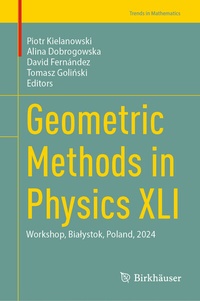
Geometric Methods in Physics XLI
Description

This volume collects papers based on lectures given at the XLI Workshop on Geometric Methods in Physics, held in Bialystok, Poland in July 2024 as well as extended abstracts of minicourses presented during the XIII School on Geometry and Physics. These chapters provide readers an overview of cutting-edge research in quantum field theories, infinite-dimensional groups, integrable systems, noncommutative geometry, and a wide variety of other areas. Specific topics include:
Graded structures
Lie algebra structures
Quasicrystals
Sigma models
Barycentric algebras
Nijenhuis geometry
Geometric Methods in Physics XLI will be a valuable resource for mathematicians and physicists interested in recent developments at the intersection of these areas.
More details
Other editions
Additional editions
Persons
Dr. Piotr Kielanowski
is a professor of theoretical and mathematical physics at the University of Bialystok,
Poland and during the period 1995-2023 he was a professor at the Center for Research and Advanced Studies of
the Polytechnic University of Mexico in Mexico City (Centro de Investigación y de Estudios Avanzados). He
has published more than 80 original papers in the field of particle phenomenology and has mentored several
PhD students. He is co-author of a book on quantum mechanics (Arno Bohm, Piotr Kielanowski, G. Bruce
Mainland, Quantum Physics States, Observables and Their Time Evolution, Springer 2019, ISBN: 978-94-024-
1760-9). He has been a member of the Organizing Committee of the Bialowieza Workshop on Geometric
Methods in Physics for about 20 years and has been the editor of successive volumes of the proceedings.
Alina Dobrogowska
is an associate professor of mathematics at the University of Bialystok. Since
2019, she has served as dean of the Faculty of Mathematics at the University of Bialystok. Her
scientific interests focus on topics such as: factorization method, orthogonal polynomials, integrable
systems, bi-Hamiltonian structures, Poisson geometry, Lie algebras and Lie algebroids. She has
published around 40 original papers. She is also a coauthor of the book 40 Years of Workshop on
Geometric Methods in Physics. She has been the member of the Organizing Committee of the
Workshop on Geometric Methods in Physics since 2001 and has been the editor of recent volumes of
the proceedings.
Dr. David Fernández
is a professor of theoretical physics at the Center for Research and Advanced Studies of
the National Polytechnic Institute in Mexico City. He has published more than 80 original papers in the field of
mathematical physics and has mentored 14 PhD students. He has made important contributions in the
generation of exactly solvable Hamiltonians through the factorization method and supersymmetric quantum
mechanics. He has been a member of the Advisory Committee of the Bialowieza Workshop on Geometric
Methods in Physics since 2016.
Dr. Tomasz Golinski
is an assistant professor of mathematics at the University of Bialystok,
Poland. He has published around 20 original papers in the field of integrable systems and infinitedimensional
geometry. He has been the scientific secretary of the Workshop on Geometric Methods
in Physics since 2003 and has been the editor of recent volumes of the proceedings. He is also a
coauthor of the volume 40 Years of Workshop on Geometric Methods in Physics.
Content
Part I: Workshop Lectures.- Chapter 1 Scattering in phase space quantum mechanics - the Born approximation.- Chapter 2 The Schwarzschild's solution and Mach's principle.- Chapter 3 Geometric flows, entropy and nonlinear electrodynamics.- Chapter 4 Weird, Odd, Generalized.- Chapter 5 Restricted orbits of closed range operators.- Chapter 6 On certain Lie algebra structures.- Chapter 7 Darboux transformations applied to graphene in magnetic fields.- Chapter 8 Variants of asymptotics in the Belinski-Khalatnikov-Lifshitz scenario.- Chapter 9 Poisson structures in the Banach setting: comparison of different approaches -2.- Chapter 10 Q-manifolds and sigma models.- Chapter 11 Quasicrystal problem - on rigidity of non-periodic structures from statistical mechanics point of view.- Chapter 12 Qusicrystals in Vernam cipher.- Chapter 13 Explicit Formulae for Deformation Quantization with Separation of Variables of G2,4(C) .- Chapter 14 On the conformal Lie superalgebras K(1; N = 1; 2; 3) and related semi-supersymmetric integrable systems.- Chapter 15 Notes on equivalent formulations of Hamiltonian dynamics on multicotangent bundles.- Chapter 16 Star Product and Star Zeta Function.- Chapter 17 Partitions of unity and barycentric algebras.- Part II: Abstracts of Lectures at "XIII School on Geometry and Physics".- Chapter 18 Nijenhuis Geometry and its Applications.- Chapter 19 Generalized geometry in relation to physics and mechanics -3 .- Chapter 20 Barycentric algebras - convexity and order.
