

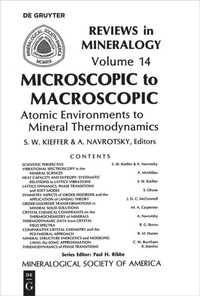
Microscopic to Macroscopic
Description

Volume 14 of Reviews in Mineralogy covers a short course about the relations among the microscopic structure of minerals and their macroscopic thermodynamic properties. Understanding the micro-to-macro relations provides a rigorous theoretical foundation for formulation of energy relations. With such a foundation, measured parameters can be understood, and extrapolation and prediction of thermodynamic properties beyond the range of measurement can be done with more confidence than if only empirical relations are used.
The purpose of this course is to consider the microscopic factors that influence the free energy of minerals: atomic environments, bonding, and crystal structure. These factors influence the structural energy and the detailed nature of the lattice vibrations which are an important source of entropy and enthalpy at temperatures greater than 0 K. The same factors determine the relative energy of different phases, and thereby; the relative stability of different minerals. Configurational entropy terms arising from disorder also contribute to the energy and entropy. In transition metal compounds there are additional energy and entropy terms arising from the electronic configurations, leading to additional stabilizations, magnetic ordering, and, incidentally, color.
Organized by Sue Kieffer and Alex Navrotsky, the course was presented by the ten authors of this book on the campus of Washington College in Chestertown, Maryland. This was the second of MSA's short courses to be given in conjunction with meetings of the American Geophysical Union.
More details
Other editions
Additional editions
Persons
Susan Werner Kieffer , United States Geological Survey, Arizona, USA and Alexandra Navrotsky , Arizona State University, Arizona, USA.
Content
- Intro
- REVIEWS in MINERALOGY
- FOREWORD
- TABLE OF CONTENTS
- Chapter 1. SCIENTIFIC PERSPECTIVE
- Chapter 2. VIBRATIONAL SPECTROSCOPY in the MINERAL SCIENCES
- Chapter 3. HEAT CAPACITY and ENTROPY: SYSTEMATIC RELATIONS to LATTICE VIBRATIONS
- Chapter 4. LATTICE DYNAMICS, PHASE TRANSITIONS and SOFT MODES
- Chapter 5. SYMMETRY ASPECTS of ORDER-DISORDER and the APPLICATION of LANDAU THEORY
- Chapter 6. ORDER-DISORDER TRANSFORMATIONS in MINERAL SOLID SOLUTIONS
- Chapter 7. CRYSTAL CHEMICAL CONSTRAINTS on the THERMOCHEMISTRY of MINERALS
- Chapter 8. THERMODYNAMIC DATA from CRYSTAL FIELD SPECTRA
- Chapter 9. COMPARATIVE CRYSTAL CHEMISTRY and the POLYHEDRAL APPROACH
- Chapter 10. MINERAL STRUCTURE ENERGETICS and MODELING USING the IONIC APPROACH
- Chapter 11. THERMODYNAMICS of PHASE TRANSITIONS
- APPENDIX A. The Continuum Approach: Debye Model, Velocity- Density Systematics and Entropy-Volume Correlation
- APPENDIX B. Interatomic Model for Entropy Change with Coordination Change
- ACKNOWLEDGEMENTS
- REFERENCES
