

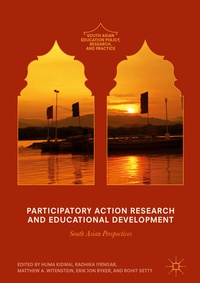
Participatory Action Research and Educational Development
South Asian Perspectives
Published on 11. April 2017
XXIX, 290 pages
978-3-319-48905-6 (ISBN)
Description

This volume brings together diverse thinkers and practitioners on Participatory Action Research (PAR) and educational development in South Asia. Contributors draw from their research and field experiences on how PAR is currently being understood, theorized, debated, and implemented for education of children in South Asia. This book will act as a key reference text for academics, students, and practitioners interested in the intersection of education and participatory development in the region. The book opens a constructive debate on PAR approaches to education and proposes a reflective framework that allows the reader to develop their perspectives about the conceptual, methodological, and sociopolitical potential and limitations of participatory approaches.
Reviews / Votes
"This is a valuable contribution and will be of interest to all concerned with the practice and theory of Participatory Action Research. Its firm empirical grounding, combined with the rich diversity of the contributions makes it a treasure trove for practitioners and others, both in South Asia and internationally." (Robert Chambers, Institute of Development Studies, University of Sussex, UK)"Thought-provoking and accessible, this book challenges the taken-for-granted approaches to restructuring education by positioning practice as vitally informing policy, and by effectively demonstrating how perspectives from research and practice can be combined." (Amita Gupta, School of Education, The City College of New York, USA)
"This book is a welcome addition to the hitherto slender collection of research material in contrast to conventional research methods. Combining research with field-based observation, the book is an important key reference for studies related to an interface between education and participatory development in South Asia." (Mondira Dutta, School of International Studies, Jawaharlal Nehru University, India)
More details
Series
Edition
1st ed. 2017
Language
English
Place of publication
Cham
Switzerland
Publishing group
Springer International Publishing
Product notice
Reflowable
Illustrations
XXIX, 290 p.
File size
3,32 MB
ISBN-13
978-3-319-48905-6 (9783319489056)
DOI
10.1007/978-3-319-48905-6
Schweitzer Classification
Other editions
Additional editions
Huma Kidwai | Radhika Iyengar | Matthew A. Witenstein
Participatory Action Research and Educational Development
South Asian Perspectives
Book
04/2017
Palgrave Macmillan
€117.69
Article exhausted; check different version
Persons
Huma Kidwai is an education consultant with the World Bank's Sub-Saharan Africa Division (Education-Global Practices). She holds an EdD from Teachers College, Columbia University, USA.
Radhika Iyengar is Director of Education for the Millennium Villages Project (MVP), Center for Globalization and Sustainable Development at the Earth Institute, Columbia University, USA.
Matthew A. Witenstein is Postdoctoral Fellow in the School of Education at University of Redlands, USA, where he helps coordinate the doctoral program.
Erik Jon Byker is Assistant Professor in the Department of Reading and Elementary Education at the University of North Carolina at Charlotte, USA.
Rohit Setty is a recent United States-India Educational Foundation Fulbright-Nehru Fellow with the National Council of Educational Research and Training's Regional Institute of Education, Mysore, India, and a graduate of theUniversity of Michigan, USA.
Radhika Iyengar is Director of Education for the Millennium Villages Project (MVP), Center for Globalization and Sustainable Development at the Earth Institute, Columbia University, USA.
Matthew A. Witenstein is Postdoctoral Fellow in the School of Education at University of Redlands, USA, where he helps coordinate the doctoral program.
Erik Jon Byker is Assistant Professor in the Department of Reading and Elementary Education at the University of North Carolina at Charlotte, USA.
Rohit Setty is a recent United States-India Educational Foundation Fulbright-Nehru Fellow with the National Council of Educational Research and Training's Regional Institute of Education, Mysore, India, and a graduate of theUniversity of Michigan, USA.
Content
Introduction: Participatory Action Research and Education - Key Approaches and Debates.- Chapter 1. Defining PAR to Refine PAR: Theorizing Participatory Action Research in South Asian Educational Contexts.- Chapter 2. Utilizing "a version of PAR" to explore children's voices on inclusion: The case of two primary schools in Bangladesh.- Chapter 3. The ASER 'Translating Policy into Practice' Toolkit: From Participatory Action Research to Evidence-Based Action.- Chapter 4. Northern Province Education System in Sri Lanka: Participatory Review, Recommendation, Implementation and Monitoring.- Chapter 5. Unpacking Participation: The Case of Child-Centered Pedagogy in India.- Chapter 6. Learning and evolving in Hybrid Learning: a PAR perspective.- Chapter 7. Reclaiming the collective: challenging neoliberal ideology through PAR.- Chapter 8. Applying participatory action research to program evaluation in education policy.- Case Study 1: Photovoice & Girls' Education in Gujarat, India.- CaseStudy 2: Utilizing memoing as a reflexive tool in PAR.- Case Study 3: One Moment of Participatory Data Analysis.- Case Study 4: Shikshagiri - Including Marginalised children in Policy and Praxis of Education.- Conclusion: Reading and Rewriting South Asia.
