

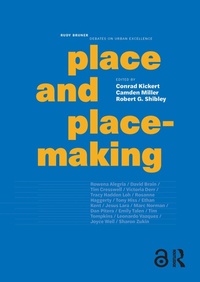
Place and Placemaking
1st Edition
Published on 1. June 2026
432 pages
978-1-040-51740-6 (ISBN)
Description

This book focuses on the importance of place and the multifaceted process of placemaking to the creation of durable and meaningful urban environments. It features international thought leaders, judiciously curated and convened across disciplines, cultures, and viewpoints to debate their perspectives on the merits and challenges of place and placemaking. Chapters investigate the tenor, timeliness, and tensions of place, and how we envision, co-create, and communicate place with colleagues, citizens, and critics. Stemming from the first Rudy Bruner Debate on Urban Excellence, chapter authors expressly present their experience, insights, and questions on place and placemaking, inspiring critical reflection and action in the world that surrounds us. This book will be of interest to students and practitioners in urban planning, urban design, real estate, architecture, and landscape architecture and to urban advocates and civic leaders.
Reviews / Votes
"This book does what's most needed at this moment in the global adoption of placemaking: it draws a clear line between placebaking - the formulaic application of placemaking recipes - and the deeper work of confronting placelessness through genuine co-creation. It shows how communities can claim agency and ownership in the creative, asset-based making of place. Place and Placemaking reminds us of Jane Jacobs's essential truth: 'the city that has something for everyone was made by everyone.' An essential read for those moving beyond the buzzword to the real art and science of placemaking."Ryan Smolar, Director of PlacemakingUS
"This book lays out the essential principles of place and placemaking, enriched by timely perspectives on creating places that embody the values of long-term residents and newcomers alike. This propels the work as crucial reading for both scholars and practitioners."
Dr. Linda Groat, Professor of Architecture, University of Michigan
More details
Series
Edition
1. Auflage
Language
English
Place of publication
London
United Kingdom
Publishing group
Taylor & Francis Ltd
Target group
College/higher education
Professional and scholarly
Illustrations
1 Tables, color; 7 Line drawings, color; 103 Halftones, color; 110 Illustrations, color
File size
122,32 MB
ISBN-13
978-1-040-51740-6 (9781040517406)
Copyright in bibliographic data and cover images is held by Nielsen Book Services Limited or by the publishers or by their respective licensors: all rights reserved.
Schweitzer Classification
Other editions
Additional editions

Conrad Kickert | Camden Miller | Robert Shibley
Place and Placemaking
Book
06/2026
1st Edition
Routledge
€47.50
Shipment within 10-20 days
Conrad Kickert | Camden Miller | Robert Shibley
Place and Placemaking
Book
06/2026
1st Edition
Routledge
€191.50
Shipment within 10-20 days
Persons
Conrad Kickert, PhD, is an associate professor at the University at Buffalo's School of Architecture and Planning, and the Director of Programs at the Rudy Bruner Center for Urban Excellence. Born and raised in The Netherlands, Conrad received degrees in urbanism and architecture at the TU Delft and holds a PhD in architecture from the University of Michigan. He has worked as an urban researcher and designer for various design offices, property developers, and non-profit organizations in The Netherlands, the United Kingdom, and the United States.
Camden Miller, PhD, is a clinical assistant professor at the University at Buffalo's School of Architecture and Planning and the Director of Operations at the Rudy Bruner Center for Urban Excellence. Camden investigates housing market dynamics (its limitations and exclusion of under-represented groups including people of color and low-income) and how we can work towards providing high-quality affordable housing for everyone within the housing market.
Robert Shibley, FAIA, FAICP, is Dean Emeritus of the University at Buffalo's School of Architecture and Planning and the Director of the Rudy Bruner Center for Urban Excellence. During his term as Dean from 2011 to 2023, Shibley guided the school to a top position in research generation among the nation's schools of architecture and planning. As a teacher, scholar, and practitioner of architecture and planning for more than 50 years, he has dedicated his career to advancing knowledge-based design and placemaking in service to the public.
Camden Miller, PhD, is a clinical assistant professor at the University at Buffalo's School of Architecture and Planning and the Director of Operations at the Rudy Bruner Center for Urban Excellence. Camden investigates housing market dynamics (its limitations and exclusion of under-represented groups including people of color and low-income) and how we can work towards providing high-quality affordable housing for everyone within the housing market.
Robert Shibley, FAIA, FAICP, is Dean Emeritus of the University at Buffalo's School of Architecture and Planning and the Director of the Rudy Bruner Center for Urban Excellence. During his term as Dean from 2011 to 2023, Shibley guided the school to a top position in research generation among the nation's schools of architecture and planning. As a teacher, scholar, and practitioner of architecture and planning for more than 50 years, he has dedicated his career to advancing knowledge-based design and placemaking in service to the public.
Content
0.0 Introduction: Pleas, predicaments, and paradoxes of place and placemaking
Positioning Place
1.0 Introduction to Positioning Place and Placemaking
1.1 The Place of Place and Placemaking
1.2 Positioning Place with Older Adults
1.3 The Problem of "Place"
Envisioning Place
2.0 Envisioning Place and Placemaking: An Introduction
2.1 Placemaking as an Art of Civic Connection
2.2 The Pragmatist's Guide to Envisioning Place: From Islands of Innovation to Systems of Support
2.3 Density, Context, and Place
Co-Creating Place
3.0 The Mosaic of Co-Creating Place: Engagement, identity, and Community
3.1. Making Room: Governance, Belonging, and the End of Homelessness
3.2 The Tragedy and Triumph of Place: Building from the Global Movement for Public Space and Placemaking
3.3 Placemaking in Immigrant Communities: Challenges, Contributions, and Future Directions
Communicating Place
4.0 The Power of Communicative Practices
4.1 Changing the Narrative About Place through Story
4.1 "I Wish for a Happy Planet": Young People's Conceptions, Imaginaries and Potentials for Co-Learning in Place
4.3 Placemaking: A Work of Fiction Striving to Become a True Story
5.0 Potentials and Pathways of Place and Placemaking
Positioning Place
1.0 Introduction to Positioning Place and Placemaking
1.1 The Place of Place and Placemaking
1.2 Positioning Place with Older Adults
1.3 The Problem of "Place"
Envisioning Place
2.0 Envisioning Place and Placemaking: An Introduction
2.1 Placemaking as an Art of Civic Connection
2.2 The Pragmatist's Guide to Envisioning Place: From Islands of Innovation to Systems of Support
2.3 Density, Context, and Place
Co-Creating Place
3.0 The Mosaic of Co-Creating Place: Engagement, identity, and Community
3.1. Making Room: Governance, Belonging, and the End of Homelessness
3.2 The Tragedy and Triumph of Place: Building from the Global Movement for Public Space and Placemaking
3.3 Placemaking in Immigrant Communities: Challenges, Contributions, and Future Directions
Communicating Place
4.0 The Power of Communicative Practices
4.1 Changing the Narrative About Place through Story
4.1 "I Wish for a Happy Planet": Young People's Conceptions, Imaginaries and Potentials for Co-Learning in Place
4.3 Placemaking: A Work of Fiction Striving to Become a True Story
5.0 Potentials and Pathways of Place and Placemaking
