

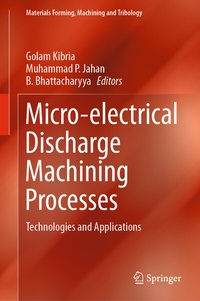
Micro-electrical Discharge Machining Processes
Description

This book offers a comprehensive collection of micro electrical discharge machining (EDM) processes, including hybrid processes. It discusses the theory behind each process and their applications in various technological as well as biomedical domains, and also presents a brief background to various micro EDM processes, current research challenges, and detailed case studies of micro-manufacturing miniaturized parts. The book serves as a valuable guide for students and researchers interested in micro EDM and other related processes.
More details
Other editions
Additional editions
Persons
Dr. Golam Kibria is an Assistant Professor at the Department of Mechanical Engineering, Aliah University, Kolkata. He graduated in Mechanical Engineering from Kalyani Government Engineering College, West Bengal. He completed his M.Tech. in Production Engineering at Jadavpur University, Kolkata in 2008, followed by his Ph.D. at the same university in 2014. After working at Sikkim Manipal University for a year he joined Aliah University, Kolkata. His research interests include non-conventional machining processes, micromachining and advanced manufacturing and forming technology. He is a life member of The Institution of Engineers (IEI), India. He has published more than 20 research articles in peer-reviewed international and national journals, and about 40 papers in conference proceedings. He has authored 5 book chapters and is also an editorial board member and reviewer for a number of respected journals.
Dr. Muhammad Pervej Jahan an Assistant Professor at the Department of Mechanical and Manufacturing Engineering at Miami University. His research and teaching interests include advanced manufacturing, non-conventional manufacturing processes, and micro- and nano-machining. He received his B.S. and Ph.D. in Mechanical Engineering from Bangladesh University of Engineering and Technology (BUET) and National University of Singapore (NUS), respectively. He has published over 50 research articles in peer-reviewed journals and international conferences, and also contributed several book chapters.
Dr. B. Bhattacharyya is a Professor and former Head of the Production Engineering Department, Jadavpur University. He is also the coordinator of the Center of Advanced Study Program at the University Grants Commission (UGC) and the AICTE Quality Improvement Programme at Jadavpur University. His major research areas include non-traditional machining, micromachining, and advanced manufacturing systems. He has published more than 100 research articles in national and international journals, and around 270 papers in conference proceedings. He has guided several doctoral students and also successfully completed a number of research projects. In addition to authoring several book chapters, Dr. Bhattacharyya has recently published a book titled Electrochemical Micromachining for Nanofabrication, MEMS and Nanotechnology . He is also a recipient of the Career Award of UGC, New Delhi.
