

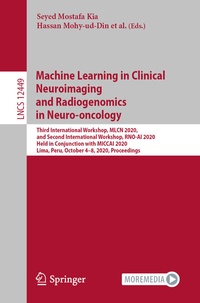
Machine Learning in Clinical Neuroimaging and Radiogenomics in Neuro-oncology
Third International Workshop, MLCN 2020, and Second International Workshop, RNO-AI 2020, Held in Conjunction with MICCAI 2020, Lima, Peru, October 4-8, 2020, Proceedings
Published on 30. December 2020
XVIII, 305 pages
978-3-030-66843-3 (ISBN)
Description

This book constitutes the refereed proceedings of the Third International Workshop on Machine Learning in Clinical Neuroimaging, MLCN 2020, and the Second International Workshop on Radiogenomics in Neuro-oncology, RNO-AI 2020, held in conjunction with MICCAI 2020, in Lima, Peru, in October 2020.*
For MLCN 2020, 18 papers out of 28 submissions were accepted for publication. The accepted papers present novel contributions in both developing new machine learning methods and applications of existing methods to solve challenging problems in clinical neuroimaging.
For RNO-AI 2020, all 8 submissions were accepted for publication. They focus on addressing the problems of applying machine learning to large and multi-site clinical neuroimaging datasets. The workshop aimed to bring together experts in both machine learning and clinical neuroimaging to discuss and hopefully bridge the existing challenges of applied machine learning in clinical neuroscience.
*The workshops were held virtually due to the COVID-19 pandemic.
More details
Series
Edition
1st ed. 2020
Language
English
Place of publication
Cham
Switzerland
Publishing group
Springer International Publishing
Product notice
Reflowable
Illustrations
XVIII, 305 p. 8 illus.
File size
52,48 MB
ISBN-13
978-3-030-66843-3 (9783030668433)
DOI
10.1007/978-3-030-66843-3
Schweitzer Classification
Other editions
Additional editions
Seyed Mostafa Kia | Hassan Mohy-ud-Din | Ahmed Abdulkadir
Machine Learning in Clinical Neuroimaging and Radiogenomics in Neuro-oncology
Third International Workshop, MLCN 2020, and Second International Workshop, RNO-AI 2020, Held in Conjunction with MICCAI 2020, Lima, Peru, October 4-8, 2020, Proceedings
Book
12/2020
Springer
€53.49
Shipment within 7-9 days
Content
- Intro
- Additional Volume Editors
- MLCN 2020 Preface
- MLCN 2020 Organization
- RNO-AI 2020 Preface
- RNO-AI 2020 Organization
- Contents
- MLCN 2020
- Surface Agnostic Metrics for Cortical Volume Segmentation and Regression
- 1 Introduction
- 2 Related Work
- 3 Method
- 4 Experimental Methods and Results
- 5 Discussion
- 6 Conclusion
- References
- Automatic Tissue Segmentation with Deep Learning in Patients with Congenital or Acquired Distortion of Brain Anatomy
- 1 Introduction
- 2 Materials
- 2.1 Normal Brains
- 2.2 Distorted Brains
- 2.3 Pre-processing and Reference Tissue Segmentation
- 3 Methods
- 4 Experiments
- 4.1 Results
- 5 Discussion
- 5.1 Conclusions
- References
- Bidirectional Modeling and Analysis of Brain Aging with Normalizing Flows
- 1 Introduction
- 2 Problem Formulation and Pre-processing
- 2.1 Reference Space and Deformation-Based Analysis
- 2.2 Dimensionality Reduction via PCA on Diffeomorphisms
- 3 Normalizing Flow Model for Brain Aging Analysis
- 3.1 Bidirectional Conditional Modeling
- 3.2 Normalizing Flow Architecture and Training
- 4 Experiments and Results
- 5 Conclusion
- References
- A Multi-task Deep Learning Framework to Localize the Eloquent Cortex in Brain Tumor Patients Using Dynamic Functional Connectivity
- 1 Introduction
- 2 Eloquent Cortex Localization Using Deep Learning
- 3 Experimental Results
- 4 Conclusion
- References
- Deep Learning for Non-invasive Cortical Potential Imaging
- 1 Introduction
- 1.1 Statement of the Problem
- 1.2 State-of-the-Art
- 2 Methods
- 3 Experiments
- 4 Discussion
- 5 Conclusions
- References
- An Anatomically-Informed 3D CNN for Brain Aneurysm Classification with Weak Labels
- 1 Introduction
- 2 Materials and Methods
- 2.1 Data Set
- 2.2 Image Processing
- 2.3 An Anatomically-Informed 3D-CNN
- 2.4 Patch Sampling Strategy
- 2.5 Evaluation Approach
- 3 Results
- 4 Discussion
- References
- Ischemic Stroke Segmentation from CT Perfusion Scans Using Cluster-Representation Learning
- 1 Introduction
- 2 Method
- 2.1 Sample Clustering and Cluster-Representative Encoder
- 2.2 Multi-Clustering U-Net (MCU-Net)
- 3 Experiments
- 3.1 Dataset
- 3.2 Experimental Settings
- 3.3 Segmentation Results and Discussion
- 4 Conclusion
- References
- SeizureNet: Multi-Spectral Deep Feature Learning for Seizure Type Classification
- 1 Introduction
- 2 The Proposed Framework (SeizureNet)
- 2.1 Saliency-Encoded Spectrograms
- 2.2 Multi-Spectral Feature Learning
- 2.3 The Proposed Ensemble Architecture (SeizureNet)
- 2.4 Training and Implementation
- 3 Experiments and Results
- 3.1 SeizureNet for Knowledge Distillation
- 3.2 Significance of Saliency-Encoded Spectrograms
- 3.3 Significance of Multi-Spectral Feature Learning
- 4 Conclusion and Future Work
- References
- Decoding Task States by Spotting Salient Patterns at Time Points and Brain Regions
- 1 Introduction
- 2 Salient Patterns over Time and Space (SPOTS)
- 3 Results
- 3.1 Dataset and Pre-processing
- 3.2 Classifier Performance
- 3.3 Interpretation of Results
- 4 Conclusion
- References
- Patch-Based Brain Age Estimation from MR Images
- 1 Introduction
- 2 Materials and Methods
- 2.1 Dataset and Pre-processing
- 2.2 Pipeline
- 3 Results
- 4 Discussion
- 5 Conclusion
- References
- Large-Scale Unbiased Neuroimage Indexing via 3D GPU-SIFT Filtering and Keypoint Masking
- 1 Introduction
- 2 Method
- 2.1 Keypoint Extraction Using Gaussian Scale-Space Filtering on the GPU
- 2.2 Masked Keypoint Analysis
- 3 Experiments
- 3.1 Data
- 3.2 Processing
- 3.3 Keypoint Extraction Performance
- 3.4 Keypoint Visualisation
- 3.5 HCP Family Relationship Classification
- 4 Conclusion
- References
- A Longitudinal Method for Simultaneous Whole-Brain and Lesion Segmentation in Multiple Sclerosis
- 1 Introduction
- 2 Existing Cross-Sectional Method
- 3 Longitudinal Extension
- 4 Experiments and Results
- 5 Discussion and Conclusion
- References
- Towards MRI Progression Features for Glioblastoma Patients: From Automated Volumetry and Classical Radiomics to Deep Feature Learning
- 1 Introduction
- 1.1 Current Practice of Progression Assessment and Radiomics Research
- 2 Proposed Data-Driven Approach
- 3 Materials and Methods
- 3.1 Data
- 3.2 Experiments
- 4 Results
- 5 Conclusion and Outlook
- References
- Generalizing MRI Subcortical Segmentation to Neurodegeneration
- 1 Introduction
- 2 Methods
- 2.1 Original LiviaNET
- 2.2 Manipulating the Network Input
- 2.3 Data Augmentation
- 2.4 Network Architecture
- 2.5 Post-processing
- 2.6 Experimental Setup
- 3 Results and Discussion
- 4 Conclusion
- References
- Multiple Sclerosis Lesion Segmentation Using Longitudinal Normalization and Convolutional Recurrent Neural Networks
- 1 Introduction
- 2 Method
- 2.1 Longitudinal Normalization
- 2.2 Network Architecture
- 2.3 Post-processing
- 3 Experimental Setup
- 3.1 Dataset
- 3.2 Longitudinal Normalization Configuration
- 3.3 Training and Implementation Details
- 3.4 Evaluation
- 4 Results
- 5 Discussion and Conclusion
- References
- Deep Voxel-Guided Morphometry (VGM): Learning Regional Brain Changes in Serial MRI
- 1 Introduction
- 2 Materials and Methods
- 2.1 Image Data
- 2.2 Voxel-Guided Morphometry
- 2.3 Preprocessing
- 2.4 Deep VGM: Architecture
- 2.5 Deep VGM: Training and Loss Functions
- 2.6 Evaluation
- 2.7 Implementation
- 3 Results
- 3.1 Quantitative Evaluation
- 3.2 Qualitative Evaluation
- 4 Discussion
- 5 Conclusion
- References
- A Deep Transfer Learning Framework for 3D Brain Imaging Based on Optimal Mass Transport
- 1 Introduction
- 2 Methods
- 2.1 Overview
- 2.2 Datasets
- 2.3 Image Acquisition and Preprocessing
- 2.4 Area Preserving Mapping of Brain Shape Metrics
- 2.5 Transfer Learning Based on Pretrained ImageNet CNN Networks
- 3 Results
- 4 Discussion
- References
- Communicative Reinforcement Learning Agents for Landmark Detection in Brain Images
- 1 Introduction
- 2 Background
- 3 Methods
- 4 Experiments
- 4.1 Results
- 5 Conclusion
- References
- RNO-AI 2020
- State-of-the-Art in Brain Tumor Segmentation and Current Challenges
- 1 Introduction
- 2 Benchmark Datasets
- 3 Brain Tumor Segmentation and Diagnosis
- 3.1 Machine Learning Approaches for Brain Tumor Segmentation
- 3.2 Diagnosis and Prediction
- 4 Generalization and Explainable Models
- 5 Discussion and Conclusion
- References
- Radiomics and Radiogenomics with Deep Learning in Neuro-oncology
- 1 Introduction
- 2 Methodological Approach of Radiomics
- 3 Segmentation via Deep Learning
- 4 Radiomics Using Handcrafted Features
- 5 Radiomics Using Learned Features
- 6 Radiogenomics Using Handcrafted Features
- 7 Radiogenomics Using Learned Features
- 8 Conclusion
- References
- Machine Learning and Glioblastoma: Treatment Response Monitoring Biomarkers in 2021
- 1 Introduction
- 2 Methods
- 2.1 Search Strategy and Selection Criteria
- 2.2 Data Extraction and Risk of Bias Assessment
- 2.3 Data Synthesis and Statistical Analysis
- 2.4 Subgroup Analysis: Prognostic Biomarkers to Predict Subsequent Treatment Response
- 3 Results
- 3.1 Characteristics of Included Studies and Bias Assessment
- 3.2 Treatment Response
- 3.3 Follow-up Imaging and Histopathology at Re-Operation
- 3.4 Features
- 3.5 Test Sets
- 3.6 Subgroup Analysis: Prognostic Biomarkers to Predict Subsequent Treatment Response
- 4 Discussion
- 4.1 Summary of Findings
- 4.2 Limitations
- 4.3 Interpretation of the Results in the Context of Other Evidence
- 4.4 Implications for Future Research and Clinical Practice
- 5 Conclusion
- Appendix
- References
- Radiogenomics of Glioblastoma: Identification of Radiomics Associated with Molecular Subtypes
- 1 Introduction
- 2 Methods
- 2.1 Dataset
- 2.2 Segmentation
- 2.3 Feature Extraction
- 2.4 Statistical Analysis
- 2.5 Subtype Predictive Model
- 3 Results
- 3.1 Correlation Between Radiomics, Genomics and Overall Survival
- 3.2 Imaging Biomarkers Associated with Molecular Subtypes
- 3.3 Subtype Prediction
- 4 Discussion
- 5 Conclusion
- References
- Local Binary and Ternary Patterns Based Quantitative Texture Analysis for Assessment of IDH Genotype in Gliomas on Multi-modal MRI
- 1 Introduction
- 2 Method
- 2.1 Study Cohort/Imaging/Image Pre-processing
- 2.2 Texture Feature Extraction from 3D Local Binary Pattern
- 2.3 Texture Feature Extraction from 3D Local Ternary Pattern
- 2.4 Radiomics
- 2.5 Multivariate Analysis
- 3 Results
- 4 Conclusion
- References
- Automated Multi-class Brain Tumor Types Detection by Extracting RICA Based Features and Employing Machine Learning Techniques
- 1 Introduction
- 2 Materials and Methods
- 2.1 Data Acquisition
- 2.2 Feature Extraction
- 2.3 Reconstruction Independent Component Analysis (RICA) Based Features
- 2.4 Classification Methods
- 2.5 Testing/Training Data Formulation
- 3 Results and Discussion
- 4 Conclusion and Future Work
- References
- Overall Survival Prediction in Gliomas Using Region-Specific Radiomic Features
- 1 Introduction
- 2 Materials and Methods
- 2.1 Dataset and Preprocessing
- 2.2 Tumor Subregion Segmentation Models
- 2.3 Radiomic Feature Extraction
- 2.4 Feature Selection and Classification
- 3 Results and Discussion
- 3.1 Evaluation on Training Dataset (210 Subjects)
- 3.2 Evaluation on Validation Dataset (29 Subjects)
- 4 Conclusions
- References
- Using Functional Magnetic Resonance Imaging and Personal Characteristics Features for Detection of Neurological Conditions
- 1 Introduction
- 2 Materials and Methods
- 2.1 Dataset
- 2.2 Image Preprocessing Applied on the Dataset
- 2.3 Dimensionality Reduction and Feature Extraction
- 2.4 Feature Selection and Predictive Learning
- 3 Results and Application
- 3.1 Classification Performance of Predictive Model Using Personal Characteristics Features (PCF)
- 3.2 Classification Performance of the Predictive Model Using fMRI Data
- 3.3 Classification Performance of the Predictive Model Using Combined fMRI and Personal Characteristics Features (PCF) Data
- 3.4 Selection of the Number of Principal Components (PCs)
- 4 Conclusion
- References
- Differentiation of Recurrent Glioblastoma from Radiation Necrosis Using Diffusion Radiomics: Machine Learning Model Development and External Validation
- 1 Introduction
- 2 Materials and Methods
- 2.1 Patient Population
- 2.2 Pathological Diagnosis
- 2.3 MRI Protocol
- 2.4 Imaging Preprocessing and Radiomics Feature Extraction
- 2.5 Radiomics Feature Selection and Machine Learning
- 2.6 Diagnostic Performance in the Test Set
- 2.7 Availability of Data and Code
- 3 Results
- 3.1 Best Performing Machine Learning Models from Radiomics Features for Differentiating Recurrent GBM from RN
- 3.2 Robustness of Radiomics Models in the Test Set
- 4 Discussion
- 5 Conclusion
- References
- Brain Tumor Survival Prediction Using Radiomics Features
- 1 Introduction
- 2 Proposed Methodology
- 2.1 Image Pre-processing and ROI Extraction
- 2.2 Radiomics Features
- 2.3 Classification Models for Survival Prediction
- 3 Experimental Results
- 3.1 Dataset
- 3.2 Survival Prediction Performance
- 4 Discussion and Conclusion
- References
- Brain MRI Classification Using Gradient Boosting
- 1 Introduction
- 2 Materials and Methods
- 2.1 Dataset
- 2.2 Pre-processing and Feature Extraction
- 2.3 Classifier
- 3 Results
- 4 Discussion
- 5 Conclusion
- References
- Author Index
