

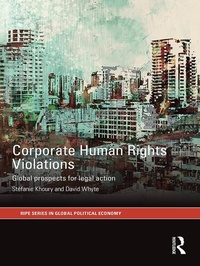
Corporate Human Rights Violations
Global Prospects for Legal Action
Published on 8. December 2016
220 pages
978-1-317-21606-3 (ISBN)
Description

This book develops an analysis of the historical, political and legal contexts behind current demands by NGOs and the United Nations Human Rights Council to hold corporations accountable for their human rights violations. Based on an analysis of the range of mechanisms of accountability that currently exist, it argues that that those demands are a response to the failure of neo-liberal policies that have dominated the practice of politics and law since the emergence of this debate in its current form in the 1970s.
Offering a new approach to understanding how struggles for hegemony are refracted through a range of legal challenges to corporate human rights violations, the book offers a fresh perspective for understanding how those struggles are played out in the global sphere. In order to analyse the prospects for using human rights law to challenge the right of corporations to author human rights violations, the book explores the development of a range of political initiatives in the UN, the uses of tort law in domestic courts, and the uses of human rights law at the European Court of Human Rights and at the Inter-American Court of Human Rights.
This book will be essential reading for all those interested in how international institutions and NGOs are both shaping and being shaped by global struggles against corporate power.
Offering a new approach to understanding how struggles for hegemony are refracted through a range of legal challenges to corporate human rights violations, the book offers a fresh perspective for understanding how those struggles are played out in the global sphere. In order to analyse the prospects for using human rights law to challenge the right of corporations to author human rights violations, the book explores the development of a range of political initiatives in the UN, the uses of tort law in domestic courts, and the uses of human rights law at the European Court of Human Rights and at the Inter-American Court of Human Rights.
This book will be essential reading for all those interested in how international institutions and NGOs are both shaping and being shaped by global struggles against corporate power.
More details
Series
Language
English
Place of publication
London
United Kingdom
Publishing group
Taylor & Francis Ltd
Target group
College/higher education
Illustrations
3 Line drawings, black and white; 3 Illustrations, black and white
File size
2,59 MB
ISBN-13
978-1-317-21606-3 (9781317216063)
Copyright in bibliographic data and cover images is held by Nielsen Book Services Limited or by the publishers or by their respective licensors: all rights reserved.
Schweitzer Classification
Other editions
Additional editions
Book
08/2018
1st Edition
Routledge
€67.03
Shipment within 10-20 days
Book
12/2016
1st Edition
Routledge
€231.50
Shipment within 10-20 days
Persons
Stefanie Khoury is Research Associate the University of Liverpool, UK. Her research focuses on the lack of accountability of state and corporate violations of human rights.
David Whyte is Professor in Socio-legal Studies at the University of Liverpool, UK, where he specialises in teaching and researching the relationship between corporate power and law.
David Whyte is Professor in Socio-legal Studies at the University of Liverpool, UK, where he specialises in teaching and researching the relationship between corporate power and law.
Content
Introduction: The Rarefied Politics of Global Legal Struggles
Introduction: Corporate Human Rights Violations
Human Rights and Corporate Accountability
A Mirror Image?
The Rarefied Politics of Global Consent
Global Social Ordering
Counter-hegemony and Resistance?
The Structure of the Book
Chapter One: From Economic Cannibalism to Corporate Human Rights Liabilities
Introduction
Corporations, Human Rights and the UN
Corporations as Bearers of Rights
Corporations as Political Institutions
The Draft Norms
Lobbying the Norms
The NGO Lobby
Conclusion: Untangling the Roots of UN Policy
Chapter Two: Different Shades of Voluntarism
Introduction
The Global Compact: 'Support Group' or 'Good Old Boys Club'?
An American in the Court of King Kofi
The "Continuation of a Business-Friendly Agenda"?
The Guiding Principles
A Fake Consensus
Conclusion
Chapter Three: A Manufactured Consent
Introduction
Evaluating the Role of the OECD Guidelines
Complaints Taken by NGOs
Mutual Agreement?
No Enforcement
Corporate Structural Advantage
Conclusion
Chapter Four: Tort Law and the Struggle Against Corporate Human Rights Violations
Introduction
The Civil Justice System and Corporate Accountability
Alien Tort Claims Act 1789
The Business Lobby Celebrates
European Transnational Tort Cases
Transnational Jurisdiction and the Imperial Court
Transnational Struggle?
Conclusion: Nearly Absolute Non-Accountability
Chapter Five: Struggles for Corporate Accountability in the Human Rights Courts
Introduction
Positive and Negative Obligations
Positive Obligations into the Private Sphere
The Horizontal Effect in the European System
The Horizontal Effect in the Inter-American System
NGOs and the Struggle for Recognition
Struggles for Collective Rights
Conclusion
Chapter Six: 'Human' Rights for Profit
Introduction
The Corporate Victim
Corporate Rights in Europe
Corporate Rights at the Inter-American Court
Corporate Law Trumps Human Rights Law
Political Struggles for Corporate Rights
Conclusion: New Mechanisms of Accountability for Corporate Human Rights Violations?
Making Struggles Around Human Rights Visible
Moving Towards a Treaty?
A Peoples' Tribunal?
Introduction: Corporate Human Rights Violations
Human Rights and Corporate Accountability
A Mirror Image?
The Rarefied Politics of Global Consent
Global Social Ordering
Counter-hegemony and Resistance?
The Structure of the Book
Chapter One: From Economic Cannibalism to Corporate Human Rights Liabilities
Introduction
Corporations, Human Rights and the UN
Corporations as Bearers of Rights
Corporations as Political Institutions
The Draft Norms
Lobbying the Norms
The NGO Lobby
Conclusion: Untangling the Roots of UN Policy
Chapter Two: Different Shades of Voluntarism
Introduction
The Global Compact: 'Support Group' or 'Good Old Boys Club'?
An American in the Court of King Kofi
The "Continuation of a Business-Friendly Agenda"?
The Guiding Principles
A Fake Consensus
Conclusion
Chapter Three: A Manufactured Consent
Introduction
Evaluating the Role of the OECD Guidelines
Complaints Taken by NGOs
Mutual Agreement?
No Enforcement
Corporate Structural Advantage
Conclusion
Chapter Four: Tort Law and the Struggle Against Corporate Human Rights Violations
Introduction
The Civil Justice System and Corporate Accountability
Alien Tort Claims Act 1789
The Business Lobby Celebrates
European Transnational Tort Cases
Transnational Jurisdiction and the Imperial Court
Transnational Struggle?
Conclusion: Nearly Absolute Non-Accountability
Chapter Five: Struggles for Corporate Accountability in the Human Rights Courts
Introduction
Positive and Negative Obligations
Positive Obligations into the Private Sphere
The Horizontal Effect in the European System
The Horizontal Effect in the Inter-American System
NGOs and the Struggle for Recognition
Struggles for Collective Rights
Conclusion
Chapter Six: 'Human' Rights for Profit
Introduction
The Corporate Victim
Corporate Rights in Europe
Corporate Rights at the Inter-American Court
Corporate Law Trumps Human Rights Law
Political Struggles for Corporate Rights
Conclusion: New Mechanisms of Accountability for Corporate Human Rights Violations?
Making Struggles Around Human Rights Visible
Moving Towards a Treaty?
A Peoples' Tribunal?
