

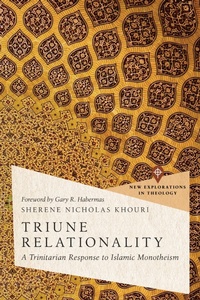
Triune Relationality
Description

For centuries, Christians and Muslims have engaged each other in debate and critique. A key area of disagreement is the nature of God: Is God a Trinity or absolutely one? To promote interfaith dialogue, Christians must understandthe history of the conversation and also articulate the doctrine of the Trinity in reasonable, compelling ways.
In this New Explorations in Theology volume, Sherene Nicholas Khouri offers both historical and constructive responses to Islamic objections to the doctrine of the Trinity. Khouri considers arguments from Arabic Christian theologians and philosophers in the eighth to tenth centuries, primarily John of Damascus, Theodore Abu Qurrah, and Yäya Ibn cAdi. When Muslims expanded beyondthe Arabic peninsula, Christians in occupied regions were spurred to defend the Trinity against the Islamic understanding of taw¿id, the absolute oneness of Allah, and against misconceptions of Christian belief.
Khouri then applies the insights of these little-known thinkers to current theology and apologetics conversations. She makes the case for appealing to the common ground of God as the greatest conceived being, then arguing that such a being must be relational in nature. While Christians today debate models of the Trinity with each other and with Muslims, they can be confident that Christians throughout history have believed in triune relationality and found in the doctrine of the Trinity an invitation to personal relationship with the divine.
Featuring new monographs with cutting-edge research, New Explorations in Theology provides a platform for constructive, creative work in the areas of systematic, historical, philosophical, biblical, and practical theology.
More details
Other editions
Additional editions
Person
Sherene Nicholas Khouri (PhD, Liberty University) is assistant professor of Arabic at Liberty University and also teaches courses on theology, apologetics, Arabic Christianity, and Islam in the John W. Rawlings School of Divinity. Born in Damascus, Syria, she served the Arabic church in the Middle East for thirteen years.
Gary R. Habermas (PhD, Michigan State University) is distinguished research professor and chair of the department of philosophy and theology at Liberty University in Lynchburg, Virginia.
Content
Foreword by Gary R. Habermas Acknowledgments Abbreviations Introduction 1. The Rise of the Abbasids and the Golden Age of Islam 2. The Iconoclastic Effect of the Qur'anic Perception of the Trinity 3. The Christian Explanation of the Trinity in the Eighth, Ninth, and Tenth Centuries 4. Western Contemporary Explanation of the Trinity 5. A Contemporary Christian Answer to Islamic Objections Against the Trinity Conclusion Bibliography GeneralIndex Scripture Index
