

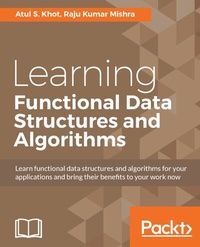
Learning Functional Data Structures and Algorithms
Learn functional data structures and algorithms for your applications and bring their benefits to your work now
Published on 8. July 2025
318 pages
978-1-78588-588-4 (ISBN)
Description

Learn functional data structures and algorithms for your applications and bring their benefits to your work now
Key Features
[*] Moving from object-oriented programming to functional programming? This book will help you get started with functional programming.
[*] Easy-to-understand explanations of practical topics will help you get started with functional data structures.
[*] Illustrative diagrams to explain the algorithms in detail.
[*] Get hands-on practice of Scala to get the most out of functional programming.
Book DescriptionFunctional data structures have the power to improve the codebase of an application and improve efficiency. With the advent of functional programming and with powerful functional languages such as Scala, Clojure and Elixir becoming part of important enterprise applications, functional data structures have gained an important place in the developer toolkit. Immutability is a cornerstone of functional programming. Immutable and persistent data structures are thread safe by definition and hence very appealing for writing robust concurrent programs. How do we express traditional algorithms in functional setting? Won't we end up copying too much? Do we trade performance for versioned data structures? This book attempts to answer these questions by looking at functional implementations of traditional algorithms. It begins with a refresher and consolidation of what functional programming is all about. Next, you'll get to know about Lists, the work horse data type for most functional languages. We show what structural sharing means and how it helps to make immutable data structures efficient and practical. Scala is the primary implementation languages for most of the examples. At times, we also present Clojure snippets to illustrate the underlying fundamental theme. While writing code, we use ADTs (abstract data types). Stacks, Queues, Trees and Graphs are all familiar ADTs. You will see how these ADTs are implemented in a functional setting. We look at implementation techniques like amortization and lazy evaluation to ensure efficiency. By the end of the book, you will be able to write efficient functional data structures and algorithms for your applications. What you will learn
[*] Learn to think in the functional paradigm
[*] Understand common data structures and the associated algorithms, as well as the context in which they are commonly used
[*] Take a look at the runtime and space complexities with the O notation
[*] See how ADTs are implemented in a functional setting
[*] Explore the basic theme of immutability and persistent data structures
[*] Find out how the internal algorithms are redesigned to exploit structural sharing, so that the persistent data structures perform well, avoiding needless copying.
[*] Get to know functional features like lazy evaluation and recursion used to implement efficient algorithms
[*] Gain Scala best practices and idioms
Who this book is forThis book is for those who have some experience in functional programming languages. The data structures in this book are primarily written in Scala, however implementing the algorithms in other functional languages should be straight forward.
Key Features
[*] Moving from object-oriented programming to functional programming? This book will help you get started with functional programming.
[*] Easy-to-understand explanations of practical topics will help you get started with functional data structures.
[*] Illustrative diagrams to explain the algorithms in detail.
[*] Get hands-on practice of Scala to get the most out of functional programming.
Book DescriptionFunctional data structures have the power to improve the codebase of an application and improve efficiency. With the advent of functional programming and with powerful functional languages such as Scala, Clojure and Elixir becoming part of important enterprise applications, functional data structures have gained an important place in the developer toolkit. Immutability is a cornerstone of functional programming. Immutable and persistent data structures are thread safe by definition and hence very appealing for writing robust concurrent programs. How do we express traditional algorithms in functional setting? Won't we end up copying too much? Do we trade performance for versioned data structures? This book attempts to answer these questions by looking at functional implementations of traditional algorithms. It begins with a refresher and consolidation of what functional programming is all about. Next, you'll get to know about Lists, the work horse data type for most functional languages. We show what structural sharing means and how it helps to make immutable data structures efficient and practical. Scala is the primary implementation languages for most of the examples. At times, we also present Clojure snippets to illustrate the underlying fundamental theme. While writing code, we use ADTs (abstract data types). Stacks, Queues, Trees and Graphs are all familiar ADTs. You will see how these ADTs are implemented in a functional setting. We look at implementation techniques like amortization and lazy evaluation to ensure efficiency. By the end of the book, you will be able to write efficient functional data structures and algorithms for your applications. What you will learn
[*] Learn to think in the functional paradigm
[*] Understand common data structures and the associated algorithms, as well as the context in which they are commonly used
[*] Take a look at the runtime and space complexities with the O notation
[*] See how ADTs are implemented in a functional setting
[*] Explore the basic theme of immutability and persistent data structures
[*] Find out how the internal algorithms are redesigned to exploit structural sharing, so that the persistent data structures perform well, avoiding needless copying.
[*] Get to know functional features like lazy evaluation and recursion used to implement efficient algorithms
[*] Gain Scala best practices and idioms
Who this book is forThis book is for those who have some experience in functional programming languages. The data structures in this book are primarily written in Scala, however implementing the algorithms in other functional languages should be straight forward.
All prices
More details
Edition
Digital original
Language
English
Place of publication
Birmingham
United Kingdom
Target group
Professional and scholarly
US School Grade: College Graduate Student
Edition type
Digital original
File size
7,28 MB
ISBN-13
978-1-78588-588-4 (9781785885884)
Copyright in bibliographic data and cover images is held by Nielsen Book Services Limited or by the publishers or by their respective licensors: all rights reserved.
Schweitzer Classification
Other editions
Additional editions
Atul S. Khot | Raju Kumar Mishra
Learning Functional Data Structures and Algorithms
Book
02/2017
Packt Publishing
€56.20
Shipment within 3-4 weeks
Persons
S. Khot Atul :
Atul S. Khot is a self-taught programmer and has written software programmes in C and C++. Having extensively programmed in Java and dabbled in multiple languages, these days, he is increasingly getting hooked on Scala, Clojure, and Erlang. Atul is a frequent speaker at software conferences and a past Dr. Dobb's product award judge. He was the author of Scala Functional Programming Patterns and Learning Functional Data Structures and Algorithms, published by Packt Publishing.Mishra Raju Kumar :
Raju Kumar Mishra is a consultant and corporate trainer for big data and programming. After completing his B. Tech from the Indian Institute of Technology (ISM) Dhanbad, he worked for Tata Steel. His deep passion for mathematics, data science, and programming took him to the Institute of Science (IISc). After graduating from IISc in computational science, he worked for Oracle as a performance engineer and software developer. He is an Oracle-certified associate for Java 7. He is a Hortonworks-certified Apache Hadoop Java developer, and holds a Developer Certification for Apache Spark (O'Reilly School of Technology and Databriks), and Revolution R Enterprise-certified Specialist Certifications. As well as this, he has also passed the Financial Risk Manager (FRM I) exam. His interest in mathematics helped him in clearing the CT3 (Actuarial Science) exam.
Atul S. Khot is a self-taught programmer and has written software programmes in C and C++. Having extensively programmed in Java and dabbled in multiple languages, these days, he is increasingly getting hooked on Scala, Clojure, and Erlang. Atul is a frequent speaker at software conferences and a past Dr. Dobb's product award judge. He was the author of Scala Functional Programming Patterns and Learning Functional Data Structures and Algorithms, published by Packt Publishing.Mishra Raju Kumar :
Raju Kumar Mishra is a consultant and corporate trainer for big data and programming. After completing his B. Tech from the Indian Institute of Technology (ISM) Dhanbad, he worked for Tata Steel. His deep passion for mathematics, data science, and programming took him to the Institute of Science (IISc). After graduating from IISc in computational science, he worked for Oracle as a performance engineer and software developer. He is an Oracle-certified associate for Java 7. He is a Hortonworks-certified Apache Hadoop Java developer, and holds a Developer Certification for Apache Spark (O'Reilly School of Technology and Databriks), and Revolution R Enterprise-certified Specialist Certifications. As well as this, he has also passed the Financial Risk Manager (FRM I) exam. His interest in mathematics helped him in clearing the CT3 (Actuarial Science) exam.
Content
Table of Contents
Why Functional Programming
Building Blocks
Lists
Binary Trees
More List Algorithms
Graph Algorithms
Random Access Lists
Queues
Streams, Laziness and Algorithms
Being Lazy - Queues and Deques
Red-Black Trees
Binomial Heaps
Sorting
Why Functional Programming
Building Blocks
Lists
Binary Trees
More List Algorithms
Graph Algorithms
Random Access Lists
Queues
Streams, Laziness and Algorithms
Being Lazy - Queues and Deques
Red-Black Trees
Binomial Heaps
Sorting

