

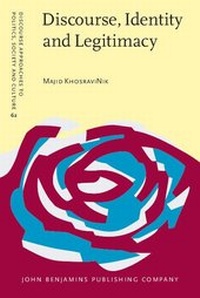
Discourse, Identity and Legitimacy
Self and Other in representations of Iran's nuclear programme
1st Edition
Published on 17. September 2015
VIII, 304 pages
978-90-272-6821-1 (ISBN)
Description

This book is a critical study of the ways that discourses of the (national) Self and Other are invoked and reflected in the reporting of a major international political conflict. Taking Iran's nuclear programme as a case study, this book offers extensive textual analysis, comparative investigation and socio-political contextualisation of national identity in newspaper reporting. In addition to providing comprehensive accounts of theory and methodology in Critical Discourse Analysis, the book provides a valuable extensive discussion of journalistic practice in Iranian and British contexts, as well as offering insights into historical development of 'discourses in place' in Iran. Across four separate chapters, major national and influential newspapers from both countries are critically analysed in terms of their micro-linguistic and macro-discoursal content and strategies. The book is a vital source for interdisciplinary scholarship and will appeal to students and researchers across the critical social sciences, particularly those in linguistics, media and communication studies, journalism and international politics.
More details
Other editions
Additional editions
Majid KhosraviNik
Discourse, Identity and Legitimacy
Self and Other in representations of Iran's nuclear programme
Book
09/2015
John Benjamins Publishing Co
€104.94
Shipment within 10-15 days
Person
Content
- Discourse, Identity and Legitimacy
- Editorial page
- Title page
- LCC data
- Table of contents
- 1. Introduction
- 1.1 Background
- 1.2 A sketch of Iran's nuclear programme
- 1.3 The research focus
- 1.4 Socio-political context of Iran
- 1.5 The structure of the book
- 2. Iran's socio-political history
- 2.1 Introduction
- 2.2 Iran before the 1979 Revolution
- 2.2.1 Ghajars, Constitutional Revolution and Reza Shah (Pahlavi I)
- 2.2.2 Mohammad Reza Shah (Pahlavi II)
- 2.2.3 Mossadegh and the nationalisation of the oil industry
- 2.2.4 Towards the Islamic Revolution
- 2.3 Iran after the Islamic Revolution: Changes in the grand rhetoric and themes
- 2.3.1 Revolutionary Period (1979-1981)
- 2.3.2 War Period (1980-1988)
- 2.3.3 Economic Reforms Period 1989-1997 (Rafsanjani)
- 2.3.4 Political Reforms Period 1997-2005 (Khatami)
- 2.3.5 Radical conservative rise 2005-2013 (Ahmadinejad)
- 2.4 Political structure of the Islamic Republic of Iran
- 3. Theoretical background
- 3.1 Critical Discourse Analysis
- 3.2 The critique/critical in CDA
- 3.2.1 CDA and Habermas
- 3.3 Discourse in CDA
- 3.4 Analysis in CDA
- 3.5 Power and ideology in CDA
- 3.6 Analysis of meanings in society (language in use)
- 3.7 Discourse-Historical Approach (DHA)
- 3.7.1 CDA and Self /Other presentation
- 3.8 CDA and the media
- 3.9 CDA and the international contexts
- 3.10 Discourse analysis, Iran and nuclear issue
- 4. The British and Iranian press
- 4.1 The Press in Iran
- 4.1.1 Historical development of the press (before the Revolution)
- 4.1.2 Historical development of the press (after the Revolution)
- 4.1.3 Jameah newspaper
- 4.1.4 Newspaper closures
- 4.1.5 Issues and challenges
- 4.2 The press in Britain
- 4.2.1 The state and the press
- 4.2.2 Political authority and the press
- 4.2.3 Economic model and the press
- 4.2.4 Ownership of the press
- 4.2.5 Approaches to journalism
- 4.2.6 Approaches to press and media analysis
- 4.2.7 Current issues
- 5. Methodology and data selection
- 5.1 Methods in Self and Other presentation
- 5.2 Methods in the Discourse-Historical Approach
- 5.2.1 Topoi
- 5.3 Presupposition and the repertoire of old knowledge
- 5.4 Deontic modalisation
- 5.5 Recontextualisation
- 5.6 Conversationalisation and vagueness
- 5.7 UK data selection
- 5.7.1 The spike
- 5.7.2 The Times' background
- 5.7.3 The Guardian's background
- 5.8 Iranian data selection
- 5.8.1 Kayhan newspaper's background
- 5.8.2 Shargh newspaper's background
- 5.9 English translation
- 6. Kayhan newspaper
- 6.1 Discourse topics analysis
- 6.2 Textual analysis: a short example
- 6.3 Referential strategy
- 6.3.1 A note on the Persian language
- 6.3.2 Referential strategy: Self
- 6.3.3 Referential strategy: Other
- 6.3.4 Referential strategy: the nuclear programme
- 6.4 Predicational strategy in Kayhan
- 6.4.1 Predicational strategy: Self
- 6.4.2 Predicational strategy: the Other
- 6.5 Argumentative strategy
- 6.5.1 Macro legitimatory arguments
- 6.5.2 Topoi in macro-legitimatory arguments
- 6.5.3 Micro-legitimatory argumentation
- 6.6 Other discursive qualities
- 6.6.1 Presuppositions
- 6.6.2 Recontextualisation of the news
- 7. Shargh newspaper
- 7.1 Discourse topics analysis
- 7.2 Shargh's contents
- 7.2.1 Textual analysis: reported official content
- 7.2.2 Textual analysis: non-official content
- 7.3 Reported official content
- 7.3.1 Referential strategy (reported official content)
- 7.3.2 Predicational strategy (reported official content)
- 7.4 Non-official content
- 7.4.1 Referential strategy (non-official content)
- 7.4.2 Predicational strategy (non-official content)
- 7.5 Argumentative strategies
- 8. The Times newspaper
- 8.1 Discourse topics analysis
- 8.2 Textual analysis: a short example
- 8.3 Referential strategy
- 8.3.1 Referential strategy: Self (the West)
- 8.3.2 Referential strategy: Other (Iran)
- 8.3.3 Referential strategy: Iran's nuclear programme
- 8.4 Predicational strategy
- 8.4.1 Predicational strategy: Self
- 8.4.2 Predicational strategy: Other
- 8.5 Argumentative strategy
- 8.5.1 Topos of threat: we are right because they are (constructed as) a threat
- 8.6 Presupposition and shared knowledge
- 8.6.1 Presupposition triggers
- 9. The Guardian newspaper
- 9.1 Discourse topics analysis
- 9.2 Textual analysis: a short example
- 9.3 Referential strategy
- 9.3.1 Referential strategy: Self (West)
- 9.3.2 Referential strategy: Other (Iran)
- 9.3.3 Referential strategy: Iran's nuclear programme
- 9.4 Predicational strategy
- 9.4.1 Predicational strategy: Self
- 9.4.2 Predicational strategy: Other
- 9.5 Argumentative strategy
- 9.6 Presupposition and shared knowledge
- 9.7 Automatic processes
- 10. Conclusion
- 10.1 Self and Other in Iranian dailies
- 10.2 Self and Other in the British dailies
- 10.3 Overall remarks
- Last word
- Appendix (Kayhan chapter)
- References list
- Index
