

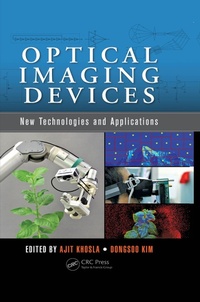
Optical Imaging Devices
New Technologies and Applications
Published on 19. December 2017
254 pages
978-1-4987-1101-2 (ISBN)
Description

Optical Imaging Devices: New Technologies and Applications delivers a comprehensive introduction to optical imaging and sensing, from devices to system-level applications. Drawing upon the extensive academic and industrial experience of its prestigious editors and renowned chapter authors, this authoritative text:
Explains the physical principles of optical imaging and sensing
Covers topics such as silicon-based imaging characteristics, nanophotonic phased arrays, thin-film sensors, label-free DNA sensors, and in vivo flow cytometry
Presents the contributions of leading researchers, real-world examples from biomedicine, recommendations for further reading, and all measurements in SI units
Optical Imaging Devices: New Technologies and Applications provides an essential understanding of the design, operation, and practical applications of optical imaging and sensing systems, making it a handy reference for students and practitioners alike.
Explains the physical principles of optical imaging and sensing
Covers topics such as silicon-based imaging characteristics, nanophotonic phased arrays, thin-film sensors, label-free DNA sensors, and in vivo flow cytometry
Presents the contributions of leading researchers, real-world examples from biomedicine, recommendations for further reading, and all measurements in SI units
Optical Imaging Devices: New Technologies and Applications provides an essential understanding of the design, operation, and practical applications of optical imaging and sensing systems, making it a handy reference for students and practitioners alike.
Reviews / Votes
"...each chapter in itself is very well-written and give a good overview of that particular topic. I particularly liked Chapter 5 on a High Speed Fluorescence Imaging System and Chapter 8 on a Laser Doppler Velocimetry application. Both Chapters give a very clear introduction to their respective fields and are highly recommended to anyone wishing to adopt these techniques."-Professor John Watson, University of Aberdeen
More details
Series
Language
English
Place of publication
London
United Kingdom
Publishing group
Taylor & Francis Ltd
Target group
College/higher education
Illustrations
126 s/w Abbildungen, 12 s/w Tabellen
12 Tables, black and white; 126 Illustrations, black and white
File size
18,52 MB
ISBN-13
978-1-4987-1101-2 (9781498711012)
Copyright in bibliographic data and cover images is held by Nielsen Book Services Limited or by the publishers or by their respective licensors: all rights reserved.
Schweitzer Classification
Other editions
Additional editions
Book
03/2021
1st Edition
CRC Press
€95.50
Shipment within 15-20 days
Book
10/2015
1st Edition
CRC Press
€207.50
Shipment within 15-20 days
Persons
Ajit Khosla received his Ph.D from Simon Fraser University, Burnaby, British Columbia, Canada, where he was awarded the 2012 Dean of Graduate Studies Convocation Medal for his Ph.D research work on the development of novel micropatternable multifunctional nanocomposite materials for flexible nano- and micro-systems. He then served as a postdoctoral fellow at Concordia University, Montreal, Quebec, Canada, and at the University of Calgary, Alberta, Canada. Since 2014, Dr. Khosla has been working toward establishing a nano-microsystem start up called Lab177 Inc. in Chatham, Ontario, Canada, with a focus on developing nano-microsystems in healthcare and flexible electronics. He is also a professor at the Soft & Wet Matter Engineering Lab (SWEL), Graduate School of Science and Engineering, Yamagata University, Japan, and a visiting scientist at the MEMS Research Lab, Department of Mechanical Engineering, College of Engineering, San Diego State University, California, USA. Dr. Khosla's research work in the area of nano-microsystems has resulted in more than 100 scientific and academic contributions, and his work has been cited more than 250 times in the last three years. An active member in the scientific community, he is an executive and program committee member for two major conferences, including secretary for the Electrochemical Society (ECS): Sensor Division, and the Society of Photographic Instrumentation Engineers (SPIE): Smart Structures and Materials-Nondestructive Evaluation. Dr. Khosla has organized various Institute of Electrical and Electronics (IEEE) technical meetings, been lead organizer for two major conference tracks at ECS, and served as a Journal of The Electrochemical Society guest editor for focus issues on microfluidics, MEMS/NEMS sensors and devices, and nano-microsystems in healthcare. He is also an editor for accelerated publications of the Journal of Microelectronics Engineering.
Dongsoo Kim received his MS and Ph.D in electrical and electronics engineering from Yonsei University, Seoul, Korea. Currently, Dr. Kim works as a principal engineer at Samsung Electronics, Suwon, Korea. Previously, he was a senior engineer in the Wireless Communication Division at Samsung Electronics, a staff analog design engineer at Aptina Imaging, San Jose, California, USA, and a postdoctoral associate in the Department of Electrical Engineering at Yale University, New Haven, Connecticut, USA. His research interests include CMOS image sensors, smart sensors, low-noise circuit design, and biomedical instrumentation.
Dongsoo Kim received his MS and Ph.D in electrical and electronics engineering from Yonsei University, Seoul, Korea. Currently, Dr. Kim works as a principal engineer at Samsung Electronics, Suwon, Korea. Previously, he was a senior engineer in the Wireless Communication Division at Samsung Electronics, a staff analog design engineer at Aptina Imaging, San Jose, California, USA, and a postdoctoral associate in the Department of Electrical Engineering at Yale University, New Haven, Connecticut, USA. His research interests include CMOS image sensors, smart sensors, low-noise circuit design, and biomedical instrumentation.
Content
Thin-Film Sensors Integrated in Information Displays. Analytical Use of Easily Accessible Optoelectronic Devices: Colorimetric Approaches Focused on Oxygen Quantification. Increasing Projector Contrast and Brightness through Light Redirection. Vision-Aided Automated Vibrometry for Remote Audio, Visual, and Range Sensing. High-Speed Fluorescence Imaging System for Freely Moving Animals. ToF Cameras for Eye-in-Hand Robotics. Smart Eye-Tracking Sensors Based on Pixel-Level Image Processing Circuits. Laser Doppler Velocimetry Technology for Integration and Directional Discrimination. Differential Photosensors for Optical Wireless Communication and Location Technologies.
