

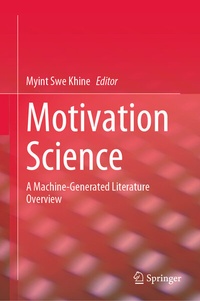
Motivation Science
Description

This volume explores human-machine collaboration and provides machine-generated auto-summaries of emerging research trends in motivation science. Each chapter presents summaries of pre-defined themes and includes an editor-written introduction. It covers various topics, from classic theories such as Maslow's hierarchy of needs to cutting-edge research in neuroscience and cultural influences on motivation. The book offers valuable insights into what makes us tick and how to harness motivation to improve our lives. The book is organized into six chapters covering interrelated topics such as the motivation science, emotion-based motivation, educational motivation, self-regulated learning, motivation and technology, and motivation and neuroscience.
The auto-summaries have been generated by a recursive clustering algorithm via the Dimensions Auto-summarizer by Digital Science. The editor of this book selected which SN content should be auto-summarized and decided its order of appearance. Please note that these are extractive auto-summaries, consisting of original sentences, but are not representative of the original paper, since we do not show the full length of the publication. Please note that only published SN content is represented here, and that machine-generated books are still at an experimental stage.
More details
Other editions
Additional editions
Person
Myint Swe Khine has more than 30 years of experience in teacher education. He holds master's degrees from the University of Southern California, USA, the University of Surrey, UK, and the University of Leicester, UK, and a doctorate from Curtin University, Australia. He has worked at the National Institute of Education, Nanyang Technological University, Singapore, and was a professor at the Emirates College for Advanced Education in the United Arab Emirates. He serves on the editorial boards of several international academic journals. Throughout his career he has published over 40 edited books. His most recent volumes include Rhizomatic Metaphor: Legacy of Deleuze and Guattari in Education and Learning (Springer, 2023) and Machine Learning in Educational Sciences: Approaches, Applications and Advances (Springer, 2024). He currently teaches in the School of Education, Curtin University, Australia.
Content
1. Motivation Science.- 2. Emotion Based Motivation.- 3. Educational Motivation.- 4. Self-Regulated learning.- 5. Motivation and Technology.- 6. Neuroscience and motivation.
