

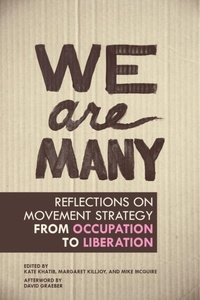
We Are Many
Description

"A wonderful collection of questions and reflections on the state of the movement today, where we came from, and where we might be going. It is all too rare that in the process of creating the movement and living the moment, participants and thinkers step back and ask the most pressing questions. This book is an important step.” Marina Sitrin, Occupy Wall Street organizer and author of Horizontalism
We have all been swept up by the momentum of the Occupy movement. We have seen the results of years of organizing in different communities come together in ways that few could have imagined, bolstered by the scores of people who have left the comfort of their daily routine behind and taken to the streets. Yet as a movement so overflowing with new social and political actors, we lack the framework we need to help us all to understand what a social movement is, to understand how change has happened in the past, to understand what this moment means and what this movement makes possible.
We Are Many is a reflection on Occupy from within the heart of the movement itself. Examining key questions: What worked? What didn't? Why? How? Is it reproducible? The authors and activists in this collection point toward a movement-based framework for future organizing. Heavily illustrated and annotated, We Are Many is a celebration of what worked, and a thoughtful analysis of what didn't.
Contributors:Michael Andrews, Michael Belt, Nadine Bloch, Rose Bookbinder, Mark Bray, Emily Brissette, George Caffentzis, George Ciccariello-Maher, Annie Cockrell, Joshua Clover, Andy Cornell, Molly Crabapple, CrimethInc., Croatoan, Paul Dalton, Chris Dixon, John Duda, Brendan M. Dunn, Lisa Fithian, Gabriella, David Graeber, Ryan Harvey, Gabriel Hetland, Marisa Holmes, Mike King, Koala Largess, Yvonne Yen Liu, Josh MacPhee, Manissa M. Maharawal, Yotam Marom, Cindy Milstein, Occupy Research, Joel Olson, Isaac Ontiveros, Morrigan Phillips, Frances Fox Piven, Vijay Prashad, Michael Premo, Max Rameau, RANT, Research & Destroy, Nathan Schneider, Jonathan Matthew Smucker, Some Oakland Antagonists, Lester Spence, Janaina Stronzake, Mattilda Bernstein Sycamore, Team Colors Collective, Janelle Treibitz, Unwoman, Immanuel Wallerstein, Sophie Whittemore, Kristian Williams, and Jaime Omar Yassin.
More details
Other editions
Additional editions
Persons
Kate Khatib: Kate Khatib is a member of the AK Press collective, and a co-founder of Red Emma's Bookstore Coffeehouse in Baltimore, MD.
Margaret Killjoy: Margaret Killjoy is an itinerant author, editor, photographer, and graphic designer, and the co-founder of Combustion Books. In addition to editing Steampunk Magazine and Graceless, Margaret is the author of What Lies Beneath the Clocktower (Combustion Books, 2011) and the editor of Mythmakers & Lawbreakers: Anarchist Writers on Fiction (AK Press, 2009).
Mike McGuire: Mike McGuire is a global justice organizer based in Baltimore, Maryland who works extensively along the eastern seaboard and in Latin America.
Contributors: Michael Andrews, Michael Belt, Nadine Bloch, Rose Bookbinder, Mark Bray, Emily Brissette, George Caffentzis, George Ciccariello-Maher, Annie Cockrell, Joshua Clover, Andy Cornell, Molly Crabapple, CrimethInc., Croatoan, Paul Dalton, Chris Dixon, John Duda, Brendan M. Dunn, Lisa Fithian, Gabriella, David Graeber, Ryan Harvey, Gabriel Hetland, Marisa Holmes, Mike King, Koala Largess, Yvonne Yen Liu, Josh MacPhee, Manissa M. Maharawal, Yotam Marom, Cindy Milstein, Occupy Research, Joel Olson, Isaac Ontiveros, Morrigan Phillips, Frances Fox Piven, Vijay Prashad, Michael Premo, Max Rameau, RANT, Research & Destroy, Nathan Schneider, Jonathan Matthew Smucker, Some Oakland Antagonists, Lester Spence, Janaina Stronzake, Mattilda Bernstein Sycamore, Team Colors Collective, Janelle Treibitz, Unwoman, Immanuel Wallerstein, Sophie Whittemore, Kristian Williams, and Jaime Omar Yassin.
Content
Full TOC forthcoming in February
Chapter Structure & Outline:
Editors' Preface: Kate Khatib, Mike McGuire, and Margaret Killjoy
Foreword: TK
Introduction: Kate Khatib and Mike McGuire
Section 1: Origins of the Occupy Movement
* Timelines
* Socio-economic conditions
* Precedents
* Origins
* Global and national movements
Section 2: What Have We Done?
* The Call & Response of Adbusters & NYGA
* Organization vs. Spontenaeity
* Tools of the movement (Assemblies, Spokescouncils, People's Mic)
* Intra-movement coordination
* The 99% meme and what it really means
* Leaderless vs. leaderful movements
* The Public Square
* Beyond the Public Square
* Kinship with other movements (labor, housing rights, economic human
rights)
* Ideological structures
* Anti-capitalism & anarchism
* Culture
Section 3: Where are we going?
* Allies & enemies
* Power relations
* Co-optation
* Keeping dissent public
* What would it look like to win?
* Expansion vs. proliferation
* What are useful tools for planning a campaign?
* How do we learn to think strategically?
Section 4: Movement Stories
Afterword: David Graeber
