

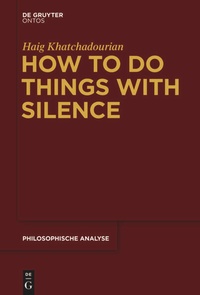
How to Do Things with Silence
1st Edition
Published on 16. October 2015
XIV, 211 pages
978-1-5015-0144-9 (ISBN)
Description

This work is a detailed analytical study of different forms of silent doing. It explores a range of topics related to silence, including the theory of silent doing and its relationship to other forms of action and communication, silence and aesthetics, the ethics and politics of silence, and the religious dimensions of silence. The book, as an original contribution to analytical philosophy, should be of interest to philosophers and students.
More details
Other editions
Additional editions
Haig Khatchadourian
How to Do Things with Silence
E-Book
10/2015
1st Edition
De Gruyter
€134.95
Available for download
Haig Khatchadourian
How to Do Things with Silence
Book
09/2015
1st Edition
De Gruyter
€134.95
Shipment within 3-4 weeks
Person
Haig Khatchadourian, University of Wisconsin-Milwaukee, U.S.A.
Content
- Intro
- Contents
- Introduction
- Part I: Ways of "Doing"
- 1 Informal 'Logic' and Contextual Meanings of Silence
- 1.1 Forms of Doing
- 1.2 Speech-Acts And The 'In'- And 'By'-formulae
- 1.3 Illocutionary and Perlocutionary Speech Acts
- 2 The Logic of Silence cont'd.: "Pragmatics" of Silence
- 2.1 Forms of Doing
- 2.2 Silent Expression/Communication
- 2.3 Non-Standard Situations in Silent
- 3 Body Language as a Form of Silent Doing
- 3.1 Body Language
- 3.2 Nature of body language
- 3.3 Conditions of Successful Body Language
- 3.4 Possible Meanings of Body Language
- 3.5 Silences as "Dispersed" Practices
- 4 Physical Action as a Form of Silent Doing
- 4.1 Movement & Physical Action
- 4.2 Action/Activity as a (Silent) Form of Doing
- Expressive and Communicative Uses of Action
- 4.3 Communicative Uses of Action described by "By-Locutions"
- 4.4 Consequentialist Uses of Action
- 5 Silence and the Inner Life
- 5.1 Silence and the Inner Life: Conscious Mental Activities, Experiences & States as Silent Forms of Doing
- 5.2 Mental States vs. Mental Activities
- 5.3 Bodily Feelings & Sensations as Silent States or Experiences
- 5.4 Unconscious Mental Activities
- 5.5 Pathologies of Inner Silence: "Silent Minds"
- 5.6 Expressive and Communicative uses of the "In"-/"By"-Formulae in Relation to the Inner Life: Some Examples
- 5.7 Infelicity, Misfiring, Force & Point in Relation to Mental and Physical States and Activities
- 5.8 Infelicity
- 5.9 Misfiring
- 5.10 Point
- Part II: Aesthetics of Silence
- 6 Silence in the Temporal Arts I: Music
- 6.1 General Remarks concerning the "Temporal" and "Visual-Spatial" Arts
- 6.2 Rests/Pauses/Silence in the Form & in the Content of Temporal Works of Art
- 6.3 General Considerations regarding the Formal Aspects of Temporal Works of Art
- 6.4 Formal Features of Temporal Art
- 6.5 The Executant's Interpretation of Works of Music
- 6.6 Silent Musical Compositions
- 6.7 Aesthetics of Silence in Dance
- 7 Silence in the Temporal Arts II: The Literary Arts
- 7.1 Formal Aspects of Temporal Art
- Roles of Rests/Pauses/Silences in Literature
- 7.2 Silence as a Theme or Part of a Theme in Literature
- 8 Silence in the Visual-Spatial Arts
- 8.1 Visual-Spatial vis-à-vis Temporal Arts
- 8.2 Aesthetic & Other Expressive Uses of Silence in the Visual-Spatial Arts
- 8.3 Silence in Painting, Sculpture and Architecture
- 8.4 Contextual Optimum Conditions of Painting, Sculpture and Architecture
- 8.5 Painting & Sculpture
- 8.6 Silent Cinema
- 8.7 Films with Significant Silences
- 9 Silence in Nature
- 9.1 Silence in Nature in the wild and in national parks
- 9.2 The Silence of the Deep
- 9.3 The Art Gardens of Japan
- 9.4 Silk Screens of Yokoyama Taikan
- 9.5 Silent Nature in Poetry
- 9.6 Silent Nature in Landscape Painting
- 9.7 Still Nature Photography: Ansel Adams
- 9.8 Documentary & Nature Films
- 9.9 Silent Feature Films & Silence In Film
- 9.10 Prose Descriptions of Silent Nature
- Part III: Ethics and Politics of Silence
- 10 The Ethics of Silence
- 11 Ethical Political Social Dimensions of Silence
- 11.1 Part One: "The Silent"
- 11.2 Part Two: "The Voiceless"
- Part IV: Silence and the Spiritual/Religious Life
- 12 Silence in the Spiritual-Religious Life
- 12.1 The mystic's spiritual ascent to the divine
- 12.2 Mysticism in Buddhism
- 12.3 Visions
- 12.4 Prayer
- 12.5 Christian Monastic Orders & Silence
- 12.6 The Silence of Death
- 12.7 Silence in Grief & Mourning
- 13 Symbolic Uses of Silence in the Spiritual/Religious Life - I
- 13.1 "The Silence of God"
- 13.2 St. John of the Cross & the hiddenness of God
- 13.3 Buddhism and the Silence of God
- 13.4 Ingmar Bergman and the Silence/Hiddenness of God
- 14 Symbolic Uses of Silence in the Spiritual/Religious Life - II
- 14.1 The Theme of Isolation And the "Hiddenness" Of God
- 14.2 The Theme of Communion And the "Presence" Of God
- Index
